
Free Safe Operating Procedure (Magnetic Particle Test) Template
Download our free Safe Operating Procedure (Magnetic Particle Test) template.
Free Safe Operating Procedure (Magnetic Particle Test) Template
DOCX • 126 KB + PDF
Updated Oct 2026
No signup required
Purpose of the Free Safe Operating Procedure (Magnetic Particle Test) Template
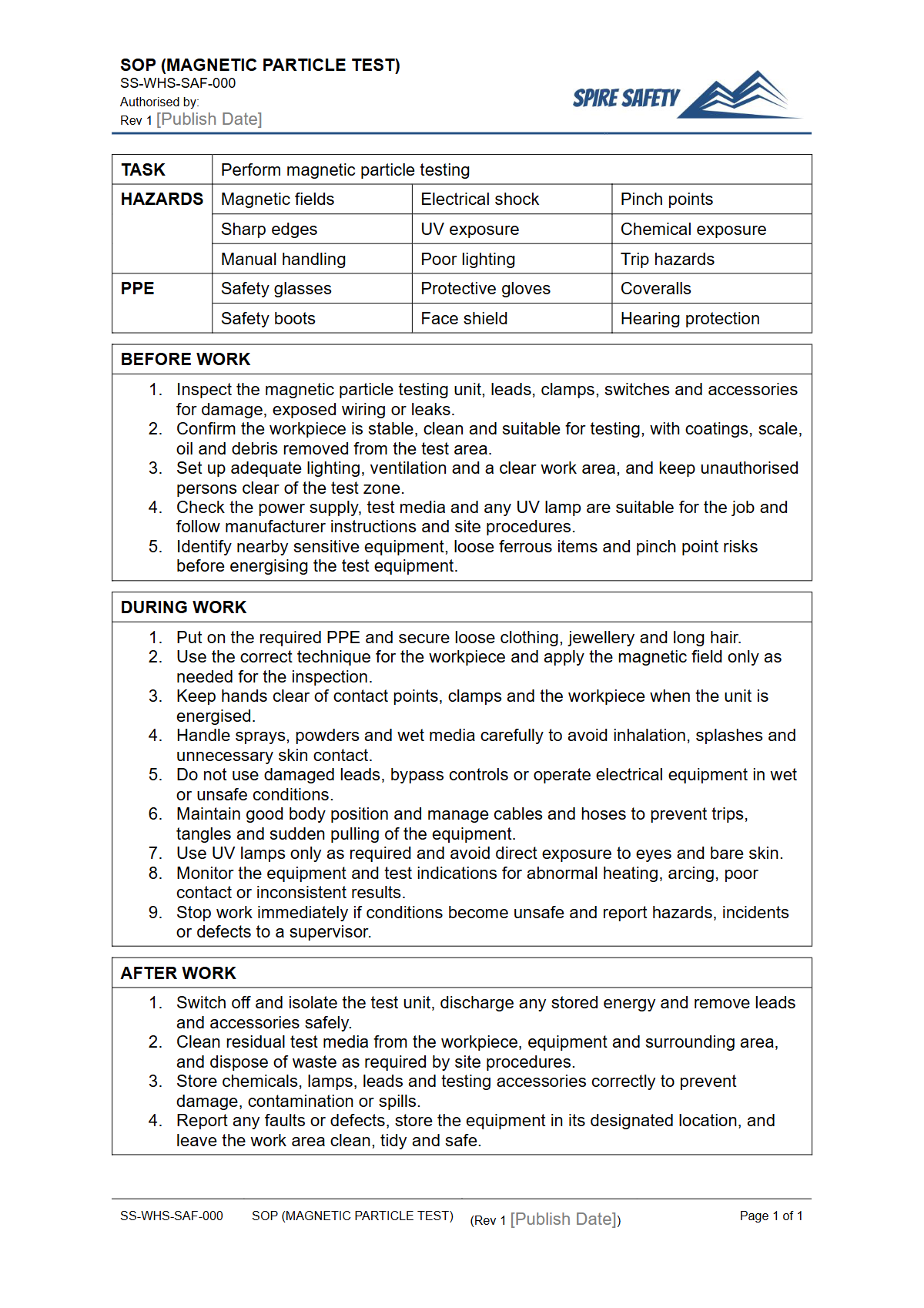
This Safe Operating Procedure (SOP) template for Magnetic Particle Testing (MPT) provides a structured starting point for documenting the safety requirements for this common non-destructive testing (NDT) method. Using a free Safe Operating Procedure (Magnetic Particle Test) template helps organisations systematically identify and control the hazards associated with the task.
These include electrical risks from yokes, exposure to chemicals in inks and carriers, potential fire hazards, and risks from strong magnetic fields. A well-developed SOP is a fundamental component of effective WHS management systems, ensuring tasks are performed safely and consistently.
Video walkthrough
How to use the Free Safe Operating Procedure (Magnetic Particle Test) Template
Our free Safe Operating Procedure (Magnetic Particle Test) template is available for download in both DOCX and PDF formats. The DOCX file is fully editable, allowing for comprehensive customisation to reflect the specific circumstances of your workplace.
IMPORTANT: This document is a template only and must be customised to suit your specific equipment, chemicals, personnel, and operational environment. We are not responsible for the outcomes of you using this template. Key areas requiring your input include:
- Listing the specific make and model of MPT equipment (e.g., yokes, bench units).
- Identifying the exact chemical products used (inks, powders, contrast paints) and referencing their Safety Data Sheets (SDS).
- Detailing site-specific Personal Protective Equipment (PPE) requirements based on your risk assessment.
- Outlining your workplace's unique emergency procedures, including contacts and muster points.
- Incorporating any other company-specific policies or procedures.
When to use it
This SOP should be used as a key reference document before, during, and after conducting magnetic particle inspection tasks. It is an essential tool for training new technicians, providing a checklist for pre-start inspections, and serving as an on-the-job guide for workers.
The procedure should be reviewed regularly and updated whenever processes, equipment, or chemicals change. The implementation and use of such procedures are often verified during a WHS compliance auditing program to ensure they are practical and being followed correctly.
Who should use it
This procedure is intended for use by persons conducting a business or undertaking (PCBUs), WHS managers, supervisors, and, most importantly, the NDT technicians who perform magnetic particle testing. It helps PCBUs fulfil their duty of care by providing a safe system of work.
For technicians, it clarifies the expected steps for safe operation, hazard control, and emergency response. It also serves as a valuable record for demonstrating that workers have been properly instructed on how to perform the task safely. While this SOP covers MPT, organisations often require documented procedures for other common equipment, like those detailed in our Free Air Compressor SOP (Safe Operating Procedure) Template.
Key Hazards in Magnetic Particle Testing
Magnetic Particle Testing involves a unique combination of hazards that require careful management. Electrical equipment like electromagnetic yokes presents a risk of electric shock, particularly if cables or plugs are damaged.
Documenting the need for pre-use electrical checks is vital. Given this risk, having procedures for emergency response is critical, such as those found in our Free Safe Operating Procedure (Defibrillator Operation) Template.
Chemical hazards are also significant. MPT uses various inks, some of which are solvent or oil-based and can be flammable or harmful if inhaled or absorbed through the skin.
The template prompts users to specify controls like adequate ventilation and appropriate chemical-resistant gloves. Furthermore, accessing large components for testing may require working at height, introducing fall hazards that must be managed, whether using elevated platforms or simple access equipment like that covered in our FREE Step Ladder SOP Template.
You can find a wide range of other templates and guides in our complete free WHS resources library to help build out your safety management system.
Common mistakes
Common mistakes to avoid
- Using a generic SOP without customising it for site-specific equipment and chemicals.
- Failing to conduct a pre-use inspection of electrical equipment like yokes and cables.
- Neglecting to provide adequate ventilation when using solvent or oil-based particle carriers.
- Not referencing the Safety Data Sheet (SDS) for the specific chemical products being used.
Legal references
Legal considerations
The following legal requirements may be relevant to this type of work.
- Work Health and Safety Act (Harmonised) — Provides the primary duties for protecting workers and other people from work health and safety risks.
- Work Health and Safety Regulations (Harmonised) — Sets out requirements supporting the management of workplace hazards and risks.
The following codes may be relevant to this type of work.
- Managing WHS Risks Code of Practice — Provides practical guidance on identifying hazards, assessing risks and applying effective controls.
- Work Health and Safety Consultation, Cooperation and Coordination Code of Practice — Provides practical guidance on consulting workers and coordinating with other duty holders.
- Managing the Work Environment and Facilities Code of Practice — Provides practical guidance on safe work environments, workplace facilities and related controls.
Did you know
Wet vs. Dry Method
Magnetic particle testing can be performed using either a 'wet' or 'dry' method. The wet method, where particles are suspended in a liquid carrier, is generally more sensitive for detecting very fine surface cracks.
Black Light Inspection
Fluorescent magnetic particle inspection requires a darkened area and a specialised UV-A light source, often called a 'black light'. The fluorescent particles glow brightly under the UV light, making indications of flaws highly visible to the inspector.
FAQ
Frequently asked questions
01What is a Safe Operating Procedure for Magnetic Particle Testing?
02Is this MPT SOP template ready to use immediately?
03What are the main hazards involved in Magnetic Particle Testing?
04Who is responsible for creating a Safe Operating Procedure for MPT?
Share this resource
Free Safe Operating Procedure (Magnetic Particle Test) Template
Browse Categories
How To Use It
- 1Download and open in Word or PDF.
- 2Replace the placeholders with your business details.
- 3Get it reviewed by a WHS specialist before rollout.
Need it customised?
Our WHS consultants can adapt this template to your site, run a gap analysis, or audit what you already have in place.
Book a Free Consultation WHS consulting servicesor call 1300 156 382
Related templates
- Free Safe Operating Procedure (Magnetic Separator) Template
- Free Safe Operating Procedure (Magnetic Stirrer) Template
- Free Safe Operating Procedure (Mandoline Slicer) Template
- Free Safe Operating Procedure (Mandrel Reel) Template
- Free Safe Operating Procedure (Manhole Cover Check) Template
- Free Safe Operating Procedure (Manhole Cover Lifting) Template