
Free Safe Operating Procedure (Machine Cleaning) Template
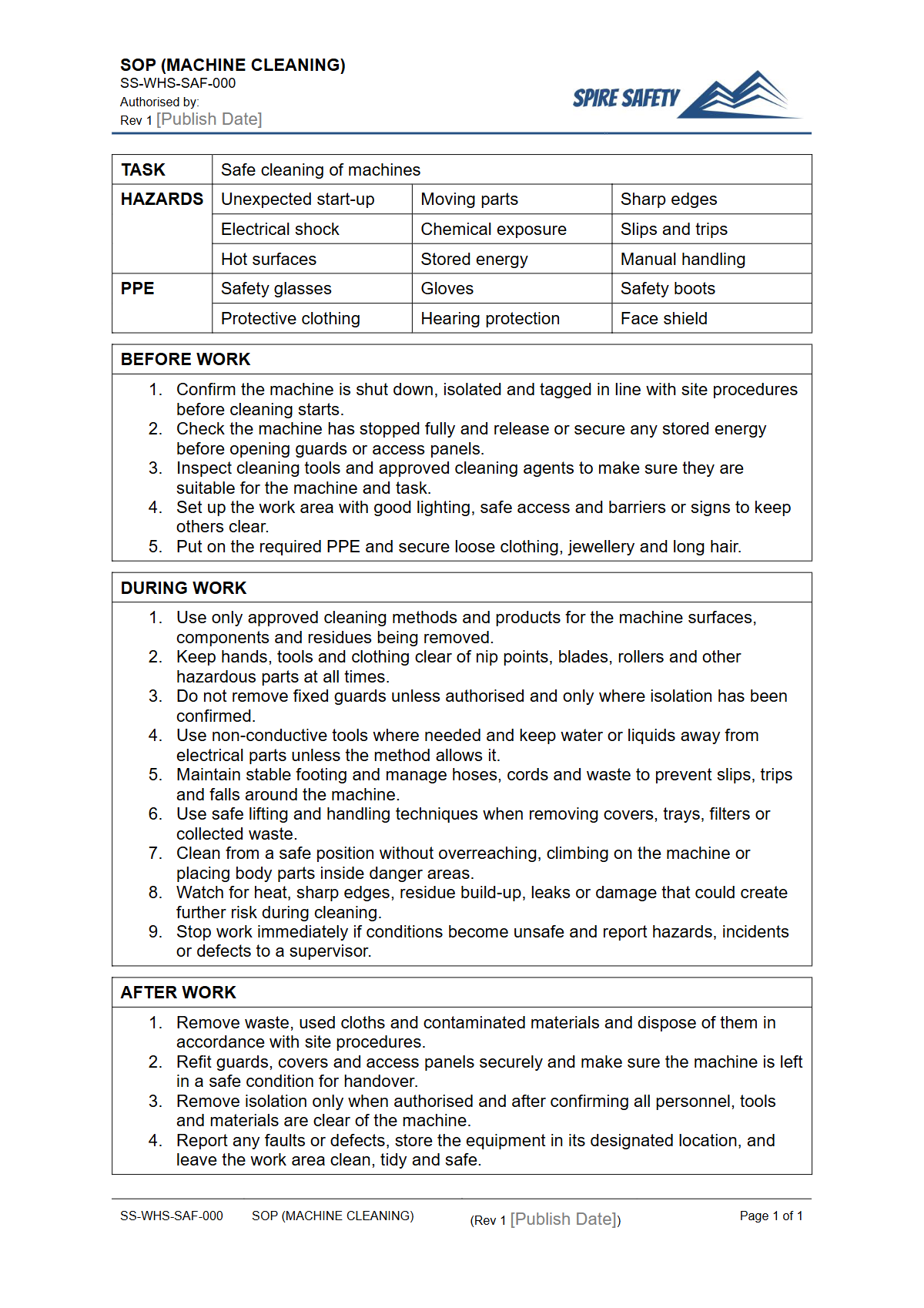
Download our free Safe Operating Procedure (Machine Cleaning) Template. This customisable DOCX and PDF helps you detail safe work steps for equipment cleaning.
Free Safe Operating Procedure (Machine Cleaning) Template
DOCX • 126 KB + PDF
Updated Oct 2026
No signup required
Purpose of the Free Safe Operating Procedure (Machine Cleaning) Template
Effectively managing workplace safety involves documenting procedures for all high-risk tasks. This is where our Free Safe Operating Procedure (Machine Cleaning) Template provides a critical starting point.
Cleaning machinery is not a low-risk activity; it exposes workers to serious hazards including unexpected machine start-up, entanglement in moving parts, exposure to hazardous chemicals, and electrical shock. Using a structured SOP ensures that every step of the cleaning process is planned, assessed for risk, and communicated clearly to workers.
This helps your organisation meet its primary duty of care and prevents costly and tragic incidents.
A dedicated SOP for machine cleaning helps standardise your approach, ensuring that safety is not left to chance or individual interpretation. It forms an essential part of a robust safety framework, demonstrating a proactive approach to risk management.
Properly documented procedures are fundamental for training, inductions, and ongoing competency checks, forming a core component when implementing comprehensive WHS management systems that protect your team and your business.
Video walkthrough
How to use the Free Safe Operating Procedure (Machine Cleaning) Template
This document is a foundational template designed to be adapted to your specific operational context. It is structured based on the principles of the model WHS framework, providing logical sections for you to populate with your site-specific information.
To use it effectively, you must conduct a thorough risk assessment for each piece of machinery and the associated cleaning task. Identify all potential hazards, assess the risks, and document the control measures required to eliminate or minimise them.
This includes specifying lockout/tagout (LOTO) procedures, required Personal Protective Equipment (PPE), and safe handling instructions for cleaning agents.
Customisation is Essential
Important: This is a template and must be customised to the specific machinery, cleaning agents, and work environment at your site. We are not liable for any incidents that may occur from the use of this document.
It is your responsibility to ensure it is tailored to your workplace's unique risks. Review the completed SOP with the workers who perform the task to ensure it is practical and understood.
Regular reviews are also crucial, and an independent WHS compliance audit can help verify the effectiveness of your documented procedures.
When to Use a Machine Cleaning SOP
A Safe Operating Procedure for machine cleaning should be developed and used for any piece of equipment where the cleaning process introduces risk. This is not limited to large industrial plant. The SOP should be referenced before performing:
- Routine daily, weekly, or monthly cleaning tasks.
- Scheduled deep cleaning or sanitation.
- Cleaning performed as part of preventative maintenance schedules.
- Post-maintenance clean-ups to remove debris or lubricants.
- Any non-routine cleaning required after a breakdown or spill.
For example, while a Telehandler SOP covers its general operation, a separate procedure detailing how to safely clean mud, debris, and grease from its articulated boom and cabin would be a best-practice addition to your safety system.
Who Should Use This Safe Operating Procedure
This SOP is intended for all personnel involved in the cleaning of machinery. This includes, but is not limited to:
- Machine Operators: Who often perform routine end-of-shift cleaning.
- Maintenance Personnel: Who may conduct more intensive cleaning as part of servicing.
- Dedicated Cleaning Staff: Whose primary role involves sanitation and cleaning of equipment.
- Supervisors and Managers: Who are responsible for overseeing the work, providing training, and ensuring procedures are followed correctly.
All individuals required to perform or supervise machine cleaning must be trained on the contents of the finalised SOP. This training should cover hazard identification, isolation procedures, correct use of PPE, and emergency response.
Competency should be verified before a worker is authorised to perform the task independently. Even for seemingly simple equipment, formal procedures are vital; our air compressor SOP is another example where pressurised systems create non-obvious hazards during maintenance and cleaning.
Key Elements to Include in Your Procedure
When customising the template, ensure you address several critical areas to create a comprehensive and effective document. A robust machine cleaning SOP must detail the sequence of actions from start to finish.
This includes pre-start preparations like gathering the correct cleaning agents and PPE. A critical section is the isolation and de-energisation sequence, often known as Lockout/Tagout (LOTO), which is the most important step in preventing accidental start-up.
The procedure should also clearly describe the cleaning steps, including which tools to use and which parts of the machine to focus on. Some associated tasks, like needing to access high areas for cleaning, might require their own procedures, just as a step ladder SOP outlines safe use for simple access equipment.
Finally, your SOP must outline post-cleaning checks, such as ensuring all guards are back in place before re-energising the equipment, and specify procedures for waste disposal. Including emergency actions for scenarios like chemical spills or injury is also essential.
Documenting procedures for all high-risk plant is a cornerstone of workplace safety; you can find more examples of task-specific procedures, such as our circular saw SOP, in our resource library. By carefully considering each of these elements, you transform a generic template into a powerful tool for workplace safety.
You can also explore our full free WHS resources library for other helpful templates and guides.
Common mistakes
Common mistakes to avoid
- Using generic cleaning instructions that don't match the specific machine's hazards.
- Failing to properly isolate all energy sources before starting work (incomplete Lockout/Tagout).
- Neglecting to perform a specific risk assessment for the cleaning task itself, separate from the machine's operational risk assessment.
- Providing inadequate or incorrect PPE for the cleaning chemicals and physical hazards involved.
Legal references
Legal considerations
The following legal requirements may be relevant to this type of work.
- Work Health and Safety Act (Harmonised) — Provides the primary duties for protecting workers and other people from work health and safety risks.
- Work Health and Safety Regulations (Harmonised) — Sets out requirements supporting the management of workplace hazards and risks.
The following codes may be relevant to this type of work.
- Managing WHS Risks Code of Practice — Provides practical guidance on identifying hazards, assessing risks and applying effective controls.
- Work Health and Safety Consultation, Cooperation and Coordination Code of Practice — Provides practical guidance on consulting workers and coordinating with other duty holders.
- Managing the Work Environment and Facilities Code of Practice — Provides practical guidance on safe work environments, workplace facilities and related controls.
Did you know
Stored Energy Risks
Even after a machine is switched off and unplugged, it can still hold dangerous energy (e.g., hydraulic/pneumatic pressure, tensioned springs, or suspended parts). A proper lockout/tagout procedure is essential to dissipate this stored energy before cleaning begins.
Cleaning Agents are Chemicals
The cleaning chemicals themselves are often a primary hazard. A risk assessment must consider the specific chemicals used, referencing their Safety Data Sheets (SDS) to determine correct handling procedures, ventilation, and required PPE.
FAQ
Frequently asked questions
01Is a Safe Operating Procedure legally required for machine cleaning in Australia?
02What is the difference between a SWMS and an SOP for machine cleaning?
03How often should a machine cleaning SOP be reviewed?
04Who is responsible for writing a Safe Operating Procedure for machine cleaning?
Share this resource
Free Safe Operating Procedure (Machine Cleaning) Template
Browse Categories
How To Use It
- 1Download and open in Word or PDF.
- 2Replace the placeholders with your business details.
- 3Get it reviewed by a WHS specialist before rollout.
Need it customised?
Our WHS consultants can adapt this template to your site, run a gap analysis, or audit what you already have in place.
Book a Free Consultation WHS consulting servicesor call 1300 156 382
Related templates
- Free Safe Operating Procedure (Machine Guard Removal) Template
- Free Safe Operating Procedure (Machine Lubrication) Template
- Free Safe Operating Procedure (Mag Drill) Template
- Free Safe Operating Procedure (Magnetic Particle Test) Template
- Free Safe Operating Procedure (Magnetic Separator) Template
- Free Safe Operating Procedure (Magnetic Stirrer) Template