
Free Safe Operating Procedure (Machine Lubrication) Template
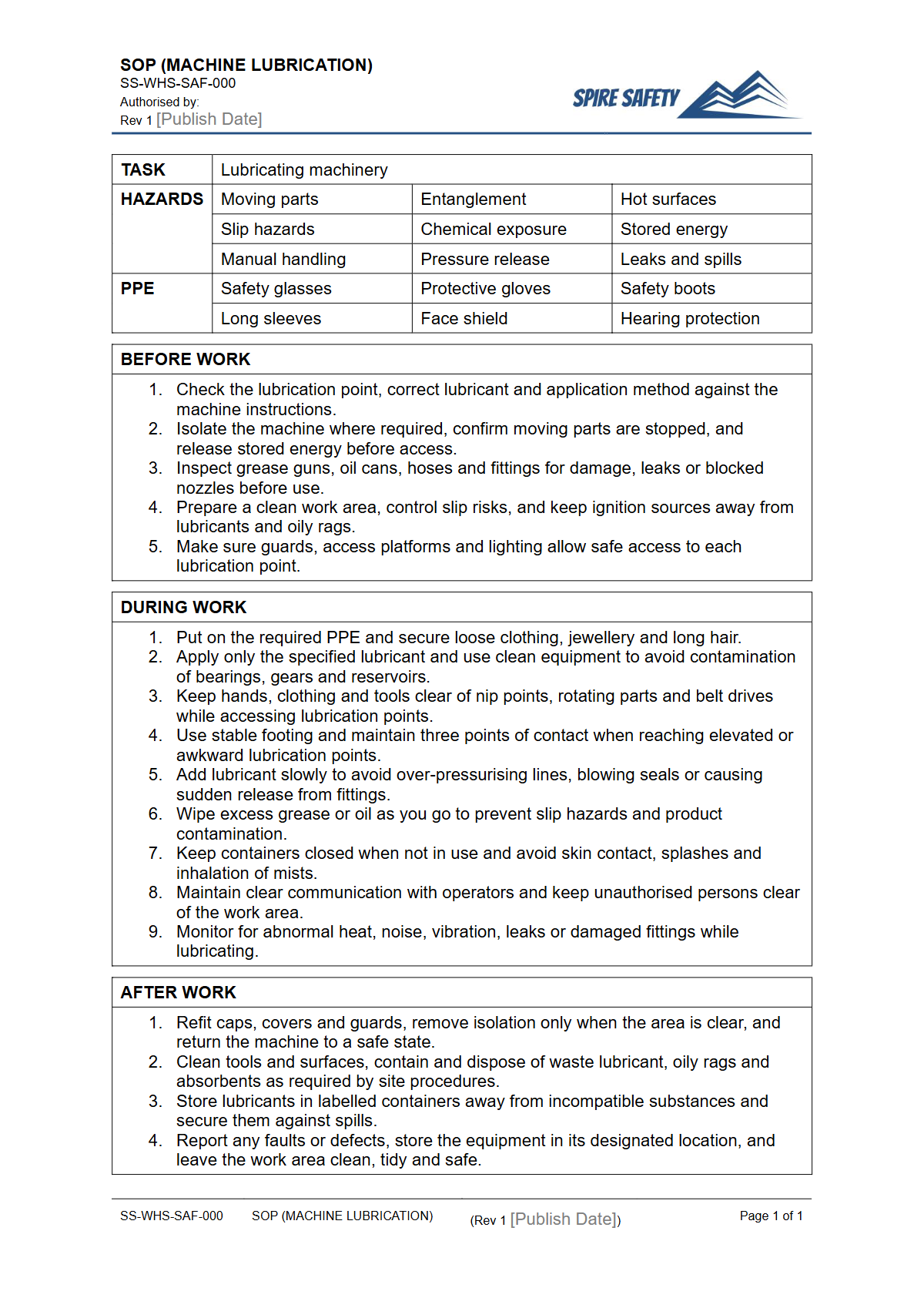
Download our free Safe Operating Procedure (Machine Lubrication) template. This customisable DOCX & PDF helps formalise machine maintenance safety.
Free Safe Operating Procedure (Machine Lubrication) Template
DOCX • 126 KB + PDF
Updated Oct 2026
No signup required
Purpose of the Free Safe Operating Procedure (Machine Lubrication) Template
This Free Safe Operating Procedure (Machine Lubrication) Template provides a structured framework for documenting the safe methods required to lubricate plant and machinery. Proper lubrication is a critical maintenance task that prevents equipment failure and extends its operational life, but it also introduces significant risks if not managed correctly.
These risks include entanglement in moving parts, exposure to hazardous chemicals, high-pressure injection injuries, and slips from oil spills. Formalising this process into an SOP helps control these hazards, ensures consistency in work practices, and forms a key part of your overall WHS management systems.
Video walkthrough
How to use the Free Safe Operating Procedure (Machine Lubrication) Template
This document is a starting point, not a finished product. To properly implement the Free Safe Operating Procedure (Machine Lubrication) Template, you must customise it to reflect the specific machinery, tasks, and environment at your workplace. Download the DOCX file and work through each section, adding site-specific details such as:
- Specific machine makes and models
- Types and quantities of lubricants and grease used
- Designated lockout/tagout points
- Required Personal Protective Equipment (PPE)
- Site-specific emergency procedures
Note: We have designed this template to be adapted; your final document must be specific to your site's unique requirements. For machinery with complex systems, like those outlined in our FREE Grader SOP (Safe Operating Procedure) Template, detailed customisation is essential.
When to use it
A machine lubrication SOP should be used as a primary reference document for all lubrication tasks. It is essential during scheduled preventative maintenance to ensure all steps are followed correctly and consistently.
The procedure should also be used to train new maintenance personnel or upskill existing workers on new equipment. Furthermore, it serves as a critical safety checklist before commencing any lubrication job, reinforcing safe work habits. The principles within this SOP apply to a wide range of equipment, from simple workshop tools to complex plant like that covered in our FREE Dozer SOP (Safe Operating Procedure) Template.
Who should use it
This Safe Operating Procedure is intended for several key roles within an organisation. Maintenance fitters, mechanics, and technicians will use it as a direct guide for performing their work.
Machine operators who are responsible for daily or weekly lubrication checks will also refer to it. Supervisors and team leaders should use the SOP to conduct pre-start checks, oversee work, and deliver toolbox talks on lubrication safety. WHS managers and coordinators will use it as part of risk assessments, incident investigations, and to ensure procedural rigour during WHS compliance audits.
Key Elements of an Effective Lubrication SOP
Beyond the basic steps, a robust SOP for machine lubrication should include several critical safety elements. A mandatory pre-operational inspection checklist ensures the machine and work area are safe before any work begins.
It must also detail specific lockout/tagout procedures to isolate all energy sources—a non-negotiable step to prevent accidental start-up. The SOP should specify the exact type and grade of lubricant for each application point, along with safe handling and storage instructions.
For pneumatic systems, the procedures might be similar to those in our Free Air Compressor SOP (Safe Operating Procedure) Template, which also emphasises energy isolation. Finally, it must list the required Personal Protective Equipment (PPE), such as safety glasses, chemical-resistant gloves, and steel-capped boots.
Integrating SOPs into Your Safety Culture
Having a written procedure is only the first step. To be effective, the SOP must be integrated into your organisation's daily operations and safety culture.
This involves comprehensive training for all relevant personnel to ensure they understand not just the 'how' but the 'why' behind each step. Regular reviews and updates are necessary to keep the document relevant as equipment, products, or regulations change.
If you need assistance embedding these kinds of documents and processes into your business, our team provides expert WHS consulting to help build a proactive safety environment. Consistent application and management reinforcement turn a document into a living safety tool.
By using this template and customising it thoroughly, you create a vital tool for preventing injuries and ensuring the reliability of your machinery. This procedure is one of many documents designed to support Australian businesses in managing workplace risks. For more templates and safety guides, browse our complete free WHS resources library.
Common mistakes
Common mistakes to avoid
- Failing to de-energise and lock out the machine before starting work.
- Using incorrect or contaminated lubricants for the specific application.
- Not wearing the correct Personal Protective Equipment (PPE), such as chemical-resistant gloves and safety glasses.
- Forgetting to clean up lubricant spills immediately, creating significant slip and fall hazards.
Legal references
Legal considerations
The following legal requirements may be relevant to this type of work.
- Work Health and Safety Act (Harmonised) — Provides the primary duties for protecting workers and other people from work health and safety risks.
- Work Health and Safety Regulations (Harmonised) — Sets out requirements supporting the management of workplace hazards and risks.
The following codes may be relevant to this type of work.
- Managing WHS Risks Code of Practice — Provides practical guidance on identifying hazards, assessing risks and applying effective controls.
- Work Health and Safety Consultation, Cooperation and Coordination Code of Practice — Provides practical guidance on consulting workers and coordinating with other duty holders.
- Managing the Work Environment and Facilities Code of Practice — Provides practical guidance on safe work environments, workplace facilities and related controls.
Did you know
Stored Energy Hazard
Even when a machine is turned off, it can hold stored energy (hydraulic, pneumatic, electrical, or mechanical) that can be released unexpectedly during maintenance tasks like lubrication.
Lubricant Choice Matters
Using the wrong lubricant can be as dangerous as using none at all. It can lead to premature component failure, overheating, and increased fire risk.
FAQ
Frequently asked questions
01What is a Safe Operating Procedure for machine lubrication?
02Why is lockout/tagout essential for machine lubrication?
03Does this SOP template cover all types of machinery?
04How often should we review our lubrication SOPs?
Share this resource
Free Safe Operating Procedure (Machine Lubrication) Template
Browse Categories
How To Use It
- 1Download and open in Word or PDF.
- 2Replace the placeholders with your business details.
- 3Get it reviewed by a WHS specialist before rollout.
Need it customised?
Our WHS consultants can adapt this template to your site, run a gap analysis, or audit what you already have in place.
Book a Free Consultation WHS consulting servicesor call 1300 156 382
Related templates
- Free Safe Operating Procedure (Mag Drill) Template
- Free Safe Operating Procedure (Magnetic Particle Test) Template
- Free Safe Operating Procedure (Magnetic Separator) Template
- Free Safe Operating Procedure (Magnetic Stirrer) Template
- Free Safe Operating Procedure (Mandoline Slicer) Template
- Free Safe Operating Procedure (Mandrel Reel) Template