
Free Safe Operating Procedure (Machine Guard Removal) Template
Download our free Safe Operating Procedure (Machine Guard Removal) Template.
Free Safe Operating Procedure (Machine Guard Removal) Template
DOCX • 126 KB + PDF
Updated Oct 2026
No signup required
Purpose of the Free Safe Operating Procedure (Machine Guard Removal) Template
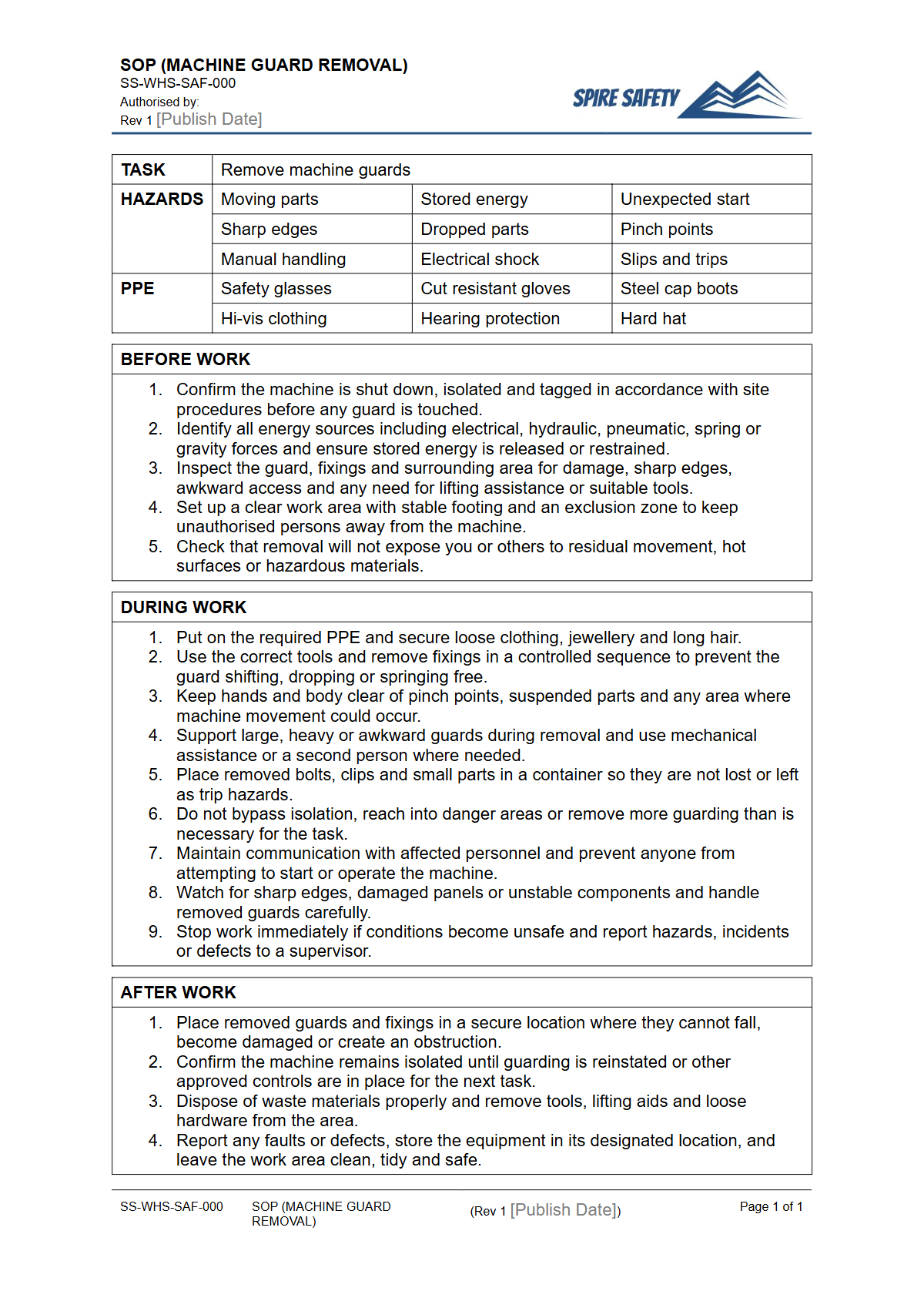
Effectively managing machinery risks is a cornerstone of workplace safety. This Free Safe Operating Procedure (Machine Guard Removal) Template provides a structured starting point for documenting the approved process for accessing machinery for maintenance, cleaning, or repairs.
Removing a guard exposes workers to significant hazards, including entanglement, crushing, cutting, and shearing. A formal SOP ensures these tasks are performed in a controlled, consistent, and safe manner, every time.
The primary purpose of this SOP is to outline the critical steps required before, during, and after a guard is removed. It prompts users to identify all energy sources, implement isolation and lockout/tagout (LOTO) procedures, and verify de-energisation before work begins.
It also details the steps for safely reinstalling guards and testing machinery before returning it to operational status. Documenting this process is a key part of demonstrating how your organisation meets its duty of care under Australian WHS laws.
For equipment-specific guidance, you might also consult documents like our FREE Circular Saw SOP (Safe Operating Procedure) Template to see how procedures are applied to different plant.
Video walkthrough
How to use the Free Safe Operating Procedure (Machine Guard Removal) Template
This document is a downloadable template, available in both DOCX for easy editing and PDF for simple distribution. It is designed to be adapted to the unique context of your workplace.
You must review and customise every section to reflect your specific machinery, operational procedures, risk controls, and personnel responsibilities. A generic procedure is not sufficient; site-specific details are essential for the SOP to be effective.
To use the template:
- Download the DOCX file.
- Consult with machine operators, maintenance staff, and supervisors to gather detailed information.
- Conduct a risk assessment for the task of removing, and reinstalling, guards on each specific piece of equipment.
- Fill in the sections with details relevant to your plant, including specific isolation points, required tools, and personal protective equipment (PPE).
- Ensure the procedure aligns with the manufacturer's instructions and your overall WHS management systems.
- Train all relevant workers on the finalised SOP and make it readily accessible at the point of use.
Important: This document is a template and must be customised to your specific machinery, workplace, and legislative requirements. We are not liable for the outcomes of its use.
You should always seek professional advice to ensure your safety documents are suitable for your circumstances. Our WHS consulting services can assist in developing these critical documents.
When to use this Safe Operating Procedure
This Safe Operating Procedure should be used any time a machine guard needs to be temporarily removed by an authorised person, exposing them or others to the hazards the guard is designed to control. It is not for routine operation. Common situations include:
- Performing scheduled or breakdown maintenance.
- Clearing a jam or blockage from within the machine.
- Conducting detailed inspections or diagnostics that require internal access.
- Cleaning parts of the machine that are inaccessible during normal operation.
- Replacing worn or damaged components.
Using this SOP ensures that a consistent, safe methodology is applied for non-routine tasks, minimising the risk of incidents. Following a documented procedure is particularly important for complex equipment, and you may need multiple SOPs for different plant, such as those covered in our Free Air Compressor SOP (Safe Operating Procedure) Template.
Who should use this Safe Operating Procedure
This SOP is intended for use by trained and authorised personnel only. The roles involved in its application typically include:
- Maintenance Personnel: The primary users who perform the task of removing and reinstalling guards. They must be competent in the machine's specific isolation and LOTO procedures.
- Machine Operators: Who may be involved in shutting down and preparing the machine for maintenance and are responsible for confirming it is safe before restarting work.
- Supervisors and Team Leaders: Responsible for ensuring the SOP is followed correctly, issuing any necessary permits to work, and verifying the machine is safe before authorising its return to service.
- WHS Managers/Officers: Who may be involved in developing, reviewing, and auditing the SOP to ensure its ongoing effectiveness. A formalised procedure is a key piece of evidence during a WHS compliance audit.
You can find more specialised procedures for different types of equipment in our free WHS resources library, which contains a wide range of templates for your business.
Common mistakes
Common mistakes to avoid
- Failing to isolate all energy sources, including electrical, hydraulic, pneumatic, and gravitational.
- Neglecting to test for de-energisation ('try' step in 'lockout-tagout-try') before starting work.
- Not replacing all guards correctly or securely before returning the machine to service.
- Leaving the key in the lockout padlock, defeating the purpose of personal isolation.
Legal references
Legal considerations
The following legal requirements may be relevant to this type of work.
- Work Health and Safety Act (Harmonised) — Provides the primary duties for protecting workers and other people from work health and safety risks.
- Work Health and Safety Regulations (Harmonised) — Sets out requirements supporting the management of workplace hazards and risks.
The following codes may be relevant to this type of work.
- Managing WHS Risks Code of Practice — Provides practical guidance on identifying hazards, assessing risks and applying effective controls.
- Work Health and Safety Consultation, Cooperation and Coordination Code of Practice — Provides practical guidance on consulting workers and coordinating with other duty holders.
- Managing the Work Environment and Facilities Code of Practice — Provides practical guidance on safe work environments, workplace facilities and related controls.
Did you know
Hierarchy of Control
Fixed machine guarding is considered an Level 2 'Engineering Control' in the hierarchy of risk control. Removing it temporarily means you must rely on lower-level 'Administrative Controls', like this SOP and lockout procedures, making strict adherence critical.
Lockout vs. Tagout
A 'lockout' device physically prevents a machine from being energised. A 'tagout' device is simply a warning tag. Australian standards prioritise the use of lockout devices wherever they are practicable.
FAQ
Frequently asked questions
01Is a Safe Operating Procedure legally required for removing machine guards in Australia?
02What is the difference between a JSA/SWMS and an SOP for machine guarding?
03Who is authorised to remove a machine guard?
04What should happen after maintenance is complete and before the machine is restarted?
Share this resource
Free Safe Operating Procedure (Machine Guard Removal) Template
Browse Categories
How To Use It
- 1Download and open in Word or PDF.
- 2Replace the placeholders with your business details.
- 3Get it reviewed by a WHS specialist before rollout.
Need it customised?
Our WHS consultants can adapt this template to your site, run a gap analysis, or audit what you already have in place.
Book a Free Consultation WHS consulting servicesor call 1300 156 382
Related templates
- Free Safe Operating Procedure (Machine Lubrication) Template
- Free Safe Operating Procedure (Mag Drill) Template
- Free Safe Operating Procedure (Magnetic Particle Test) Template
- Free Safe Operating Procedure (Magnetic Separator) Template
- Free Safe Operating Procedure (Magnetic Stirrer) Template
- Free Safe Operating Procedure (Mandoline Slicer) Template