
Free Safe Operating Procedure (Lounge Chair Cleaning) Template
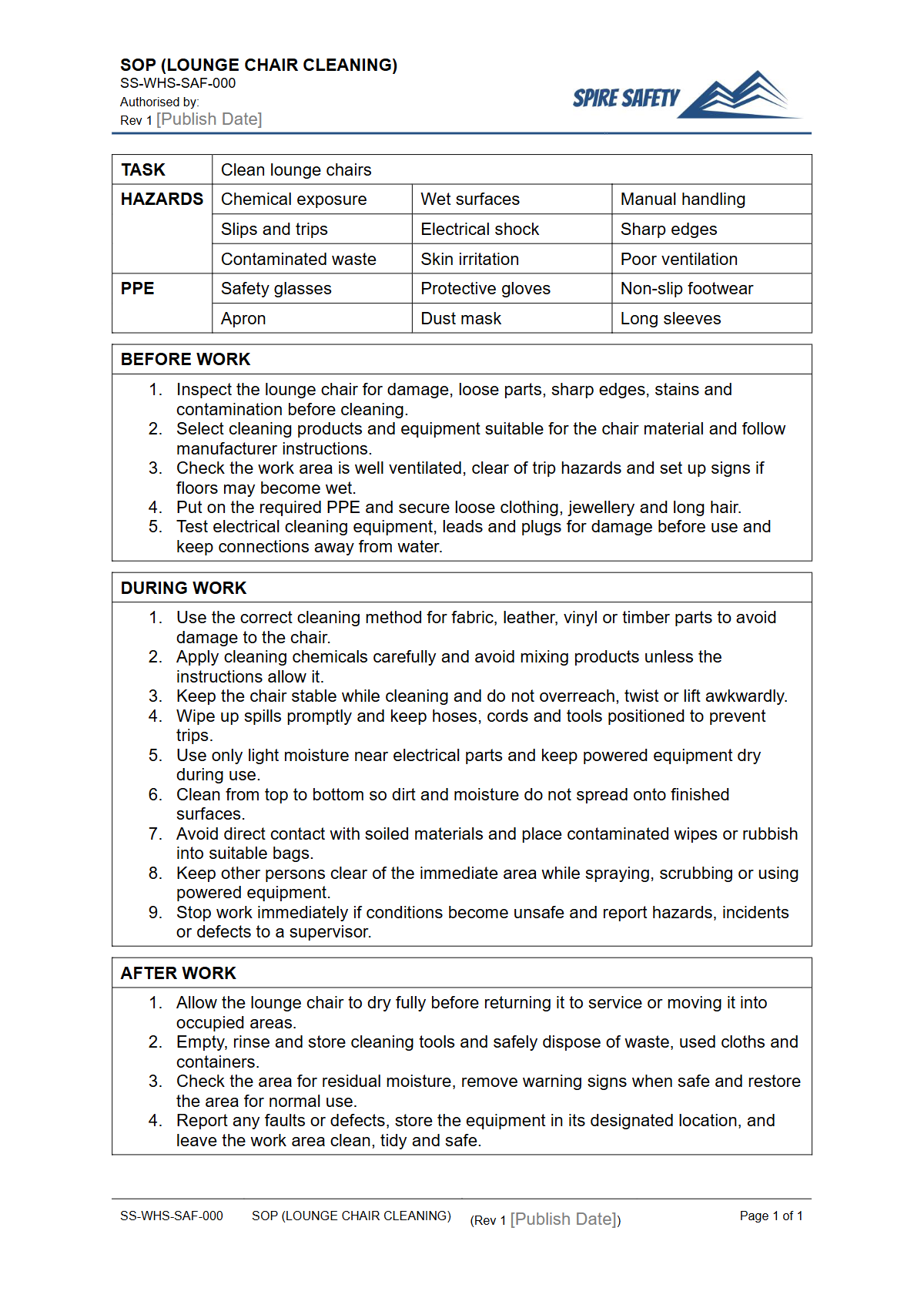
Download our free Safe Operating Procedure for lounge chair cleaning. This DOCX and PDF template helps manage chemical and manual handling risks.
Free Safe Operating Procedure (Lounge Chair Cleaning) Template
DOCX • 126 KB + PDF
Updated Oct 2026
No signup required
Purpose of the Free Safe Operating Procedure (Lounge Chair Cleaning) Template
This free Safe Operating Procedure (Lounge Chair Cleaning) template provides a structured framework for documenting the required steps to clean lounge chairs and other upholstered furniture safely. Formalising your process is a critical step in managing workplace health and safety.
The SOP guides users through pre-operational checks, the cleaning process itself, and post-operational tasks, helping to ensure a consistent and safe approach every time.
A comprehensive SOP helps a Person Conducting a Business or Undertaking (PCBU) meet their primary duty of care. It systematically addresses common hazards associated with cleaning tasks, such as chemical exposure from cleaning agents, ergonomic strain from manual tasks, electrical risks from equipment, and potential slips or trips.
Integrating this document is a key component of building robust WHS management systems that protect workers and demonstrate due diligence.
Video walkthrough
How to use the Free Safe Operating Procedure (Lounge Chair Cleaning) Template
This Safe Operating Procedure is available for download in both DOCX and PDF formats. The DOCX file is fully editable, allowing you to tailor the content to your specific operational needs.
While this template is aligned with Australian WHS principles, it is essential that it is adapted for your workplace.
Important: This document provides a foundational structure, but it is not a complete, out-of-the-box solution. We have developed it as a starting point; you must customise it to reflect the specific equipment (e.g., vacuums, steam cleaners), chemicals, work environment, and personnel at your site.
Always consult with your workers and review the Safety Data Sheets (SDS) for all cleaning products in use before finalising the procedure.
When to use an SOP for Lounge Chair Cleaning
An SOP for lounge chair cleaning should be used as a primary reference document for anyone performing the task. It is particularly valuable during the induction and training of new employees, ensuring they understand the approved, safe method from day one.
It can also form the basis for toolbox talks or refresher training sessions to reinforce safe work behaviours.
Furthermore, this SOP should be readily available in the work area for easy reference. It is a living document that should be reviewed and updated following any incident, near miss, or when new equipment, chemicals, or cleaning techniques are introduced. This process of review is a fundamental part of continuous improvement and can be validated through regular WHS compliance auditing.
Who Should Use This Template
This template is designed for use by a wide range of personnel. WHS managers, facilities managers, and team leaders in sectors like commercial cleaning, hospitality, healthcare, and office management will find it essential for standardising procedures.
Small business owners who directly manage their own WHS obligations can also use it to establish and document safe systems of work.
By implementing a task-specific SOP, you provide clear, unambiguous instructions that reduce the likelihood of incidents. It also serves as a crucial training tool and a record of the risk management process.
A library of well-maintained SOPs, including procedures for other common workplace tasks like a Safe Operating Procedure for defibrillator operation, demonstrates a proactive approach to safety.
Key Hazards and Control Measures
When customising your SOP, pay close attention to the specific hazards present in your workplace. These typically include:
- Chemical Hazards: Arising from cleaning solutions, spot removers, and deodorisers. Controls include ensuring adequate ventilation, referring to the SDS, and using specified Personal Protective Equipment (PPE) such as gloves and safety glasses.
- Ergonomic & Manual Task Hazards: From lifting and moving heavy or awkward furniture, and maintaining sustained or awkward postures during cleaning. Controls involve team lifting, using mechanical aids, and encouraging regular posture changes.
- Electrical Hazards: From powered equipment like vacuum cleaners, wet-vacs, or steam cleaners. Controls include regular visual inspection of cords and plugs, and ensuring equipment has been appropriately tested and tagged. Similar principles apply to other equipment, as detailed in our Free Air Compressor SOP.
Integrating these specific controls into your customised SOP is vital for its effectiveness. If you require assistance in developing complex procedures or implementing your safety system, consider seeking specialist WHS consulting support to ensure all risks are adequately addressed.
Once completed, this SOP becomes one part of your overall safety framework. Explore our free WHS resources library to find other templates and tools that can support your commitment to a safer workplace.
Common mistakes
Common mistakes to avoid
- Using the template without customising it for specific workplace chemicals and equipment.
- Failing to train workers on the finalised SOP and confirm their understanding.
- Not providing or enforcing the use of the Personal Protective Equipment (PPE) listed in the SOP.
- Forgetting to review and update the SOP after an incident or when procedures change.
Legal references
Legal considerations
The following legal requirements may be relevant to this type of work.
- Work Health and Safety Act (Harmonised) — Provides the primary duties for protecting workers and other people from work health and safety risks.
- Work Health and Safety Regulations (Harmonised) — Sets out requirements supporting the management of workplace hazards and risks.
The following codes may be relevant to this type of work.
- Managing WHS Risks Code of Practice — Provides practical guidance on identifying hazards, assessing risks and applying effective controls.
- Work Health and Safety Consultation, Cooperation and Coordination Code of Practice — Provides practical guidance on consulting workers and coordinating with other duty holders.
- Managing the Work Environment and Facilities Code of Practice — Provides practical guidance on safe work environments, workplace facilities and related controls.
Did you know
SDS is Key
A Safety Data Sheet (SDS) isn't just a recommendation; it's a legal requirement in Australia for hazardous chemicals. It contains critical information on handling, first aid, and emergency procedures.
Manual Task Risks
According to Safe Work Australia, manual handling injuries are one of the most common types of workplace injuries. Even moving office furniture can lead to serious sprains and strains if not done correctly.
FAQ
Frequently asked questions
01What is a Safe Operating Procedure (SOP)?
02Do I need an SOP for something as simple as cleaning a chair?
03Can I use this template for commercial upholstery cleaning?
04How often should an SOP be reviewed?
Share this resource
Free Safe Operating Procedure (Lounge Chair Cleaning) Template
Browse Categories
How To Use It
- 1Download and open in Word or PDF.
- 2Replace the placeholders with your business details.
- 3Get it reviewed by a WHS specialist before rollout.
Need it customised?
Our WHS consultants can adapt this template to your site, run a gap analysis, or audit what you already have in place.
Book a Free Consultation WHS consulting servicesor call 1300 156 382
Related templates
- Free Safe Operating Procedure (Louvre Cleaning) Template
- Free Safe Operating Procedure (LPG Cylinder Filling) Template
- Free Safe Operating Procedure (Lubricant Dispensing) Template
- Free Safe Operating Procedure (Luggage Cart Handling) Template
- Free Safe Operating Procedure (Luggage Trolley Use) Template
- Free Safe Operating Procedure (Machine Cleaning) Template