
Free Safe Operating Procedure (Louvre Cleaning) Template
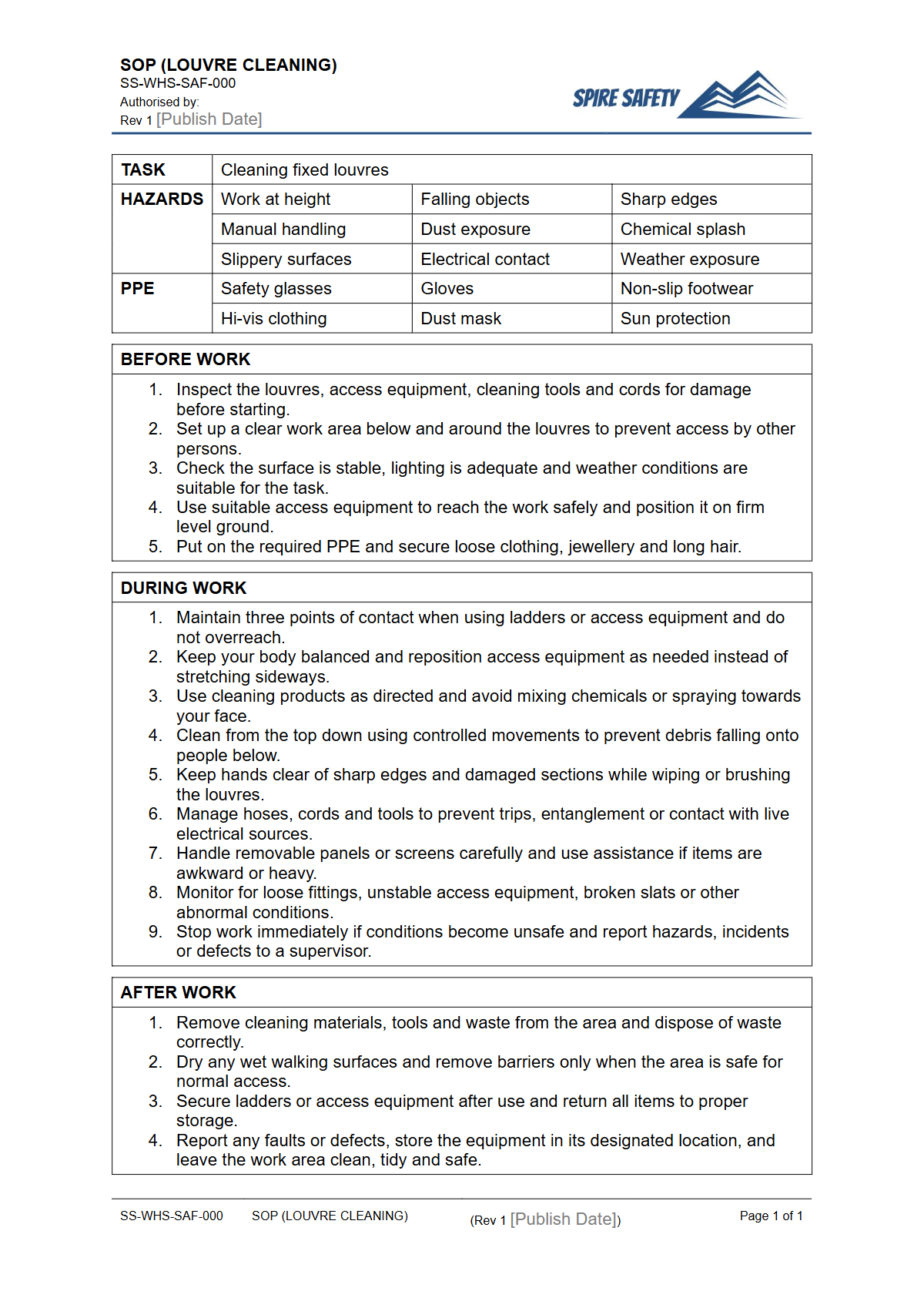
Download our free Safe Operating Procedure (Louvre Cleaning) Template. This DOCX and PDF helps outline safe work methods for cleaning louvres.
Free Safe Operating Procedure (Louvre Cleaning) Template
DOCX • 126 KB + PDF
Updated Oct 2026
No signup required
Purpose of the Free Safe Operating Procedure (Louvre Cleaning) Template
This Free Safe Operating Procedure (Louvre Cleaning) Template provides a structured starting point for documenting a safe system of work for cleaning louvres and similar slatted fixtures. Louvre cleaning can present multiple hazards, including working at heights, manual handling, exposure to cleaning chemicals, and slips, trips, and falls.
A documented SOP ensures that workers have clear, consistent instructions to follow, helping your organisation meet its primary duty of care under Australian WHS legislation.
Using a standardised procedure helps to minimise risks by outlining required PPE, pre-operational checks, emergency responses, and a step-by-step process for the task. It acts as a critical tool for worker training and competency verification.
For tasks involving height access, it's vital to have specific procedures for the equipment used, which is why our FREE Step Ladder SOP Template can be a valuable companion document.
Video walkthrough
How to use the Free Safe Operating Procedure (Louvre Cleaning) Template
To get started, simply download the template in your preferred format (DOCX for easy editing or PDF). The document is structured to guide you through the essential components of a robust SOP.
You should review each section and adapt the content to match the specific context of your workplace.
Key areas for customisation include:
- The specific type and location of the louvres (e.g., high-level external, ground-floor internal).
- The cleaning agents and equipment to be used.
- Site-specific hazards and environmental conditions.
- Your organisation’s emergency contact details and procedures.
For dusty environments, the process may involve preliminary cleaning before washing. Some sites may use compressed air for this, a task that should be covered by its own procedure, which you can develop using our Free Air Compressor SOP (Safe Operating Procedure) Template.
Important: This document is a template only. We've provided a solid foundation, but you must customise it to reflect the specific equipment, chemicals, environment, and personnel at your workplace.
Always consult with the workers who perform the task during the drafting and review process to ensure the procedure is practical and effective.
When to use it
A Safe Operating Procedure for louvre cleaning should be developed and implemented before any worker undertakes the task. It serves as a foundational document for training new employees and for conducting refresher training for existing staff.
The SOP should be readily accessible to all relevant workers, either in a printed or digital format, at the point of work.
Furthermore, this SOP should be a reference point during safety inspections and a key piece of evidence reviewed during formal safety reviews. Scheduling regular internal or external reviews, such as a WHS compliance audit, ensures your procedures remain current and continue to effectively manage risk as your business evolves.
Who should use it
This template is designed for use by Persons Conducting a Business or Undertaking (PCBUs), managers, and supervisors who are responsible for ensuring a safe working environment. They can use it to establish and document a safe work method that fulfils their WHS obligations.
Frontline workers who perform louvre cleaning should use the finalised SOP as their primary guide for safely completing the job.
Integrating specific SOPs like this one into your safety framework is a practical way to build more comprehensive WHS management systems. It demonstrates a commitment to proactive risk management and provides clarity on the expected safe behaviours for specific tasks. A well-written SOP empowers workers to take responsibility for their own safety and that of their colleagues.
The procedure should also detail the response to potential incidents. Having clear steps for first aid and emergency communication is critical.
For medical emergencies like sudden cardiac arrest, being prepared with both equipment and trained personnel is vital, and our Free Safe Operating Procedure (Defibrillator Operation) Template can help formalise that process. You can find more templates like this in our complete free WHS resources library to support your safety initiatives.
Common mistakes
Common mistakes to avoid
- Using the template as-is without customising it for site-specific equipment, chemicals, and hazards.
- Failing to consult with and train workers on the finalised procedure before they start work.
- Neglecting to clearly specify the required Personal Protective Equipment (PPE) for each step.
- Forgetting to include emergency procedures, such as what to do in case of a fall or chemical exposure.
Legal references
Legal considerations
The following legal requirements may be relevant to this type of work.
- Work Health and Safety Act (Harmonised) — Provides the primary duties for protecting workers and other people from work health and safety risks.
- Work Health and Safety Regulations (Harmonised) — Sets out requirements supporting the management of workplace hazards and risks.
The following codes may be relevant to this type of work.
- Managing WHS Risks Code of Practice — Provides practical guidance on identifying hazards, assessing risks and applying effective controls.
- Work Health and Safety Consultation, Cooperation and Coordination Code of Practice — Provides practical guidance on consulting workers and coordinating with other duty holders.
- Managing the Work Environment and Facilities Code of Practice — Provides practical guidance on safe work environments, workplace facilities and related controls.
Did you know
A Leading Cause of Injury
According to Safe Work Australia, falls from a height are a leading cause of workplace fatalities and serious injuries. Even a fall from a relatively low height can result in significant harm.
Origin of the Word
The term 'louvre' originates from the Old French 'l'ouvert', which means 'the open one'. This name originally referred to turret-like structures on roofs that allowed ventilation.
FAQ
Frequently asked questions
01What should be included in a louvre cleaning SOP?
02Is a Safe Operating Procedure a legal requirement in Australia?
03How often should we review our Safe Operating Procedures?
04Can this template be used for all types of louvres?
Share this resource
Free Safe Operating Procedure (Louvre Cleaning) Template
Browse Categories
How To Use It
- 1Download and open in Word or PDF.
- 2Replace the placeholders with your business details.
- 3Get it reviewed by a WHS specialist before rollout.
Need it customised?
Our WHS consultants can adapt this template to your site, run a gap analysis, or audit what you already have in place.
Book a Free Consultation WHS consulting servicesor call 1300 156 382
Related templates
- Free Safe Operating Procedure (LPG Cylinder Filling) Template
- Free Safe Operating Procedure (Lubricant Dispensing) Template
- Free Safe Operating Procedure (Luggage Cart Handling) Template
- Free Safe Operating Procedure (Luggage Trolley Use) Template
- Free Safe Operating Procedure (Machine Cleaning) Template
- Free Safe Operating Procedure (Machine Guard Removal) Template