
Free Safe Operating Procedure (Luggage Cart Handling) Template
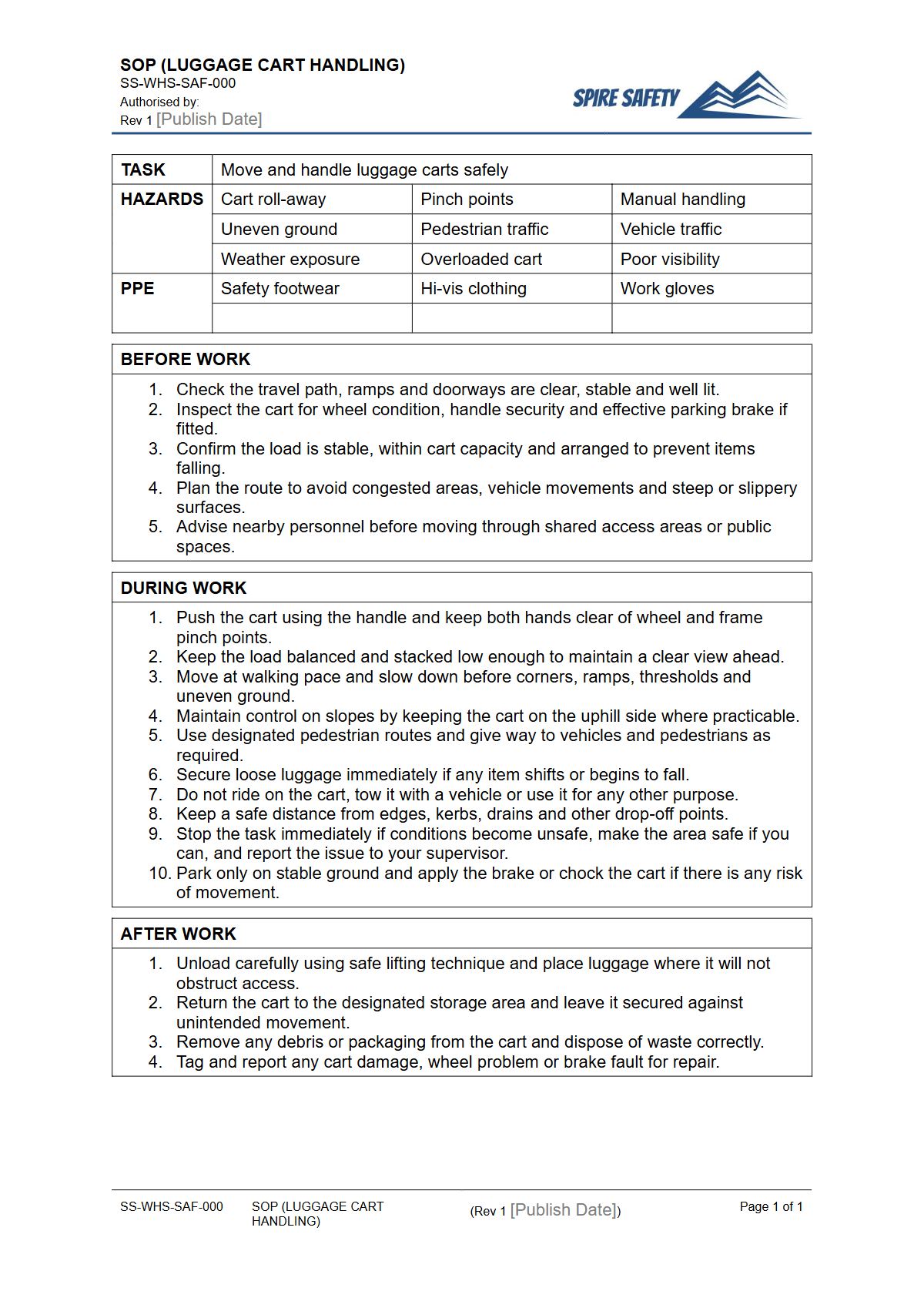
Download our free Safe Operating Procedure for Luggage Cart Handling. This customisable DOCX and PDF helps define safe work methods for your team.
Free Safe Operating Procedure (Luggage Cart Handling) Template
DOCX • 126 KB + PDF
Updated Oct 2026
No signup required
Purpose of the Free Safe Operating Procedure (Luggage Cart Handling) Template
Effectively managing manual tasks is fundamental to workplace safety, particularly in industries like hospitality, transport, and tourism. This free Safe Operating Procedure (Luggage Cart Handling) template provides a structured framework for documenting the safe and correct method for operating luggage carts.
Its primary purpose is to minimise the risk of musculoskeletal injuries, such as sprains and strains, which are commonly associated with pushing, pulling, and manoeuvring heavy or awkward loads. By establishing a clear, step-by-step process, this SOP helps standardise work practices, ensuring all employees understand the expected safe behaviours and control measures.
A documented SOP serves as a critical training tool for new and existing staff, forming an essential part of your organisation's safety protocols. It helps you demonstrate due diligence in managing foreseeable risks and acts as a key document within your broader WHS management systems. Implementing this procedure helps create a safer environment for workers, reduces the likelihood of incidents, and supports a positive safety culture where risks are actively controlled.
Video walkthrough
How to use the Free Safe Operating Procedure (Luggage Cart Handling) Template
This Safe Operating Procedure for Luggage Cart Handling is available for download as a fully editable DOCX file and a ready-to-use PDF. The template is designed to be a comprehensive starting point, pre-filled with common steps and safety considerations based on Australian WHS principles.
To use it effectively, you must adapt its contents to reflect the specific equipment, environment, and tasks at your workplace. This includes adding details about your specific models of luggage carts, the typical surfaces they are used on (e.g., carpet, ramps, elevators), and any site-specific hazards.
Important: We have developed this template as a guide. You must customise it to align with your own operational context, risk assessments, and control measures.
A generic procedure is not sufficient for compliance; you must ensure it accurately reflects the specific risks and safe work practices of your business. Consulting with the workers who actually perform the task is a crucial step in this customisation process to ensure the SOP is practical and effective.
Once customised, the SOP should be formally reviewed and approved before being communicated to all relevant personnel. It should be readily accessible in the work area and used consistently for training and operational guidance.
Regular reviews are also essential to keep the procedure current, especially after an incident or when new equipment is introduced. This review process can be integrated into your organisation's internal safety audit schedule to ensure ongoing effectiveness and relevance.
Professional WHS compliance auditing can help verify that your documented procedures are being implemented correctly in practice.
When to use it
A Safe Operating Procedure for luggage cart handling should be used as a primary reference document for any task involving these items. It is most effective when integrated into daily operations.
Use it during worker induction and onboarding to establish safe work habits from day one. It should also be a key resource for refresher training sessions, helping to reinforce correct procedures and address any observed bad habits.
Supervisors can use the SOP as a basis for toolbox talks or pre-start meetings, reminding teams of key risks like manual handling, load stability, and navigating public spaces.
The SOP is also an invaluable tool following a near miss or incident. It provides a benchmark against which actual work practices can be compared, helping to identify procedural gaps or areas where training needs to be improved.
While this document is specific to luggage carts, the principles apply to many simple manual handling tasks. For procedures involving other types of common workplace equipment, you might reference our FREE Step Ladder SOP Template as another example of a task-specific safety document.
Who should use it
This template is designed for use by a range of personnel within an organisation. WHS Managers, Health and Safety Representatives (HSRs), and Compliance Officers will find it a useful tool for developing and formalising safety documentation.
Supervisors, Team Leaders, and Department Heads in hotels, airports, and transport companies are responsible for implementing the procedure on the ground, using it to train their teams and monitor day-to-day safe work practices.
The end-users of the completed SOP are the workers themselves—the porters, bellhops, baggage handlers, and concierge staff who handle luggage carts daily. The procedure should be written in simple, clear language that is easy for them to understand and apply.
For businesses needing assistance to develop comprehensive training programs or refine their safety documentation, engaging external WHS consulting services can provide expert guidance and support.
Furthermore, an SOP for a specific task should exist within a wider ecosystem of workplace safety preparedness. For instance, while this procedure controls risks from the task itself, it's also vital to have protocols for emergencies.
Ensuring your team is trained and equipped for first aid response, such as through a clear Free Safe Operating Procedure (Defibrillator Operation) Template, contributes to a more holistic safety culture. You can find more templates and tools like this in our complete free WHS resources library.
Common mistakes
Common mistakes to avoid
- Overloading carts beyond the manufacturer's specified weight limit.
- Failing to customise the generic template to reflect site-specific hazards and cart types.
- Using poor stacking techniques that create top-heavy, unstable, or vision-obstructing loads.
- Neglecting regular maintenance checks on wheels, handles, and braking mechanisms.
Legal references
Legal considerations
The following legal requirements may be relevant to this type of work.
- Work Health and Safety Act (Harmonised) — Provides the primary duties for protecting workers and other people from work health and safety risks.
- Work Health and Safety Regulations (Harmonised) — Sets out requirements supporting the management of workplace hazards and risks.
The following codes may be relevant to this type of work.
- Managing WHS Risks Code of Practice — Provides practical guidance on identifying hazards, assessing risks and applying effective controls.
- Work Health and Safety Consultation, Cooperation and Coordination Code of Practice — Provides practical guidance on consulting workers and coordinating with other duty holders.
- Managing the Work Environment and Facilities Code of Practice — Provides practical guidance on safe work environments, workplace facilities and related controls.
Did you know
Manual Handling Risk
According to Safe Work Australia, injuries resulting from manual handling are one of the most common types of workplace injuries in the country, with body stressing accounting for over a third of all serious claims.
Centre of Gravity
When loading a luggage cart, placing the heaviest items at the bottom and centred over the wheels lowers the cart's centre of gravity, making it significantly more stable and easier to control.
FAQ
Frequently asked questions
01What key information should be included in a Luggage Cart Handling SOP?
02How does an SOP for luggage carts help reduce injuries?
03Who is responsible for enforcing a Luggage Cart Handling SOP?
04How often should we review our Luggage Cart Handling SOP?
Share this resource
Free Safe Operating Procedure (Luggage Cart Handling) Template
Browse Categories
How To Use It
- 1Download and open in Word or PDF.
- 2Replace the placeholders with your business details.
- 3Get it reviewed by a WHS specialist before rollout.
Need it customised?
Our WHS consultants can adapt this template to your site, run a gap analysis, or audit what you already have in place.
Book a Free Consultation WHS consulting servicesor call 1300 156 382
Related templates
- Free Safe Operating Procedure (Luggage Trolley Use) Template
- Free Safe Operating Procedure (Machine Cleaning) Template
- Free Safe Operating Procedure (Machine Guard Removal) Template
- Free Safe Operating Procedure (Machine Lubrication) Template
- Free Safe Operating Procedure (Mag Drill) Template
- Free Safe Operating Procedure (Magnetic Particle Test) Template