
Free Safe Operating Procedure (LPG Cylinder Filling) Template
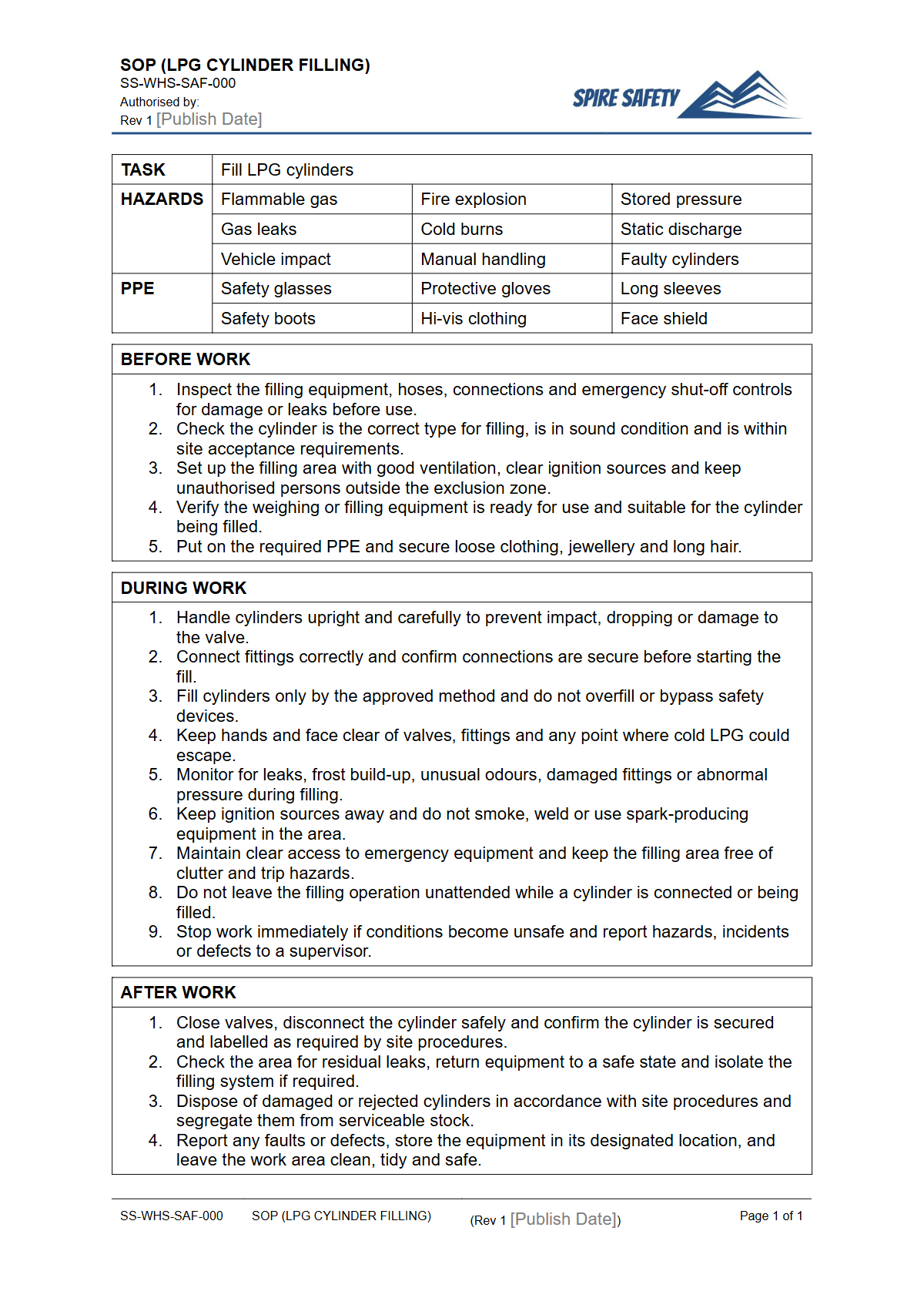
Manage the risks of decanting and filling LPG cylinders with our free Safe Operating Procedure (LPG Cylinder Filling) Template. Download your DOCX today.
Free Safe Operating Procedure (LPG Cylinder Filling) Template
DOCX • 126 KB + PDF
Updated Oct 2026
No signup required
Purpose of the Free Safe Operating Procedure (LPG Cylinder Filling) Template
Effectively managing the risks associated with filling Liquefied Petroleum Gas (LPG) cylinders is a critical safety requirement for many Australian businesses. Our Free Safe Operating Procedure (LPG Cylinder Filling) Template provides a structured starting point for documenting a clear, step-by-step process for this high-risk task.
This document is designed to help you control hazards such as fire, explosion, static electricity, cold burns, and asphyxiation, which are inherent in handling LPG.
An SOP is a fundamental component of an organisation's safety framework, outlining the accepted and safest way to perform a specific task. Using this template helps you meet your primary duty of care under WHS law by providing workers with clear instructions, defining required personal protective equipment (PPE), and establishing emergency protocols.
A well-developed SOP is a key building block in creating robust WHS management systems that protect people and ensure operational consistency.
Video walkthrough
How to use the Free Safe Operating Procedure (LPG Cylinder Filling) Template
This document is provided in both DOCX and PDF formats for your convenience. The DOCX file is fully editable, allowing you to tailor the content to the specific equipment, chemicals, and environmental conditions at your worksite.
The procedure should be developed in consultation with workers who perform the task and reviewed by a competent person before implementation.
Important: This is a template, not a finished document. We have provided a structured foundation aligned with Australian WHS practice, but you must customise it to reflect your unique operational risks.
This includes adding details about your specific filling equipment, cylinder types, site layout, emergency shut-off locations, and required PPE. Your finalised SOP should also align with the manufacturer's operating instructions for the filling apparatus and the Safety Data Sheet (SDS) for the LPG being used.
Once customised, the SOP becomes a valuable control measure. Regular reviews of its effectiveness are essential for maintaining safety standards.
Incorporating this review process into your schedule of WHS compliance auditing can help ensure the procedure remains relevant and effective over time.
When to use a Safe Operating Procedure for LPG Cylinder Filling
A Safe Operating Procedure for this task should be an integral part of your daily operations and safety management. It should be used as the primary reference document for any worker authorised to fill LPG cylinders.
Its application is particularly crucial in several scenarios: training and induction for new employees, conducting refresher training for experienced staff, and as a standard for assessing worker competency.
Furthermore, the SOP serves as a benchmark for workplace inspections and a key document in the event of an incident or near-miss investigation. Having clear, established procedures for high-risk tasks demonstrates a commitment to proactive safety management.
Just as you would document the safe use of common equipment with a step ladder SOP, a procedure for handling hazardous substances like LPG is non-negotiable. This document can also be cross-referenced in your site's overall emergency plan, ensuring procedures are consistent and readily available when needed.
Who should use this template
This template is designed for Persons Conducting a Business or Undertaking (PCBUs), site managers, supervisors, and WHS professionals. It provides a reliable framework for you to build upon, ensuring all critical safety elements are considered when drafting your final site-specific procedure.
Frontline supervisors can use the final document to train their teams and enforce safe work practices on the floor.
Workers who perform LPG filling should also be involved in the customisation process, as their direct experience is invaluable for creating a practical and effective procedure. If your organisation lacks the in-house expertise to confidently assess the risks or finalise the procedure, engaging external experts is a sensible step.
The specialists at Spire Safety can provide targeted WHS consulting to help you navigate complex hazards and develop robust safety documentation for your specific needs.
Common mistakes
Common mistakes to avoid
- Overfilling cylinders by bypassing safety mechanisms or ignoring weight/volume limits.
- Failing to conduct a leak test with a soapy water solution on the cylinder valve after filling.
- Permitting ignition sources like mobile phones, non-intrinsically safe tools, or smoking within the hazardous zone.
- Wearing inappropriate PPE, particularly synthetic clothing that can accumulate static electricity.
Legal references
Legal considerations
The following legal requirements may be relevant to this type of work.
- Work Health and Safety Act (Harmonised) — Provides the primary duties for protecting workers and other people from work health and safety risks.
- Work Health and Safety Regulations (Harmonised) — Sets out requirements supporting the management of workplace hazards and risks.
The following codes may be relevant to this type of work.
- Managing WHS Risks Code of Practice — Provides practical guidance on identifying hazards, assessing risks and applying effective controls.
- Work Health and Safety Consultation, Cooperation and Coordination Code of Practice — Provides practical guidance on consulting workers and coordinating with other duty holders.
- Managing the Work Environment and Facilities Code of Practice — Provides practical guidance on safe work environments, workplace facilities and related controls.
Did you know
Heavier Than Air
LPG vapour is about 1.5 to 2 times heavier than air. In the event of a leak, it can accumulate in low-lying areas like pits or drains, creating a significant and often invisible fire or asphyxiation hazard.
The 80% Rule
LPG cylinders are only ever filled to about 80% of their total capacity. This empty space, known as 'ullage', is essential to allow the liquid LPG to safely expand with increases in temperature.
FAQ
Frequently asked questions
01What key information should be included in an LPG cylinder filling SOP?
02Is a special licence required to fill LPG cylinders in Australia?
03How often should a Safe Operating Procedure for LPG cylinder filling be reviewed?
04Can I use this template for both automotive LPG and BBQ cylinders?
Share this resource
Free Safe Operating Procedure (LPG Cylinder Filling) Template
Browse Categories
How To Use It
- 1Download and open in Word or PDF.
- 2Replace the placeholders with your business details.
- 3Get it reviewed by a WHS specialist before rollout.
Need it customised?
Our WHS consultants can adapt this template to your site, run a gap analysis, or audit what you already have in place.
Book a Free Consultation WHS consulting servicesor call 1300 156 382
Related templates
- Free Safe Operating Procedure (Lubricant Dispensing) Template
- Free Safe Operating Procedure (Luggage Cart Handling) Template
- Free Safe Operating Procedure (Luggage Trolley Use) Template
- Free Safe Operating Procedure (Machine Cleaning) Template
- Free Safe Operating Procedure (Machine Guard Removal) Template
- Free Safe Operating Procedure (Machine Lubrication) Template