
Free Safe Operating Procedure (Log Grapple) Template
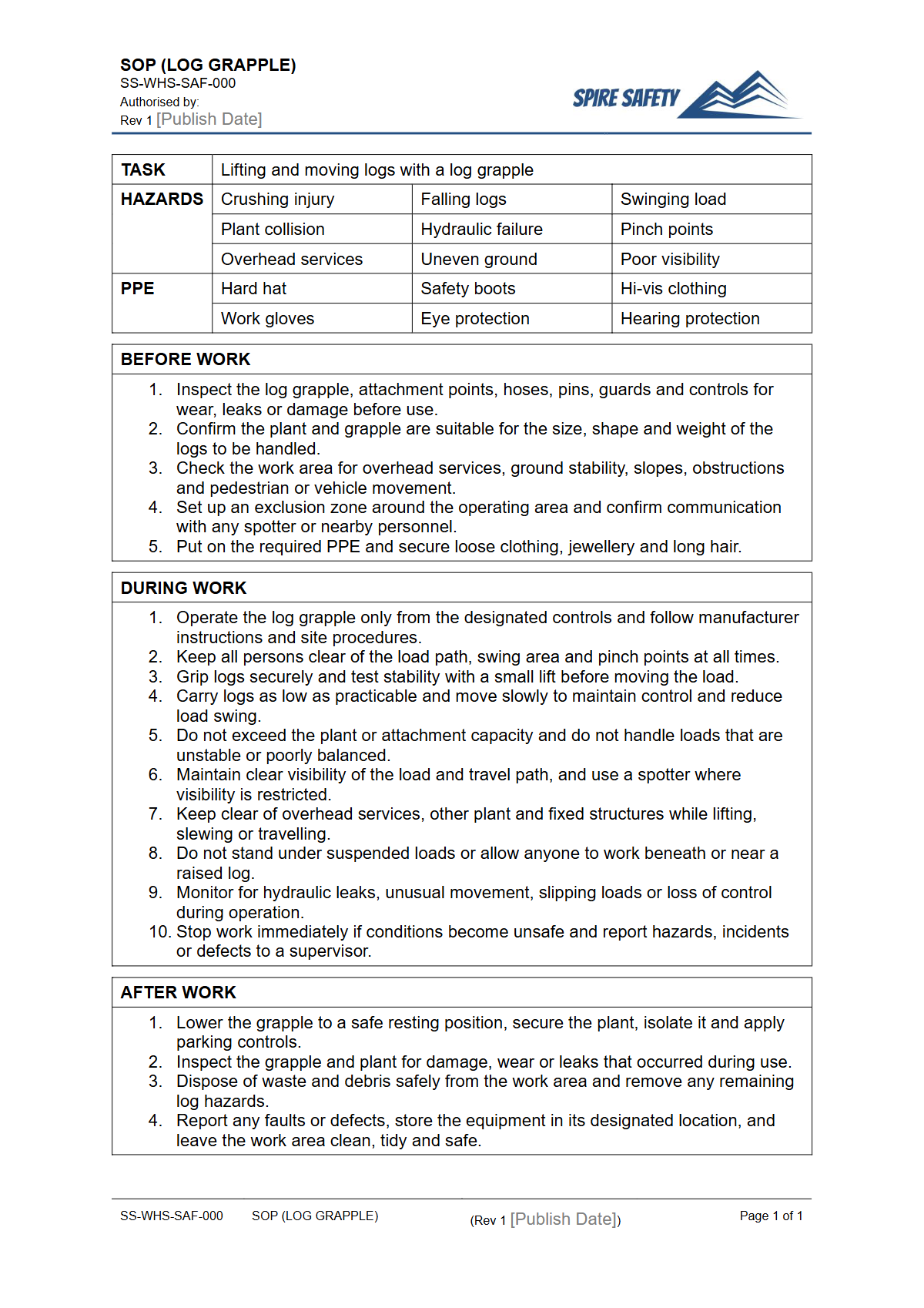
Download our free Safe Operating Procedure (Log Grapple) template. This customisable DOCX & PDF provides a solid foundation for your WHS documentation.
Free Safe Operating Procedure (Log Grapple) Template
DOCX • 126 KB + PDF
Updated Oct 2026
No signup required
Purpose of the Free Safe Operating Procedure (Log Grapple) Template
Operating machinery with attachments like log grapples introduces significant risks that must be managed. This Free Safe Operating Procedure (Log Grapple) Template provides a structured starting point for your organisation to document the required steps for operating this equipment safely.
A comprehensive SOP is a key tool for hazard identification, risk control, and operator training, forming a critical part of your overall safety management system. It details the accepted, safe method for performing a task, helping to ensure all workers follow a consistent, low-risk process.
Using a standardised procedure helps reduce the likelihood of incidents caused by human error, equipment misuse, or a lack of knowledge. It outlines pre-operational checks, step-by-step operational instructions, and shutdown protocols.
Implementing a thorough SOP demonstrates a commitment to workplace health and safety and provides a clear reference for workers and supervisors. Much like our free Dozer SOP template, this document is designed to be adapted to the specific plant used in your operations.
Video walkthrough
How to use the Free Safe Operating Procedure (Log Grapple) Template
This template is provided in both DOCX and PDF formats for your convenience. The DOCX file is fully editable, allowing you to tailor it to your specific operational needs.
To use the template effectively, you should consult with the people who actually operate the equipment. Their hands-on experience is invaluable for identifying practical hazards and effective controls.
Important: This is a template, not a finished document. You must customise it to reflect your unique workplace.
Review every section and adapt the content to match the specific make and model of your log grapple and host machine (e.g., excavator, skid steer), your site conditions, the materials being handled, and your organisation's existing safety policies. We cannot be responsible for the safety of your workplace; you are responsible for developing and implementing your own safe systems of work.
When to use it
A log grapple SOP is not a 'set and forget' document. It should be an active part of your daily operations.
It is used to induct and train new operators, providing them with a clear, step-by-step guide to safe operation. It also serves as a checklist for pre-start inspections, ensuring the equipment is fit for use before any work begins.
Furthermore, the SOP is a valuable reference tool for supervisors conducting safety observations and for teams investigating a near miss or incident. A well-maintained suite of SOPs is a cornerstone of effective WHS management systems.
Who should use it
This Safe Operating Procedure should be used by several key personnel within an organisation. Primarily, machine operators must be trained on the SOP and use it as their guide for safe work practices.
Supervisors and team leaders are responsible for ensuring operators adhere to the documented procedures and for providing coaching where necessary. WHS managers and coordinators will use the SOP as part of the broader risk management framework, ensuring it is properly developed, reviewed, and integrated with other safety documentation, similar to how one might manage a FREE Telehandler SOP Template for different equipment.
Key Elements of a Log Grapple SOP
A robust SOP for a log grapple should contain several critical sections to be effective. While our template provides a solid structure, ensure your final document includes:
- Required PPE: A list of all personal protective equipment required, such as high-visibility clothing, steel-capped boots, hard hats, gloves, and eye protection.
- Hazard Identification and Risk Controls: A summary of potential hazards (e.g., dropped loads, hydraulic failure, crush zones, uneven terrain) and the control measures in place to mitigate them.
- Pre-Operational Checks: A detailed checklist for inspecting the grapple, hydraulic lines, attachment points, and host machine before starting work. This process is often a focus during WHS compliance auditing to verify that plant is inspected before use.
- Step-by-Step Operating Guide: Clear, concise instructions for attaching the grapple, lifting, moving, and releasing loads securely. This should cover different scenarios relevant to your worksite.
- Shutdown and Emergency Procedures: Instructions on how to safely shut down the equipment, park it correctly, and what to do in case of an emergency like a hydraulic fluid spill or mechanical failure.
Developing this document requires careful thought and consultation. If your team lacks the internal expertise to adapt this template confidently, engaging external support through general WHS consulting can provide the necessary guidance.
You can also explore our free WHS resources library for other templates and guides to support your safety efforts.
Common mistakes
Common mistakes to avoid
- Failing to customise the template for the specific make and model of the grapple and host machine.
- Neglecting to include site-specific hazards such as overhead powerlines, ground stability issues, or exclusion zones.
- Using the SOP as a one-time training document instead of an active, on-the-job reference for workers.
- Not reviewing and updating the procedure after a near miss, incident, or change in equipment.
Legal references
Legal considerations
The following legal requirements may be relevant to this type of work.
- Work Health and Safety Act (Harmonised) — Provides the primary duties for protecting workers and other people from work health and safety risks.
- Work Health and Safety Regulations (Harmonised) — Sets out requirements supporting the management of workplace hazards and risks.
The following codes may be relevant to this type of work.
- Managing WHS Risks Code of Practice — Provides practical guidance on identifying hazards, assessing risks and applying effective controls.
- Work Health and Safety Consultation, Cooperation and Coordination Code of Practice — Provides practical guidance on consulting workers and coordinating with other duty holders.
- Managing the Work Environment and Facilities Code of Practice — Provides practical guidance on safe work environments, workplace facilities and related controls.
Did you know
Hydraulic Pressure
Log grapples operate using immense hydraulic pressure, which can exceed 3,000 PSI. A failure in a hydraulic line at this pressure can inject fluid through the skin, causing severe and potentially life-threatening injuries.
Attachment Points
A significant number of incidents involving machinery attachments occur not during operation, but during the process of connecting or disconnecting them from the host machine due to unexpected movement or insecure connections.
FAQ
Frequently asked questions
01What is a Safe Operating Procedure (SOP) for a log grapple?
02Is this free log grapple SOP template ready to use immediately?
03Who is responsible for writing a log grapple SOP?
04How often should a Safe Operating Procedure be reviewed?
Share this resource
Free Safe Operating Procedure (Log Grapple) Template
Browse Categories
How To Use It
- 1Download and open in Word or PDF.
- 2Replace the placeholders with your business details.
- 3Get it reviewed by a WHS specialist before rollout.
Need it customised?
Our WHS consultants can adapt this template to your site, run a gap analysis, or audit what you already have in place.
Book a Free Consultation WHS consulting servicesor call 1300 156 382
Related templates
- Free Safe Operating Procedure (Log Loader) Template
- Free Safe Operating Procedure (Log Loading) Template
- Free Safe Operating Procedure (Log Splitter) Template
- Free Safe Operating Procedure (Log Trailer) Template
- Free Safe Operating Procedure (Log Unloading) Template
- Free Safe Operating Procedure (Loop Impedance Test) Template