
Free Safe Operating Procedure (Log Loader) Template
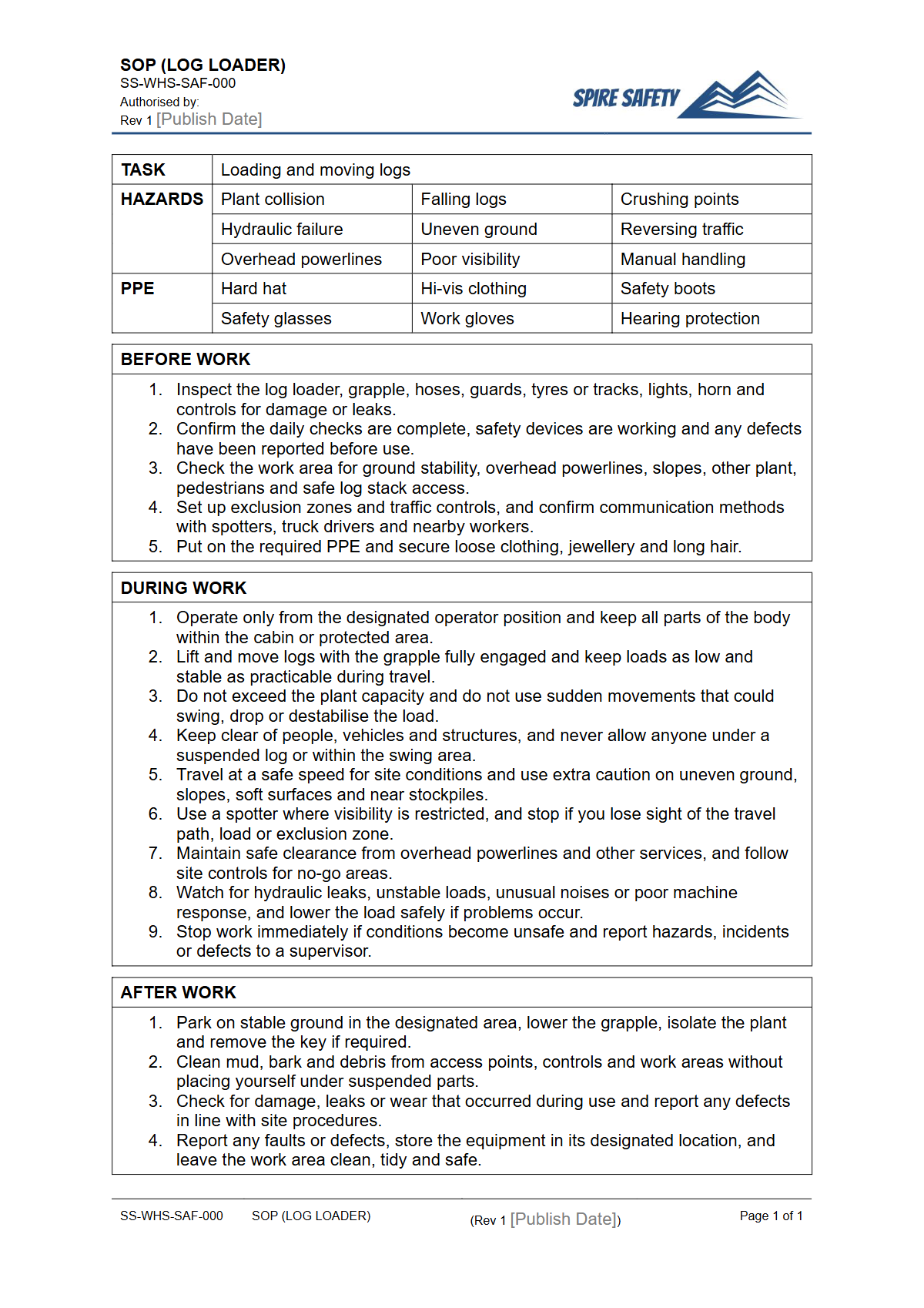
Download our free Safe Operating Procedure (Log Loader) template.
Free Safe Operating Procedure (Log Loader) Template
DOCX • 126 KB + PDF
Updated Oct 2026
No signup required
Purpose of the Free Safe Operating Procedure (Log Loader) Template
Effectively managing high-risk plant like log loaders is critical for preventing serious incidents in forestry, logistics, and timber processing industries. Our free Safe Operating Procedure (Log Loader) template provides a structured starting point for documenting the essential safety requirements for operating this machinery.
A well-developed SOP is a key tool for ensuring operators understand the hazards and the step-by-step controls needed to perform their tasks safely. It formalises your organisation's expectations and serves as a vital record for training and compliance purposes.
This document outlines potential hazards associated with log loader operation, including machine rollover, being struck by moving parts or falling logs, and collisions with other vehicles or people. It provides a framework for detailing pre-operational checks, safe operating sequences, and emergency responses.
Properly implementing this procedure is a fundamental part of integrating SOPs into your broader WHS management system, helping to foster a proactive safety culture.
Video walkthrough
How to use the Free Safe Operating Procedure (Log Loader) Template
To get started, download the template in your preferred format (DOCX or PDF) and begin adapting it to your specific operational context. This involves consulting with the people who actually operate and work around the machinery—their practical experience is invaluable for creating a document that is both accurate and useful.
Important: This document is a template and not a finished Safe Operating Procedure. You must customise it to reflect the specific log loader models, attachments, site conditions, types of logs handled, and organisational procedures at your workplace.
We strongly recommend consultation with operators, maintenance personnel, and supervisors during the customisation process to ensure the final SOP is comprehensive and practical.
Key Sections to Customise
Pay close attention to the following sections, ensuring the information is detailed and specific to your site:
- Hazard Identification: Go beyond the general hazards listed and identify site-specific risks, such as overhead powerlines, ground instability, blind spots, or specific traffic management issues.
- Pre-Operational Checks: Tailor the checklist to the make and model of your log loader. Include checks for hydraulic systems, grapples, tyres, safety guards, and communication equipment.
- Safe Operating Sequence: Detail the step-by-step process for all common tasks, including travelling, positioning the machine, lifting and gripping logs, stacking, and loading trucks. This is different from the procedure for other heavy equipment, which you can document with resources like our FREE Dozer SOP template.
- Emergency Procedures: Clearly define the actions to be taken in case of machine rollover, hydraulic failure, fire, or medical emergency.
- Maintenance and Shutdown: Specify lockout-tagout procedures and requirements for safe maintenance. Some elements may be similar to those in our FREE Telehandler SOP Template, but they must be verified for your log loader.
SOPs are not 'set and forget' documents. They should be reviewed regularly—typically annually—or whenever there is a change in equipment, processes, or following an incident.
Incorporating SOP reviews into your schedule for regular WHS compliance auditing ensures they remain relevant and effective.
When to Use It
A log loader SOP should be used as a core document for multiple WHS processes. It is essential for inducting and training new operators, providing a clear reference for experienced workers, and verifying competency.
Supervisors can use it as a checklist for observing work practices and correcting unsafe behaviour. The SOP also provides a baseline for investigating incidents, helping to identify whether procedures were followed and if they need to be improved.
Who Should Use It
This Safe Operating Procedure is intended for use by multiple groups within an organisation. A Person Conducting a Business or Undertaking (PCBU) has the primary duty of care and is responsible for ensuring safe systems of work are in place.
Managers and supervisors are responsible for implementing, monitoring, and enforcing the SOP. Operators and ground crew must be trained on the contents of the finalised, site-specific SOP and are required to follow it during their daily work. If you require assistance in defining these roles and responsibilities, consider seeking expert WHS consulting.
By customising and implementing this template, you create a powerful tool that contributes to a safer working environment. This document is one of many available in our free WHS resources library, designed to help you build a robust safety framework.
Common mistakes
Common mistakes to avoid
- Using a generic template without customising it for the specific workplace, log loader model, and tasks.
- Failing to involve experienced operators in the development and review of the SOP.
- Not providing adequate training on the finalised SOP to all relevant operators and ground crew.
- Neglecting to review and update the SOP after an incident or when operational conditions change.
Legal references
Legal considerations
The following legal requirements may be relevant to this type of work.
- Work Health and Safety Act (Harmonised) — Provides the primary duties for protecting workers and other people from work health and safety risks.
- Work Health and Safety Regulations (Harmonised) — Sets out requirements supporting the management of workplace hazards and risks.
The following codes may be relevant to this type of work.
- Managing WHS Risks Code of Practice — Provides practical guidance on identifying hazards, assessing risks and applying effective controls.
- Work Health and Safety Consultation, Cooperation and Coordination Code of Practice — Provides practical guidance on consulting workers and coordinating with other duty holders.
- Managing the Work Environment and Facilities Code of Practice — Provides practical guidance on safe work environments, workplace facilities and related controls.
Did you know
Struck-By Hazards
A significant number of serious incidents involving log loaders occur when workers on the ground are struck by the machine, its moving parts, or falling logs during loading and unloading operations.
Machine Stability
The stability of a log loader is greatly affected by the ground conditions and the load's weight and centre of gravity. Operating on uneven or soft ground significantly increases the risk of rollover.
FAQ
Frequently asked questions
01Is a Safe Operating Procedure a legal requirement for log loaders in Australia?
02What's the difference between an SOP and a SWMS?
03How often should we review our log loader SOP?
04Can I use this template for other types of loaders?
Share this resource
Free Safe Operating Procedure (Log Loader) Template
Browse Categories
How To Use It
- 1Download and open in Word or PDF.
- 2Replace the placeholders with your business details.
- 3Get it reviewed by a WHS specialist before rollout.
Need it customised?
Our WHS consultants can adapt this template to your site, run a gap analysis, or audit what you already have in place.
Book a Free Consultation WHS consulting servicesor call 1300 156 382
Related templates
- Free Safe Operating Procedure (Log Loading) Template
- Free Safe Operating Procedure (Log Splitter) Template
- Free Safe Operating Procedure (Log Trailer) Template
- Free Safe Operating Procedure (Log Unloading) Template
- Free Safe Operating Procedure (Loop Impedance Test) Template
- Free Safe Operating Procedure (Lounge Chair Cleaning) Template