
Free Safe Operating Procedure (Log Splitter) Template
Download our free Safe Operating Procedure (Log Splitter) template. This customisable DOCX & PDF provides a clear framework for operating log splitters safely.
Free Safe Operating Procedure (Log Splitter) Template
DOCX • 126 KB + PDF
Updated Oct 2026
No signup required
Purpose of the Free Safe Operating Procedure (Log Splitter) Template
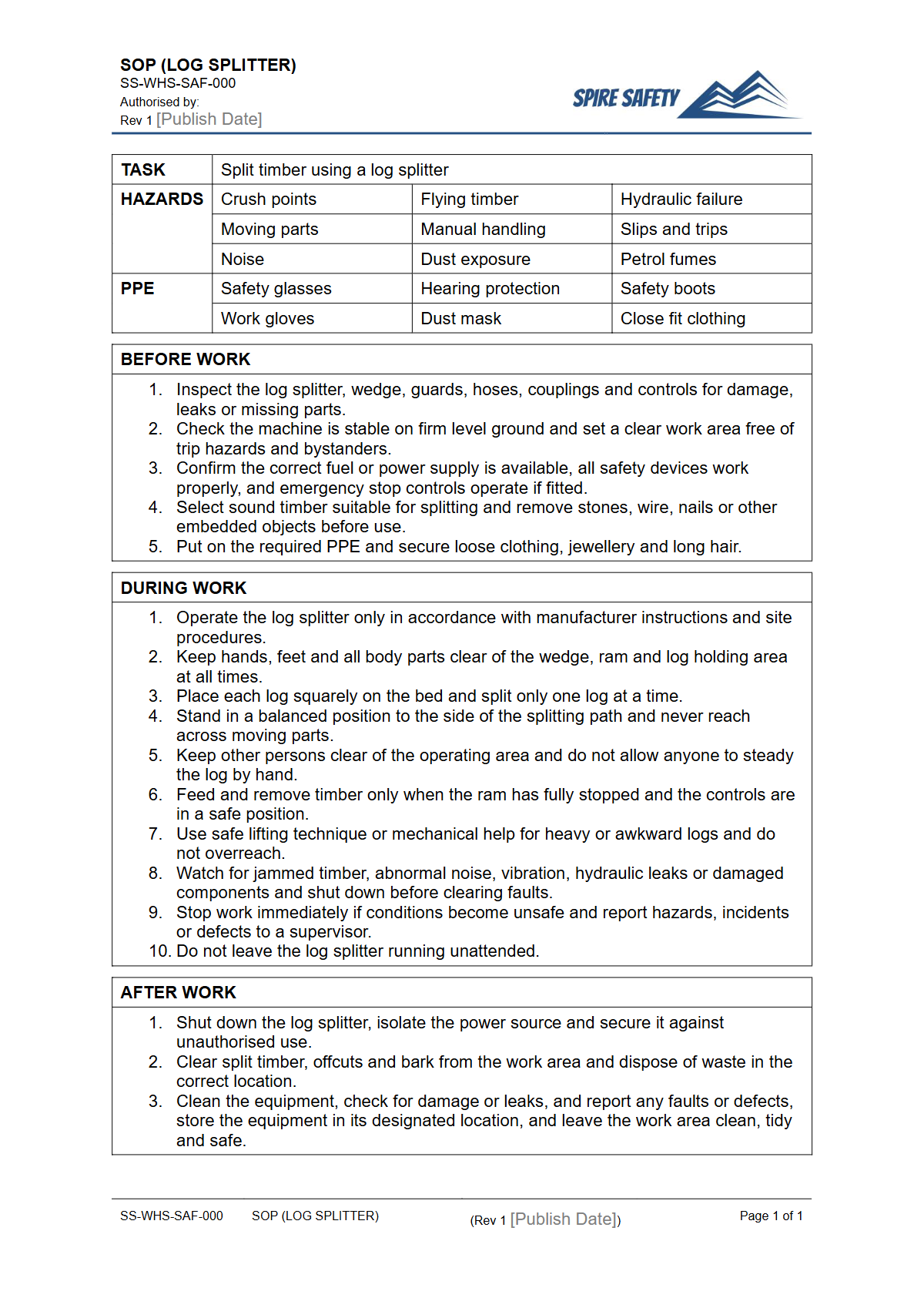
Operating a log splitter involves significant risks, including crushing, amputation, and projectile injuries. Our Free Safe Operating Procedure (Log Splitter) Template provides a structured document for outlining the required steps to perform this task safely.
Using this template helps your organisation establish and communicate clear, step-by-step instructions for workers, forming a critical administrative control measure to manage high-risk machinery. It prompts you to consider hazards such as pinch points, hydraulic fluid injection, flying wood fragments, and manual handling risks associated with loading and unloading logs.
A documented SOP is a cornerstone of a safe system of work. It provides a consistent benchmark for training and competency assessment, ensuring every operator understands the approved method for using the equipment.
This is similar to the procedural rigour required for other powerful cutting equipment, as detailed in our FREE Circular Saw SOP (Safe Operating Procedure) Template. By systematically addressing potential hazards before work begins, you can significantly reduce the likelihood of incidents and injuries in your workplace.
Video walkthrough
How to use the Free Safe Operating Procedure (Log Splitter) Template
This Free Safe Operating Procedure (Log Splitter) Template is available for immediate download in both DOCX and PDF formats. The DOCX file is fully editable, allowing you to tailor the content to the specific make and model of log splitter used at your site, as well as your unique operational environment and risk profile.
To use the template effectively, you should detail pre-operational safety checks, the required Personal Protective Equipment (PPE), step-by-step operating instructions, and clear shutdown and cleaning procedures.
It is crucial to engage with the operators who use the equipment daily during the customisation process. Their hands-on experience is invaluable for identifying practical challenges and effective control measures. An SOP is most effective when it is integrated into your organisation's broader safety framework, which can be strengthened through professionally developed WHS management systems.
Please note: This is a template that must be customised to your specific workplace. We are not responsible for the outcomes of your customisation and implementation.
When to use it
A Safe Operating Procedure for a log splitter should be a living document used throughout the lifecycle of the equipment in your workplace. It is essential during the induction and training of new operators to establish safe work habits from the start.
It also serves as a critical reference tool for experienced workers, providing a foundation for refresher training and reinforcing correct procedures. The SOP should be readily available at or near the location where the log splitter is used.
Furthermore, the SOP is a key document during formal risk assessments and should be reviewed and updated whenever a new hazard is identified. Following an incident or near-miss, the SOP must be reviewed as part of the investigation to determine if procedural gaps contributed to the event. Regular reviews are also a component of due diligence, demonstrating proactive safety management during any formal WHS compliance auditing.
Who should use it
This SOP template is designed for use by a range of personnel within an organisation. WHS Managers, Safety Advisors, and Site Supervisors will find it a valuable tool for drafting and implementing formal procedures.
Team Leaders and experienced operators should be directly involved in customising the content to ensure it is practical and reflects the realities of the task. Ultimately, the finalised SOP is for the operators themselves—it is their guide to performing the job safely every time.
Having a clear, well-written SOP helps standardise work practices across all shifts and teams, reducing variability and the associated risks. It provides a clear standard against which operator behaviour and competency can be measured.
Just as you would have clear instructions for other common workshop equipment, this SOP ensures consistency. Similar principles apply to procedures for other plant, such as those covered in our Free Air Compressor SOP (Safe Operating Procedure) Template.
The document should also clearly outline emergency procedures, including the steps to take in case of machine malfunction, hydraulic leaks, or personal injury. This ensures that workers are prepared to respond effectively in a crisis, minimising harm.
Documenting these steps is as vital as outlining the standard operating sequence. This systematic approach to safety applies to all workplace equipment, even seemingly simple items detailed in resources like our FREE Step Ladder SOP (Safe Operating Procedure) Template.
By implementing robust SOPs for all relevant plant and equipment, your business demonstrates a commitment to workplace health and safety. You can explore a wide range of similar documents in our comprehensive free WHS resources library to support your safety management efforts.
Common mistakes
Common mistakes to avoid
- Failing to customise the template for the specific make and model of the log splitter.
- Neglecting to include controls for site-specific hazards like flying debris, hydraulic fluid leaks, or awkward manual handling.
- Not consulting with the actual operators of the machine when drafting the procedure.
- Treating the SOP as a 'set and forget' document instead of a live tool for training and review.
Legal references
Legal considerations
The following legal requirements may be relevant to this type of work.
- Work Health and Safety Act (Harmonised) — Provides the primary duties for protecting workers and other people from work health and safety risks.
- Work Health and Safety Regulations (Harmonised) — Sets out requirements supporting the management of workplace hazards and risks.
The following codes may be relevant to this type of work.
- Managing WHS Risks Code of Practice — Provides practical guidance on identifying hazards, assessing risks and applying effective controls.
- Work Health and Safety Consultation, Cooperation and Coordination Code of Practice — Provides practical guidance on consulting workers and coordinating with other duty holders.
- Managing the Work Environment and Facilities Code of Practice — Provides practical guidance on safe work environments, workplace facilities and related controls.
Did you know
Hydraulic Power
Most log splitters use hydraulic systems that exert immense force, often between 10 to 30 tons. This power, while essential for splitting wood, also presents significant crushing hazards if safety guards are bypassed or missing.
FAQ
Frequently asked questions
01What is a Safe Operating Procedure for a log splitter?
02Is this log splitter SOP template compliant with Australian WHS laws?
03Who is responsible for creating and implementing the SOP?
04How often should a log splitter SOP be reviewed?
Share this resource
Free Safe Operating Procedure (Log Splitter) Template
Browse Categories
How To Use It
- 1Download and open in Word or PDF.
- 2Replace the placeholders with your business details.
- 3Get it reviewed by a WHS specialist before rollout.
Need it customised?
Our WHS consultants can adapt this template to your site, run a gap analysis, or audit what you already have in place.
Book a Free Consultation WHS consulting servicesor call 1300 156 382
Related templates
- Free Safe Operating Procedure (Log Trailer) Template
- Free Safe Operating Procedure (Log Unloading) Template
- Free Safe Operating Procedure (Loop Impedance Test) Template
- Free Safe Operating Procedure (Lounge Chair Cleaning) Template
- Free Safe Operating Procedure (Louvre Cleaning) Template
- Free Safe Operating Procedure (LPG Cylinder Filling) Template