
Free Safe Operating Procedure (Log Trailer) Template
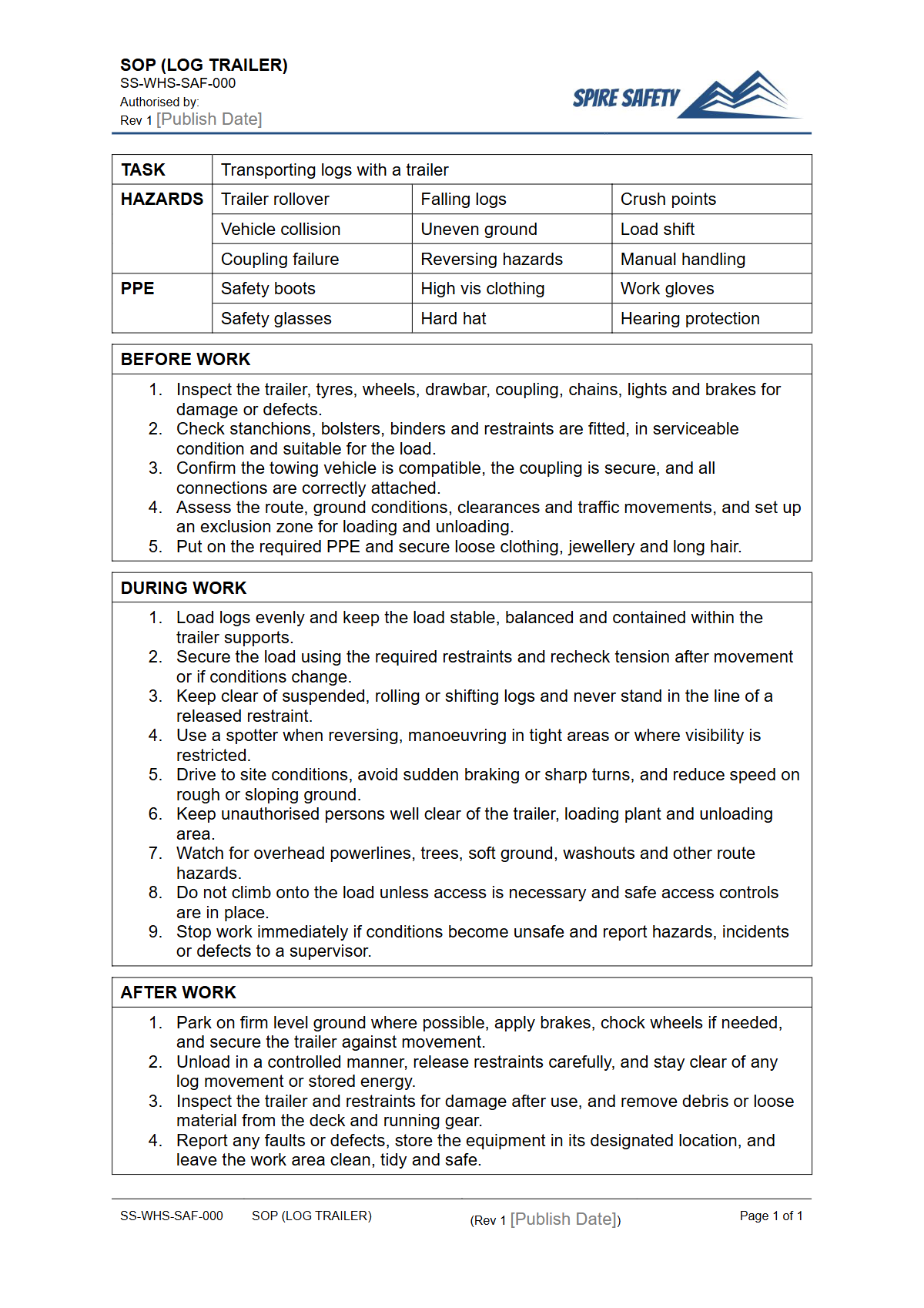
Download our Free Safe Operating Procedure (Log Trailer) Template. This customisable DOCX & PDF helps document safety controls for log trailer operations.
Free Safe Operating Procedure (Log Trailer) Template
DOCX • 126 KB + PDF
Updated Oct 2026
No signup required
Purpose of the Free Safe Operating Procedure (Log Trailer) Template
This Free Safe Operating Procedure (Log Trailer) Template provides a structured starting point for documenting the essential safety measures required for operating log trailers. The transport of logs presents significant risks, including vehicle rollovers, shifting or falling loads, and incidents during coupling and uncoupling.
A well-defined SOP helps to mitigate these hazards by outlining clear, step-by-step instructions for workers, ensuring tasks are performed consistently and safely.
Using this template helps your organisation establish a formal process for managing high-risk activities associated with log transport. It serves as a critical training tool for new operators and a reference for experienced workers. Formalising procedures demonstrates a commitment to safety and is a key component of building robust comprehensive WHS management systems.
Video walkthrough
How to use the Free Safe Operating Procedure (Log Trailer) Template
Our Safe Operating Procedure for log trailers is provided as a fully editable DOCX file, with a PDF version for easy distribution. To use it, simply download the file and begin customising it to suit your operational context.
This involves adding your company branding, specifying the exact make and model of trailers used, and detailing the tasks and control measures relevant to your worksite, whether it's a forest, mill, or transport yard.
Important: This template is a general guide. It is essential that you customise this document to reflect the specific equipment used, the unique environmental conditions of your site(s), and your organisation's existing WHS policies.
We strongly recommend consulting the manufacturer's operating manual, conducting a site-specific risk assessment, and involving your workers in the customisation process. In many forestry operations, other heavy equipment is used; our Dozer SOP Template can provide guidance for associated earthmoving tasks.
When to use this SOP
A log trailer SOP should be used as the primary reference document for all stages of operation. This includes pre-start inspections to verify the roadworthiness of the prime mover and trailer, checks on braking systems, and inspection of load restraint equipment.
It should guide workers through the specific procedures for safe loading and unloading, including communication protocols with machine operators.
The SOP is also critical for outlining requirements for securing the load to prevent movement during transit and for detailing safe driving techniques, especially on unsealed or steep haul roads. The procedures in the SOP should be referenced during worker inductions, refresher training, and toolbox talks. Maintaining safe access roads is vital, a task often covered by a Grader SOP Template.
Who should use it
This Safe Operating Procedure is intended for use by all personnel involved with log trailer operations. This primarily includes the drivers and operators who are directly responsible for the vehicle.
Supervisors and managers must also use the SOP to oversee work, enforce safe practices, and deliver training. Safety officers and WHS managers will find the template useful for establishing safety benchmarks and for conducting internal reviews and inspections.
Effectively implementing an SOP means verifying its use in practice. This can be achieved through regular workplace observations and formal WHS compliance auditing to ensure the documented procedures are understood and followed by all relevant staff. For tasks around the log yard, other equipment like telehandlers may be in use, which should also be covered by a specific procedure, such as our Telehandler SOP Template.
This document is just one of many resources designed to support Australian businesses in managing their workplace safety obligations. You can explore our complete free WHS resources library for more templates, checklists, and guides.
Common mistakes
Common mistakes to avoid
- Failing to adequately customise the generic template for site-specific hazards and equipment.
- Neglecting thorough pre-start checks of the trailer, especially tyres, brakes, and load-binding equipment.
- Improperly securing logs, leading to load shift during transit, particularly on gradients or corners.
- Underestimating the impact of speed and terrain on vehicle stability, leading to rollovers on haul roads.
Legal references
Legal considerations
The following legal requirements may be relevant to this type of work.
- Work Health and Safety Act (Harmonised) — Provides the primary duties for protecting workers and other people from work health and safety risks.
- Work Health and Safety Regulations (Harmonised) — Sets out requirements supporting the management of workplace hazards and risks.
The following codes may be relevant to this type of work.
- Managing WHS Risks Code of Practice — Provides practical guidance on identifying hazards, assessing risks and applying effective controls.
- Work Health and Safety Consultation, Cooperation and Coordination Code of Practice — Provides practical guidance on consulting workers and coordinating with other duty holders.
- Managing the Work Environment and Facilities Code of Practice — Provides practical guidance on safe work environments, workplace facilities and related controls.
Did you know
Centre of Gravity
Log trailers have a very high centre of gravity, especially when fully loaded. This makes them significantly more susceptible to rollovers on corners, uneven ground, or during sudden manoeuvres compared to standard flat-deck trailers.
Load Restraint is Critical
According to the National Transport Commission's Load Restraint Guide, an unsecured or poorly secured load can shift with a force equivalent to a large percentage of its own weight, posing a severe risk to the driver and other road users.
FAQ
Frequently asked questions
01What key information should be included in a log trailer SOP?
02Who is responsible for implementing and enforcing the log trailer SOP?
03How often should a Safe Operating Procedure for a log trailer be reviewed?
04Is this log trailer SOP template suitable for jinker and skel trailers?
Share this resource
Free Safe Operating Procedure (Log Trailer) Template
Browse Categories
How To Use It
- 1Download and open in Word or PDF.
- 2Replace the placeholders with your business details.
- 3Get it reviewed by a WHS specialist before rollout.
Need it customised?
Our WHS consultants can adapt this template to your site, run a gap analysis, or audit what you already have in place.
Book a Free Consultation WHS consulting servicesor call 1300 156 382
Related templates
- Free Safe Operating Procedure (Log Unloading) Template
- Free Safe Operating Procedure (Loop Impedance Test) Template
- Free Safe Operating Procedure (Lounge Chair Cleaning) Template
- Free Safe Operating Procedure (Louvre Cleaning) Template
- Free Safe Operating Procedure (LPG Cylinder Filling) Template
- Free Safe Operating Procedure (Lubricant Dispensing) Template