
Free Safe Operating Procedure (Loading Zone Control) Template
Download our free Safe Operating Procedure (Loading Zone Control) template. This customisable DOCX & PDF helps you manage traffic and pedestrian risks.
Free Safe Operating Procedure (Loading Zone Control) Template
DOCX • 126 KB + PDF
Updated Oct 2026
No signup required
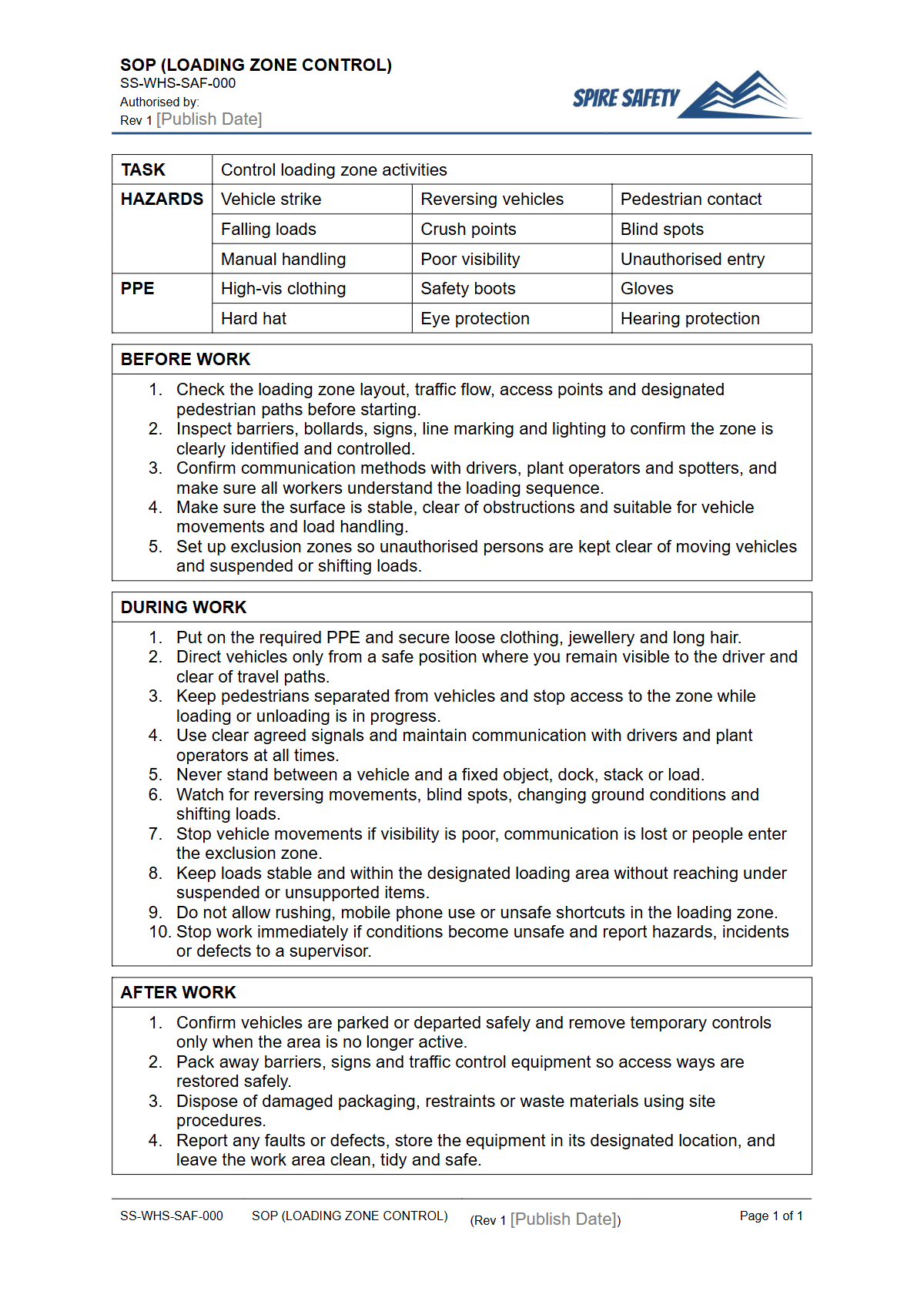
Purpose of the Free Safe Operating Procedure (Loading Zone Control) Template
This Free Safe Operating Procedure (Loading Zone Control) Template provides a structured framework for managing the high-risk activities associated with loading and unloading vehicles. Establishing clear rules for traffic flow, pedestrian segregation, and communication is fundamental to preventing incidents in these busy areas.
This SOP forms a critical component of a comprehensive WHS management system, helping your organisation meet its duty of care.
The primary purpose of this Safe Operating Procedure is to outline a safe and systematic method for controlling vehicle and pedestrian movement within a designated loading zone. It aims to minimise risks such as collisions between vehicles, plant, and people; falls from vehicles; and injuries from moving or falling objects.
The document details key safety elements, including designated traffic routes, speed limits, exclusion zones, personal protective equipment (PPE) requirements, and communication protocols. For sites utilising specific machinery, this general procedure should be supported by equipment-specific documents, such as a detailed Telehandler SOP.
Video walkthrough
How to use the Free Safe Operating Procedure (Loading Zone Control) Template
This template is provided in both DOCX and PDF formats for your convenience. To use it effectively, download the DOCX file and adapt it to the specific layout, equipment, and risks of your workplace's loading zone.
You will need to conduct a thorough risk assessment to identify all potential hazards and implement suitable control measures based on the hierarchy of control.
Important: Customise to Your Workplace
This is a template only. We've created it as a structured starting point aligned with Australian WHS practice, but you must customise it by adding your company name, logo, and site-specific details.
Review every section to ensure it accurately reflects your operational procedures, the types of vehicles used, the specific layout of the area, and the control measures you have in place. Generic procedures are insufficient for managing WHS risks effectively. Regular reviews of your documented procedures should be part of your safety assurance activities, such as internal or external WHS compliance audits.
When to use this Safe Operating Procedure
A Loading Zone Control SOP should be implemented and actively used in any workplace where vehicles and mobile plant are loaded or unloaded. This includes warehouses, distribution centres, manufacturing facilities, construction sites, and retail loading docks.
It should be used as the primary reference document for inducting new workers, delivery drivers, and contractors into the site's traffic management rules. The procedure must also be reviewed and referenced during incident investigations, near-miss reporting, and regular safety meetings to reinforce safe work practices. For tasks that involve working at height, even at low levels like accessing a truck flatbed, ensure it is supported by other relevant procedures like a step ladder SOP.
Who should use this Safe Operating Procedure
This procedure is intended for use by multiple groups within an organisation.
- Managers and Supervisors: To implement, enforce, and monitor compliance with loading zone safety rules.
- WHS/HSE Professionals: To develop, review, and integrate the SOP into the broader safety management system.
- Workers and Plant Operators: As a clear guide on how to perform their tasks safely within the loading zone.
- Traffic Controllers/Spotters: To understand their specific roles and responsibilities in directing traffic and ensuring segregation.
- Visiting Drivers and Contractors: As a key part of their site induction process to ensure they operate in accordance with your site's safety protocols.
Ensuring all personnel are trained on the procedure, including emergency actions, is vital. Having clear processes for responding to incidents, such as a defibrillator operation SOP, is a crucial part of a site's overall preparedness.
By implementing and consistently applying a robust SOP for loading zone control, your organisation can significantly reduce the risk of serious incidents. For more tools to support your safety systems, explore our complete free WHS resources library.
Common mistakes
Common mistakes to avoid
- Assuming drivers from other companies are aware of your specific site rules.
- Failing to physically segregate pedestrian footpaths from vehicle operating areas.
- Providing inadequate lighting for night-time or early morning operations, increasing blind spots.
- Not reviewing and updating the procedure after an incident, near miss, or change in layout.
Legal references
Legal considerations
The following legal requirements may be relevant to this type of work.
- Work Health and Safety Act (Harmonised) — Provides the primary duties for protecting workers and other people from work health and safety risks.
- Work Health and Safety Regulations (Harmonised) — Sets out requirements supporting the management of workplace hazards and risks.
The following codes may be relevant to this type of work.
- Managing WHS Risks Code of Practice — Provides practical guidance on identifying hazards, assessing risks and applying effective controls.
- Work Health and Safety Consultation, Cooperation and Coordination Code of Practice — Provides practical guidance on consulting workers and coordinating with other duty holders.
- Managing the Work Environment and Facilities Code of Practice — Provides practical guidance on safe work environments, workplace facilities and related controls.
Did you know
High-Risk Interaction
Safe Work Australia data consistently shows that incidents involving being hit by moving objects, primarily vehicles, are a leading cause of workplace fatalities and serious injuries in Australia. Loading zones are a key area where these interactions occur.
The Hierarchy of Control
The most effective loading zone controls involve physically separating pedestrians and vehicles (an engineering control), such as with dedicated walkways and barriers. This is far more effective than relying solely on administrative controls like signage and high-vis vests.
FAQ
Frequently asked questions
01What is a loading zone control SOP?
02Why is traffic management important in loading zones?
03Who is responsible for enforcing loading zone procedures?
04Should contractors be inducted on our loading zone SOP?
Share this resource
Free Safe Operating Procedure (Loading Zone Control) Template
Browse Categories
How To Use It
- 1Download and open in Word or PDF.
- 2Replace the placeholders with your business details.
- 3Get it reviewed by a WHS specialist before rollout.
Need it customised?
Our WHS consultants can adapt this template to your site, run a gap analysis, or audit what you already have in place.
Book a Free Consultation WHS consulting servicesor call 1300 156 382
Related templates
- Free Safe Operating Procedure (Lobby Floor Cleaning) Template
- Free Safe Operating Procedure (Lock and Key Control) Template
- Free Safe Operating Procedure (Locker Room Cleaning) Template
- Free Safe Operating Procedure (Lockformer Machine) Template
- Free Safe Operating Procedure (Lockout Tagout) Template
- Free Safe Operating Procedure (Log Grapple) Template