
Free Safe Operating Procedure (Lobby Floor Cleaning) Template
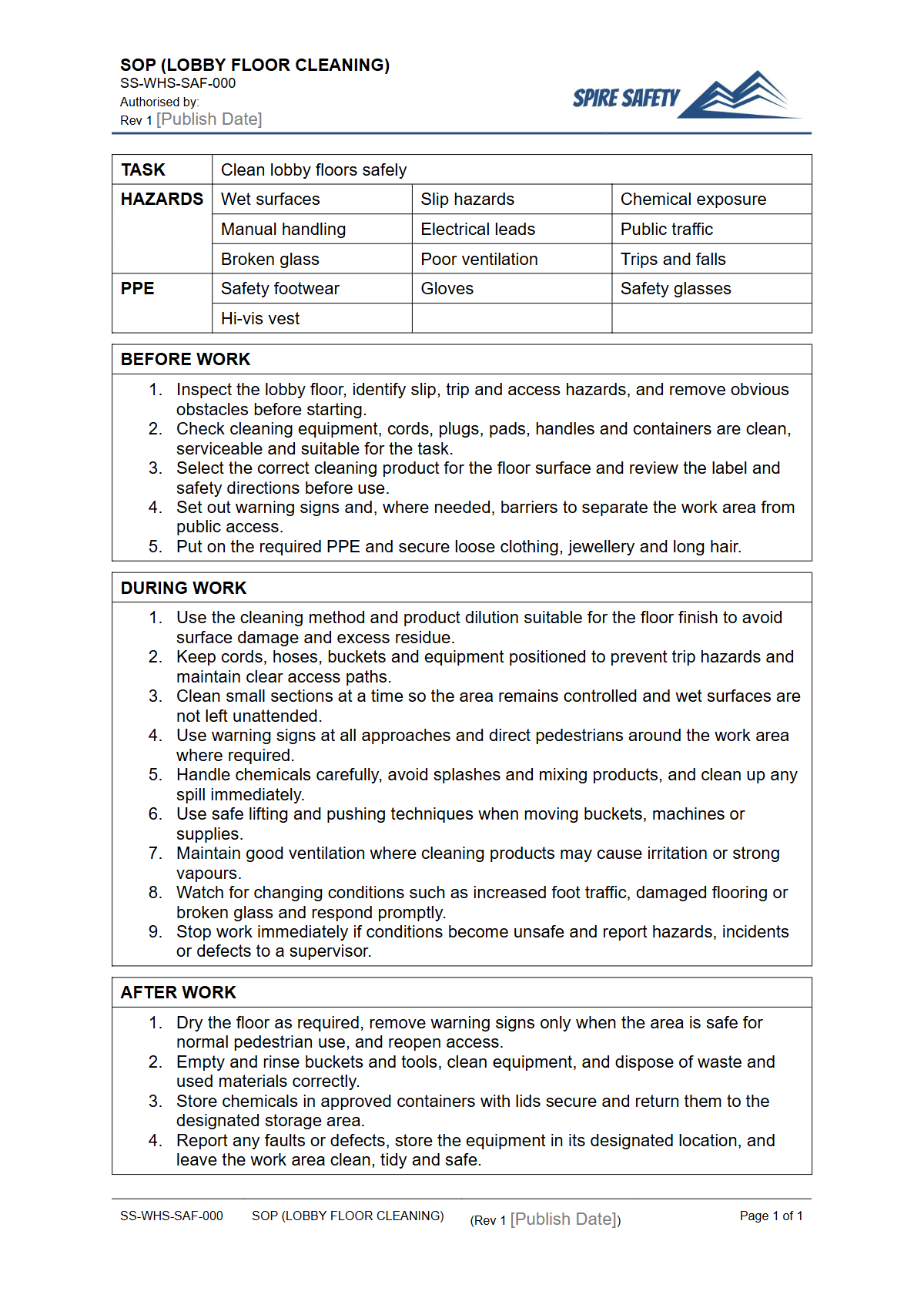
Download our Free Safe Operating Procedure for Lobby Floor Cleaning. This template helps outline safe work methods for cleaning high-traffic areas.
Free Safe Operating Procedure (Lobby Floor Cleaning) Template
DOCX • 126 KB + PDF
Updated Oct 2026
No signup required
Purpose of the Free Safe Operating Procedure (Lobby Floor Cleaning) Template
The primary purpose of this Safe Operating Procedure for Lobby Floor Cleaning is to provide clear, step-by-step instructions to minimise health and safety risks. By formally documenting the process, you can standardise cleaning operations across all staff and shifts, significantly reducing the likelihood of incidents.
It serves as a key part of your risk management strategy, addressing hazards such as wet and slippery surfaces, incorrect use of cleaning chemicals, ergonomic injuries from manual handling, and interactions with building occupants or the public.
A well-defined SOP is also essential for demonstrating due diligence and forms a fundamental part of a robust safety framework. For cleaning tasks that may require working at height, such as reaching high windows or fixtures, a separate step ladder SOP should be developed and referenced within your documentation.
Video walkthrough
How to use the Free Safe Operating Procedure (Lobby Floor Cleaning) Template
Download the template in your preferred format—DOCX for easy editing or PDF for straightforward printing—and begin adapting it to your specific operational needs. A generic procedure is not sufficient; you must review and modify every section to reflect the unique environment of your lobby, the specific cleaning equipment used, and the chemicals on site. For example, if your team uses mechanised equipment, you will need to incorporate details from a specific safe operating procedure for floor scrubber operation.
Customisation is Essential
We cannot stress this enough: you must customise this template. Involve your cleaning staff in the customisation process—their hands-on experience is invaluable for creating a practical and effective document.
Walk through the job steps on-site, identify all potential hazards, and agree on the safest control measures. Ensure the final Safe Operating Procedure lists the correct Personal Protective Equipment (PPE), emergency procedures, and contact information relevant to your business.
When to use a Safe Operating Procedure
This Safe Operating Procedure should be the go-to document for any task involving lobby floor cleaning. It is a critical tool for worker induction, ensuring new employees understand the established safe methods from their first day.
It should also be used for regular refresher training and competency assessments to maintain high safety standards.
Before starting a cleaning shift, workers can use it as a pre-start checklist to ensure all safety measures, such as deploying 'wet floor' signs and checking equipment, are in place. Furthermore, the SOP should be reviewed and updated during formal WHS compliance audits or whenever there is a change in process, equipment, or legislation, to ensure it remains current and effective.
Who should use this document
This document is designed for several key roles within an organisation. Integrating SOPs into daily operations is a core component of effective WHS management systems.
Cleaning Staff & Operators
Frontline workers are the primary users. They must read, understand, and follow the procedure every time they perform the task to ensure their own safety and the safety of others.
Supervisors & Managers
Team leaders and facility managers use the SOP to train staff, supervise work, and investigate any incidents that may occur. They are responsible for ensuring the procedure is followed correctly.
WHS Professionals
Work Health and Safety advisors or officers use the SOP as a tool for risk assessment, training development, and auditing. They often lead the development and review process.
For expert assistance in developing and implementing site-specific safety documentation, businesses can engage specialist WHS consulting services.
PCBUs
Finally, the Person Conducting a Business or Undertaking (PCBU) holds the ultimate responsibility for providing safe work systems. A properly implemented SOP is clear evidence of this commitment. To discover other templates that can support your safety framework, browse our complete free WHS resources library.
Common mistakes
Common mistakes to avoid
- Using a generic template without customising it for the specific workplace, equipment, and chemicals.
- Failing to adequately train workers on the SOP's contents and verify their understanding.
- Not providing or maintaining the Personal Protective Equipment (PPE) specified in the procedure.
- Forgetting to update the SOP after introducing new cleaning agents or machinery.
Legal references
Legal considerations
The following legal requirements may be relevant to this type of work.
- Work Health and Safety Act (Harmonised) — Provides the primary duties for protecting workers and other people from work health and safety risks.
- Work Health and Safety Regulations (Harmonised) — Sets out requirements supporting the management of workplace hazards and risks.
The following codes may be relevant to this type of work.
- Managing WHS Risks Code of Practice — Provides practical guidance on identifying hazards, assessing risks and applying effective controls.
- Work Health and Safety Consultation, Cooperation and Coordination Code of Practice — Provides practical guidance on consulting workers and coordinating with other duty holders.
- Managing the Work Environment and Facilities Code of Practice — Provides practical guidance on safe work environments, workplace facilities and related controls.
Did you know
Slips, Trips, and Falls
According to Safe Work Australia, slips, trips, and falls are a leading cause of serious workplace injuries, with contaminated floors (including those wet from cleaning) being a major contributing factor.
FAQ
Frequently asked questions
01What is the difference between an SOP and a SWMS for floor cleaning?
02How often should an SOP for lobby cleaning be reviewed?
03Do I need a separate SOP for each cleaning chemical used?
04Can this template be used for outdoor area cleaning as well?
Share this resource
Free Safe Operating Procedure (Lobby Floor Cleaning) Template
Browse Categories
How To Use It
- 1Download and open in Word or PDF.
- 2Replace the placeholders with your business details.
- 3Get it reviewed by a WHS specialist before rollout.
Need it customised?
Our WHS consultants can adapt this template to your site, run a gap analysis, or audit what you already have in place.
Book a Free Consultation WHS consulting servicesor call 1300 156 382
Related templates
- Free Safe Operating Procedure (Lock and Key Control) Template
- Free Safe Operating Procedure (Locker Room Cleaning) Template
- Free Safe Operating Procedure (Lockformer Machine) Template
- Free Safe Operating Procedure (Lockout Tagout) Template
- Free Safe Operating Procedure (Log Grapple) Template
- Free Safe Operating Procedure (Log Loader) Template