
Free Safe Operating Procedure (Lock and Key Control) Template
Establish clear protocols for managing workplace keys and locks with our free Safe Operating Procedure (SOP) for Lock and Key Control. Download now.
Free Safe Operating Procedure (Lock and Key Control) Template
DOCX • 126 KB + PDF
Updated Oct 2026
No signup required
Purpose of the Free Safe Operating Procedure (Lock and Key Control) Template
Effective lock and key control is a fundamental component of a safe and secure workplace. Our Free Safe Operating Procedure (Lock and Key Control) Template provides a structured framework for managing access to equipment, restricted areas, and energy sources.
The primary purpose is to prevent unauthorised operation of machinery, theft of assets, and accidental exposure to hazards. By implementing a formal procedure, your organisation can establish a clear chain of custody for keys, ensuring they are only issued to trained and authorised personnel.
This document serves as a critical administrative control within your overall safety framework.
Integrating this procedure is a key step in developing a holistic safety culture. A systematic approach to key management forms part of a comprehensive WHS management system, helping to meet your duty of care obligations under Australian WHS legislation.
It provides a documented, repeatable process that minimises ambiguity and enhances accountability across your teams.
Video walkthrough
How to use the Free Safe Operating Procedure (Lock and Key Control) Template
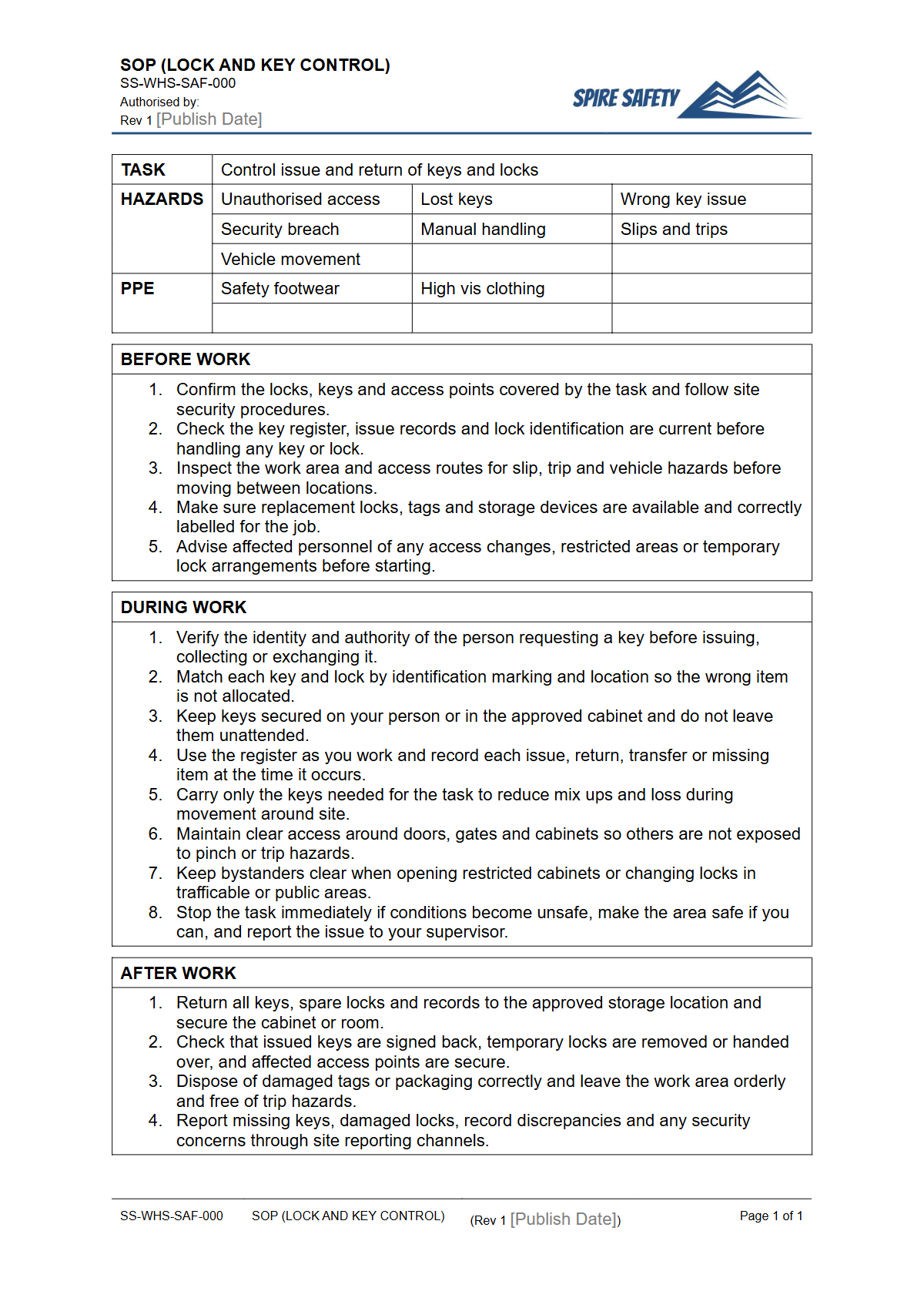
This template is provided in both DOCX and PDF formats for your convenience. The DOCX file is fully editable, allowing you to tailor the content to the specific requirements of your site, including your unique key hierarchy, register format, and personnel roles.
It includes sections for defining responsibilities, outlining the process for key issue and return, managing lost keys, and controlling master or duplicate keys. It is designed as a strong starting point aligned with Australian WHS best practices.
Important: This is a template only. To be effective, you must customise this Safe Operating Procedure to reflect the specific hazards, equipment, key systems, and roles at your workplace.
We are not responsible for any incidents that may occur from the use of this document. A generic procedure is not a substitute for a site-specific risk assessment and system of work.
When to Use a Lock and Key Control SOP
A formal lock and key control procedure should be applied in any situation where controlled access is necessary to manage risk or maintain security. This extends beyond simple lockout/tagout for maintenance.
It is essential for isolating dangerous equipment before cleaning or servicing, such as the high-energy systems detailed in our FREE Plasma Cutter SOP Template. It ensures that only competent operators can use specific plant and machinery.
Other critical applications include:
- Securing storage areas for hazardous chemicals or valuable materials.
- Controlling access to confined spaces or other high-risk zones.
- Managing the keys for a fleet of vehicles or mobile plant to prevent unauthorised use.
- Restricting entry to server rooms, electrical switch rooms, or other sensitive infrastructure areas.
- Ensuring that equipment with stored energy remains isolated, a principle also covered in our Free Air Compressor SOP Template.
Who Should Use This Safe Operating Procedure
Responsibility for implementing and adhering to this SOP is shared across several roles within an organisation. While a Site Manager or WHS Officer may oversee the entire system, its day-to-day success depends on everyone involved.
Regular internal reviews or a formal WHS compliance auditing can help verify that all personnel are following the established procedures correctly and consistently.
Key Roles and Responsibilities:
- Management/Supervisors: Responsible for authorising the procedure, allocating resources, assigning responsibilities, and ensuring all relevant workers are trained.
- Authorised Personnel: Individuals who are trained and deemed competent to be issued keys for specific equipment or areas. They are responsible for the security of their assigned keys.
- Key Custodian/Administrator: The person tasked with maintaining the key register, issuing and receiving keys, and reporting any discrepancies or losses.
- Workers: All employees have a duty to follow the procedure, report lost or damaged keys immediately, and not share or duplicate keys without authorisation.
This SOP should be included in worker induction and regular refresher training, especially for procedures involving powered tools like those in our FREE Circular Saw SOP Template. You can find more templates to support your safety systems in our free WHS resources library.
Common mistakes
Common mistakes to avoid
- Failing to maintain a complete and accurate key register.
- Using non-unique or easily duplicated keys for critical isolation points.
- Storing master keys or spare keys in insecure or obvious locations.
- Neglecting to provide formal training to all personnel on the procedure.
Legal references
Legal considerations
The following legal requirements may be relevant to this type of work.
- Work Health and Safety Act (Harmonised) — Provides the primary duties for protecting workers and other people from work health and safety risks.
- Work Health and Safety Regulations (Harmonised) — Sets out requirements supporting the management of workplace hazards and risks.
The following codes may be relevant to this type of work.
- Managing WHS Risks Code of Practice — Provides practical guidance on identifying hazards, assessing risks and applying effective controls.
- Work Health and Safety Consultation, Cooperation and Coordination Code of Practice — Provides practical guidance on consulting workers and coordinating with other duty holders.
- Managing the Work Environment and Facilities Code of Practice — Provides practical guidance on safe work environments, workplace facilities and related controls.
Did you know
Maintenance on Live Equipment
According to Safe Work Australia, a significant percentage of fatalities involving machinery occur during maintenance, cleaning, and repair. Many of these incidents are due to the failure to properly de-energise and lock out equipment before work begins.
FAQ
Frequently asked questions
01What is the difference between a lock and key control procedure and a lockout/tagout (LOTO) procedure?
02Who is responsible for managing the key register in a workplace?
03How often should a lock and key control SOP be reviewed?
04Can this template be used for securing areas as well as equipment?
Share this resource
Free Safe Operating Procedure (Lock and Key Control) Template
Browse Categories
How To Use It
- 1Download and open in Word or PDF.
- 2Replace the placeholders with your business details.
- 3Get it reviewed by a WHS specialist before rollout.
Need it customised?
Our WHS consultants can adapt this template to your site, run a gap analysis, or audit what you already have in place.
Book a Free Consultation WHS consulting servicesor call 1300 156 382
Related templates
- Free Safe Operating Procedure (Locker Room Cleaning) Template
- Free Safe Operating Procedure (Lockformer Machine) Template
- Free Safe Operating Procedure (Lockout Tagout) Template
- Free Safe Operating Procedure (Log Grapple) Template
- Free Safe Operating Procedure (Log Loader) Template
- Free Safe Operating Procedure (Log Loading) Template