
Free Safe Operating Procedure (Loading Bridge Operation) Template
Download our free Safe Operating Procedure (Loading Bridge Operation) template. This DOCX & PDF resource helps document safe work methods for your team.
Free Safe Operating Procedure (Loading Bridge Operation) Template
DOCX • 126 KB + PDF
Updated Oct 2026
No signup required
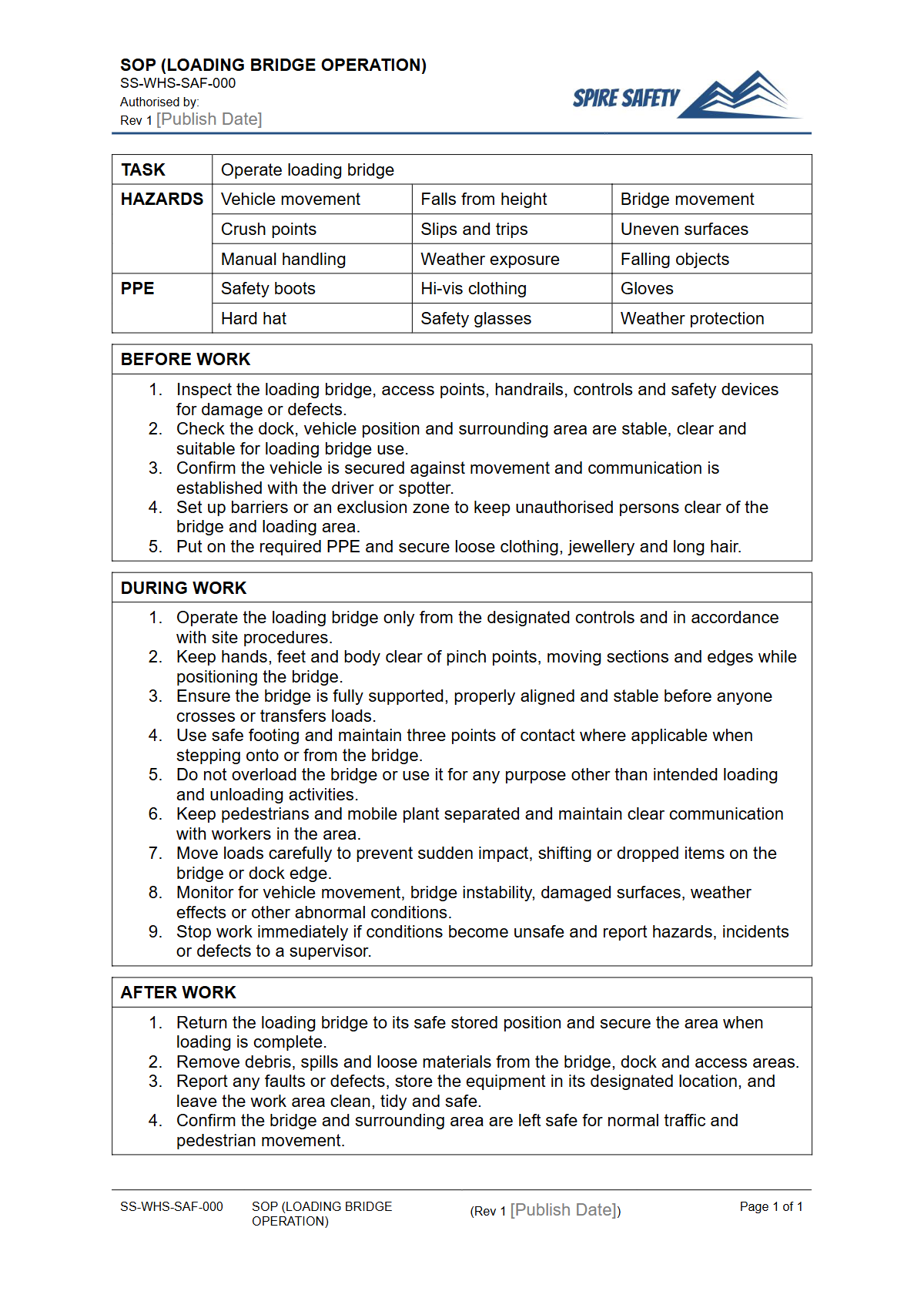
Purpose of the Free Safe Operating Procedure (Loading Bridge Operation) Template
Effectively managing workplace risks during loading and unloading is crucial for any business in transport, logistics, or warehousing. A documented Safe Operating Procedure (SOP) provides clear, step-by-step instructions to ensure tasks are performed safely and consistently.
This Free Safe Operating Procedure (Loading Bridge Operation) Template offers a structured starting point for your organisation to formalise its processes and protect its workers.
The primary purpose of this Safe Operating Procedure for loading bridge operation is to provide a clear, documented process that minimises the risk of injury to personnel and damage to equipment. By outlining pre-operational checks, safe operating steps, and emergency responses, the SOP helps standardise behaviour and ensures all workers are aware of the known hazards.
Implementing robust SOPs is a key component of an effective WHS management system, demonstrating a commitment to proactive risk control.
Video walkthrough
How to use the Free Safe Operating Procedure (Loading Bridge Operation) Template
This template is provided in both DOCX and PDF formats for your convenience. To get started, download the document and carefully review its contents against your specific operational needs.
The procedure should be adapted to reflect the make and model of your loading bridge, the layout of your loading dock, and the types of vehicles you service. You can also incorporate other specific site procedures, such as traffic management rules.
A well-written SOP can be used as a practical training tool, but a simple document is not enough; you will also need a process for verifying competency. Standardising procedures for all equipment, as seen in our Free Safe Operating Procedure (Conveyor Belt Operation) Template, is essential for a consistent safety culture.
Important: Customisation is Essential
Please note: This is a template, not a finished document. We have designed it as a starting point, and you must customise it to reflect the specific equipment, environment, and risks present in your workplace.
A generic procedure that doesn't align with your actual operations may not be effective in controlling risks.
When to use a Loading Bridge Safe Operating Procedure
A Loading Bridge Operation SOP should be readily available and referenced in several key situations. It is essential during the induction and training of new employees who will be required to operate or work near the loading bridge.
It also serves as a critical refresher tool for existing staff and should be reviewed before undertaking non-routine tasks involving the bridge. Furthermore, the SOP forms a baseline for incident investigations and regular safety inspections.
Who should use this template
This procedure is intended for use by all personnel involved with loading dock operations. This includes warehouse operators, forklift drivers, truck drivers, and supervisors responsible for overseeing these activities.
WHS managers and safety officers will find the template useful for developing and implementing safety documentation. It also serves as a key piece of evidence during a WHS compliance audit to demonstrate that safe systems of work are in place.
Key Elements of a Loading Bridge SOP
A comprehensive SOP for loading bridge operation should cover several critical areas to be effective. Ensure your customised document includes:
Pre-Operational Checks
- A checklist to verify the structural integrity of the bridge, including the deck, lip, and bumpers.
- Confirmation that the operating controls (hydraulic or manual) are functioning correctly.
- An inspection of the area to ensure it is clear of obstructions and personnel.
Safe Operation Steps
- Sequenced instructions for positioning the vehicle and securing it with wheel chocks or vehicle restraints.
- Clear steps for deploying the loading bridge onto the truck bed and ensuring it is securely seated.
- Guidelines on maximum load capacity and safe movement of material handling equipment (e.g., forklifts, pallet jacks) across the bridge.
Post-Operation Procedures
- Instructions for safely storing the loading bridge after use.
- Procedures for removing vehicle restraints and signalling to the driver that it is safe to depart.
- Housekeeping requirements to keep the loading dock area clean and free of hazards.
Similar to the detailed steps needed for heavy machinery documented in a Grader SOP (Safe Operating Procedure) Template, specificity is key to preventing incidents.
Integrating the SOP into Your Safety System
An SOP is most effective when it is part of a broader, integrated safety management system. It should be supported by practical training, competency assessments, and regular supervision.
Consider incorporating this procedure into your risk register and using it as a foundation for toolbox talks on loading dock safety. For assistance in developing a comprehensive safety framework that goes beyond individual documents, consider engaging professional WHS consulting services.
This ensures your safety efforts are systematic, strategic, and aligned with legislative requirements. You can find more templates and guides in our free WHS resources library to help build out your system.
Common mistakes
Common mistakes to avoid
- Failing to conduct pre-operational checks on the bridge's structure and controls.
- Neglecting to secure the vehicle properly with wheel chocks or restraints before deploying the bridge.
- Using a generic SOP that doesn't account for site-specific hazards like slope, weather, or traffic.
- Assuming all workers understand the procedure without providing formal training and competency assessment.
Legal references
Legal considerations
The following legal requirements may be relevant to this type of work.
- Work Health and Safety Act (Harmonised) — Provides the primary duties for protecting workers and other people from work health and safety risks.
- Work Health and Safety Regulations (Harmonised) — Sets out requirements supporting the management of workplace hazards and risks.
The following codes may be relevant to this type of work.
- Managing WHS Risks Code of Practice — Provides practical guidance on identifying hazards, assessing risks and applying effective controls.
- Work Health and Safety Consultation, Cooperation and Coordination Code of Practice — Provides practical guidance on consulting workers and coordinating with other duty holders.
- Managing the Work Environment and Facilities Code of Practice — Provides practical guidance on safe work environments, workplace facilities and related controls.
Did you know
Loading Dock Dangers
According to Safe Work Australia, the transport, postal, and warehousing industry has one of the highest rates of serious injury claims. A significant number of these incidents occur in and around loading docks.
FAQ
Frequently asked questions
01Is a Safe Operating Procedure a legal requirement for loading bridges in Australia?
02What's the difference between a SWMS and an SOP for a loading bridge?
03How often should we review our loading bridge SOP?
04Can this template be used for all types of loading bridges?
Share this resource
Free Safe Operating Procedure (Loading Bridge Operation) Template
Browse Categories
How To Use It
- 1Download and open in Word or PDF.
- 2Replace the placeholders with your business details.
- 3Get it reviewed by a WHS specialist before rollout.
Need it customised?
Our WHS consultants can adapt this template to your site, run a gap analysis, or audit what you already have in place.
Book a Free Consultation WHS consulting servicesor call 1300 156 382
Related templates
- Free Safe Operating Procedure (Loading Dock Gate) Template
- Free Safe Operating Procedure (Loading Dock Handover) Template
- Free Safe Operating Procedure (Loading Zone Control) Template
- Free Safe Operating Procedure (Lobby Floor Cleaning) Template
- Free Safe Operating Procedure (Lock and Key Control) Template
- Free Safe Operating Procedure (Locker Room Cleaning) Template