
Free Safe Operating Procedure (Conveyor Belt Operation) Template
Download our free Safe Operating Procedure (SOP) template for conveyor belt operation. A structured starting point to document your safety process.
Free Safe Operating Procedure (Conveyor Belt Operation) Template
DOCX • 155 KB + PDF
Updated Oct 2026
No signup required
Purpose of the Free Safe Operating Procedure (Conveyor Belt Operation) Template
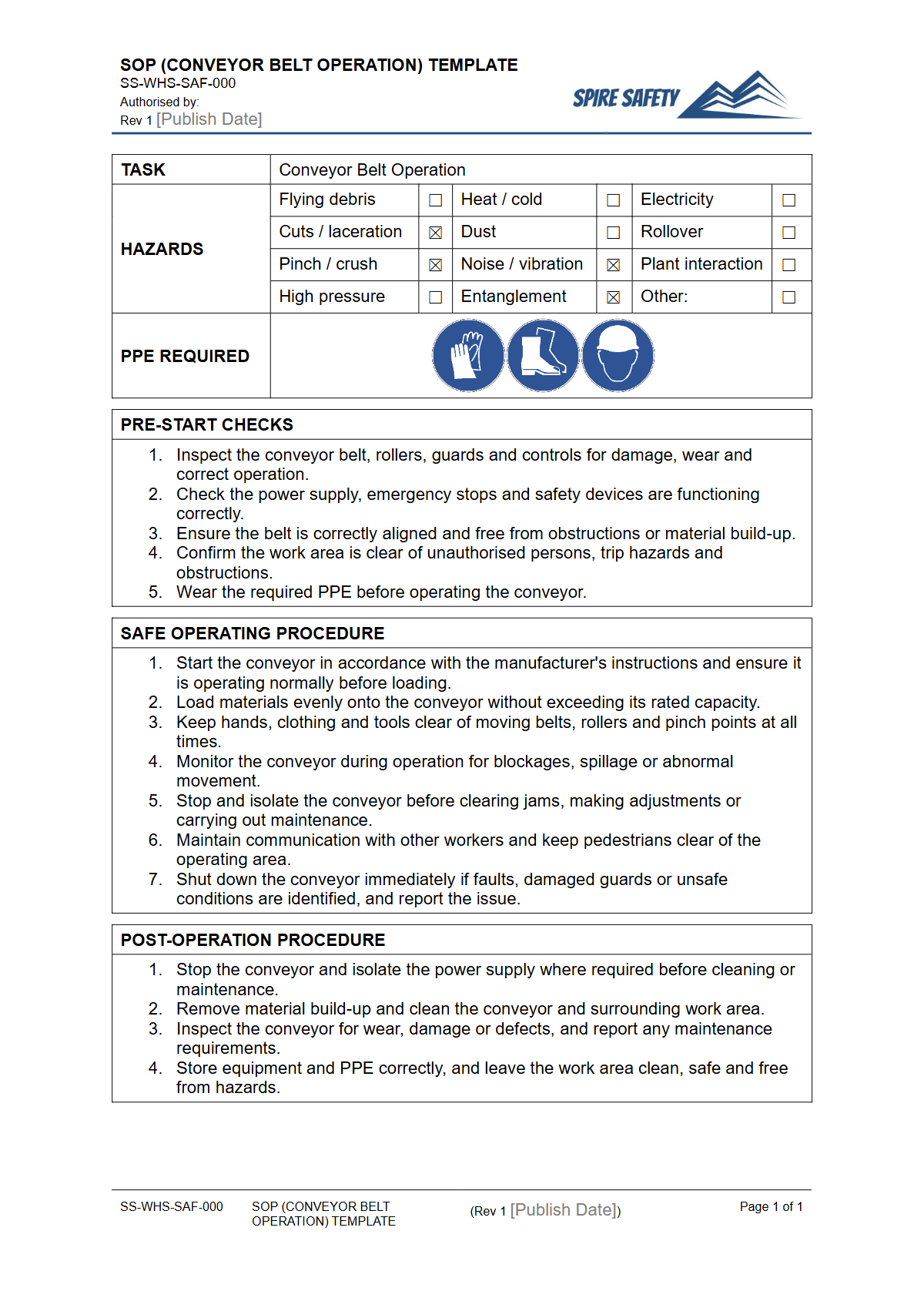
Effectively managing the risks associated with conveyor belts is a critical part of workplace safety in many industries, from manufacturing and logistics to mining and agriculture. Our Free Safe Operating Procedure (Conveyor Belt Operation) Template provides a structured framework for documenting the safe use of this equipment.
This document guides you in establishing clear, step-by-step instructions that help prevent incidents related to entanglement, crushing, and manual handling. Using a formal Safe Operating Procedure (SOP) is a key part of creating a safe system of work, demonstrating your organisation's commitment to protecting its workers.
Key Hazards to Address
When customising this template, focus on the specific hazards of your conveyor system. Common risks include nip points where the belt meets rollers, moving parts on motors and drives, and points where workers can be caught or dragged.
The SOP should detail controls for these hazards, such as the mandatory use of physical guarding, the location and testing of emergency stops, and robust lockout/tagout (LOTO) procedures for all cleaning, maintenance, and clearing of blockages. In environments with heavy machinery, consider the interaction between equipment; for instance, the procedures for loading materials onto a conveyor using a dozer should be clearly defined, similar to the process outlined in our FREE Dozer SOP Template.
Video walkthrough
How to use the Free Safe Operating Procedure (Conveyor Belt Operation) Template
This template is provided as a starting point, aligned with Australian WHS best practices. Download the DOCX file to edit and adapt it to your specific workplace, equipment, and operational needs.
The PDF version is a useful, non-editable reference. A comprehensive SOP is a fundamental component of a robust safety framework, often integrated within broader WHS management systems to ensure consistency and accountability across all high-risk tasks.
Completing the Template
Work through each section, replacing the placeholder text with detailed, site-specific information. Consult directly with experienced operators, maintenance staff, and supervisors who interact with the conveyor system daily.
Their practical knowledge is invaluable for creating a procedure that is both safe and workable. The most effective SOPs are clear, concise, and easily understood by the workers who need to follow them.
If you require expert assistance in tailoring this or other safety documents, our WHS consulting team can provide tailored support.
Important Note: This is a template, not a completed document. To be effective, you must customise it with your own site-specific details, machinery models, risk assessments, and control measures.
We are not responsible for the implementation or outcome of your final document.
When to use a Conveyor Belt Safe Operating Procedure
An SOP for conveyor belt operation should be used as a primary reference tool in several key situations. It forms the basis for initial worker training and for conducting competency assessments before an employee is authorised to operate, clean, or maintain the equipment.
It should also be readily available at the work area for quick reference. The SOP is a living document and should be reviewed during safety meetings, after any near-miss or incident, and when any part of the conveyor system or its use-case changes. Regular reviews help ensure the procedures remain relevant and effective, a process that can be verified through formal WHS compliance auditing.
Who should use this Safe Operating Procedure
This Safe Operating Procedure is intended for use by multiple roles within an organisation. WHS Managers and Site Supervisors are responsible for ensuring the procedure is developed, implemented, and reviewed.
They must also ensure all relevant workers are trained on its contents. Equipment operators and maintenance personnel are the primary end-users, required to follow the outlined steps to perform their tasks safely.
Ultimately, the Person Conducting a Business or Undertaking (PCBU) holds the primary duty of care and is responsible for providing the safe systems of work that this SOP helps to define. This principle applies to all high-risk plant, from conveyors to heavy vehicles detailed in resources like the FREE Front End Loader SOP Template.
By consistently applying and reviewing this procedure, your organisation can significantly reduce the risk of incidents. Explore our complete free WHS resources library for more templates and guides to support your safety management system.
Common mistakes
Common mistakes to avoid
- Using a generic SOP without customising it for the specific type of conveyor and workplace.
- Failing to consult with operators and maintenance staff who use the equipment when drafting the procedure.
- Not providing adequate training on the SOP's contents, particularly emergency and isolation procedures.
- Neglecting to schedule and conduct regular reviews and updates, leading to an outdated and irrelevant document.
Legal references
Legal considerations
The following legal requirements may be relevant to this type of work.
- Work Health and Safety Act (Harmonised) — Provides the primary duties for protecting workers and other people from work health and safety risks.
- Work Health and Safety Regulations (Harmonised) — Sets out requirements supporting the management of workplace hazards and risks.
The following codes may be relevant to this type of work.
- Managing WHS Risks Code of Practice — Provides practical guidance on identifying hazards, assessing risks and applying effective controls.
- Work Health and Safety Consultation, Cooperation and Coordination Code of Practice — Provides practical guidance on consulting workers and coordinating with other duty holders.
- Managing the Work Environment and Facilities Code of Practice — Provides practical guidance on safe work environments, workplace facilities and related controls.
Did you know
Leading Cause of Injury
The most serious conveyor-related injuries often involve workers being caught in or compressed by machinery, especially during maintenance, cleaning, or when trying to clear jams without proper isolation.
Lockout/Tagout is Critical
A significant portion of conveyor incidents occur when the system is thought to be de-energised but is not. A robust Lockout/Tagout (LOTO) procedure is non-negotiable for any task requiring a worker to enter a danger zone.
FAQ
Frequently asked questions
01What is a Safe Operating Procedure for a conveyor belt?
02Is a conveyor belt SOP a legal requirement in Australia?
03How often should a conveyor belt SOP be reviewed?
04Who is responsible for writing a conveyor belt SOP?
Share this resource
Free Safe Operating Procedure (Conveyor Belt Operation) Template
Browse Categories
How To Use It
- 1Download and open in Word or PDF.
- 2Replace the placeholders with your business details.
- 3Get it reviewed by a WHS specialist before rollout.
Need it customised?
Our WHS consultants can adapt this template to your site, run a gap analysis, or audit what you already have in place.
Book a Free Consultation WHS consulting servicesor call 1300 156 382
Related templates
- Free Safe Operating Procedure (Cooking Oil Storage) Template
- Free Safe Operating Procedure (Cooking Oil Transfer) Template
- Free Safe Operating Procedure (Cool Room Access) Template
- Free Safe Operating Procedure (Coolant Change) Template
- Free Safe Operating Procedure (Cooling Coil Cleaning) Template
- Free Safe Operating Procedure (Cooling Tower Blowdown) Template