
Free Safe Operating Procedure (Cool Room Access) Template
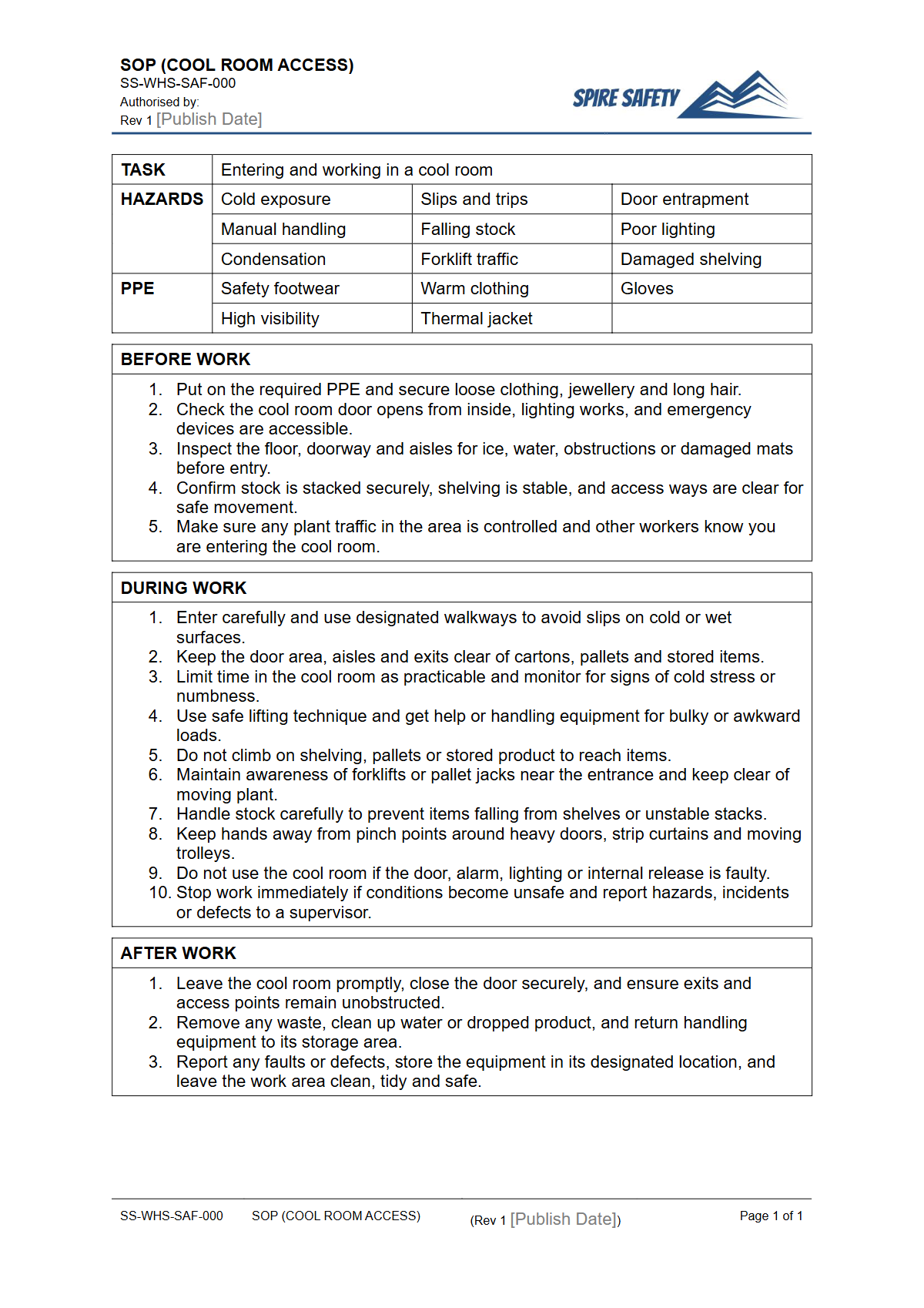
Clearly define the steps for safely entering and working in cool rooms. Download our free Safe Operating Procedure (Cool Room Access) template to get started.
Free Safe Operating Procedure (Cool Room Access) Template
DOCX • 126 KB + PDF
Updated Oct 2026
No signup required
Purpose of the Free Safe Operating Procedure (Cool Room Access) Template
Working in and around cool rooms presents unique health and safety risks, including cold stress, slips on icy surfaces, manual handling injuries, and the potential for entrapment. This Free Safe Operating Procedure (Cool Room Access) Template provides a structured framework for organisations to document safe work practices.
By clearly outlining the step-by-step process for accessing and working within these environments, you can establish clear expectations, support worker training, and demonstrate a commitment to risk management.
A well-developed Safe Operating Procedure (SOP) is a critical document for controlling hazards at their source. It serves as a practical tool for supervisors to monitor safe work practices and for workers to understand their responsibilities.
Integrating this procedure is a key part of building effective WHS management systems that protect your people and your business.
Video walkthrough
How to use the Free Safe Operating Procedure (Cool Room Access) Template
This template is available for download as a DOCX file for easy editing, as well as a print-ready PDF. The goal is to provide a solid foundation, not a final document.
It is crucial that you adapt the content to the specific conditions of your workplace.
Important: You must customise this Safe Operating Procedure to reflect your specific site, equipment (e.g., door types, alarm systems), personnel, and the findings of your site-specific risk assessment. We have designed this template to align with Australian WHS principles, but it is your organisation's responsibility to ensure the final document is accurate and fit for purpose.
Involve your workers and supervisors in the customisation process to ensure the procedure is practical and understood by everyone who will use it.
When to use this Safe Operating Procedure
A specific SOP for cool room access should be used in several key situations. It forms the basis of training for new employees during their induction and should be a focal point for regular refresher training for all relevant staff.
It is also an essential document to reference when reviewing work practices following an incident, a near-miss, or a reported hazard. Furthermore, the SOP should be reviewed and updated whenever there are changes to the cool room environment, such as the installation of new racking, changes in work processes, or the introduction of new products that affect manual handling.
If your cool room is part of a larger logistics or food processing line, you may need to integrate multiple procedures for a complete safety picture. For example, managing the interface between storage and movement might require our free Conveyer System SOP template to ensure risks are controlled from end to end.
Who should use it
This procedure is intended for use by anyone whose work requires them to enter or interact with a cool room. This includes a wide range of roles across various industries, from hospitality and food service staff to warehouse operators and maintenance personnel.
Supervisors and managers have a responsibility to ensure the procedures are implemented and followed, using the SOP as a tool for workplace inspections and performance discussions. WHS representatives and committee members will also find the template useful for developing and reviewing safety documentation as part of their function.
For larger logistics operations where pallets are moved into cool rooms using machinery, you should also consult specific plant procedures. You can use resources like our FREE Telehandler SOP Template to manage associated plant risks.
Key Hazards in Cool Room Operations
Effectively managing cool room safety means recognising and controlling a specific set of hazards. Customising this template requires a thorough understanding of the risks present in your environment, which typically include:
- Cold Stress: Exposure to low temperatures can lead to hypothermia, frostbite, and impaired judgement and coordination, increasing the risk of other injuries.
- Slips, Trips & Falls: Condensation, spills, and ice build-up on floors create highly hazardous slippery surfaces. Poor lighting can exacerbate this risk.
- Manual Handling: Lifting, carrying, and moving stock in a cold environment can increase the risk of musculoskeletal injuries. Cold can make muscles less flexible and workers may have their grip or movement restricted by PPE.
- Entrapment: This is a critical risk. Workers can be accidentally trapped inside by faulty or self-locking doors. A failure of internal release mechanisms or alarm systems can have severe consequences.
- Air Quality: Depending on the refrigeration system, there may be a risk of exposure to refrigerants like ammonia, which can be toxic. Poor ventilation can also be a concern.
Addressing these complex hazards effectively can be challenging. Our WHS consulting services can provide expert guidance to help you conduct thorough risk assessments and develop robust safety controls for your specific operations.
You can also explore our free WHS resources library for more templates and guides on related topics.
Common mistakes
Common mistakes to avoid
- Assuming workers understand the risks without providing formal, task-specific training.
- Failing to regularly inspect and test door seals, internal release mechanisms, and emergency alarms.
- Allowing ice or condensation to build up on floors, creating severe slip hazards.
- Not scheduling adequate warm-up breaks for staff working for extended periods in the cold.
Legal references
Legal considerations
The following legal requirements may be relevant to this type of work.
- Work Health and Safety Act (Harmonised) — Provides the primary duties for protecting workers and other people from work health and safety risks.
- Work Health and Safety Regulations (Harmonised) — Sets out requirements supporting the management of workplace hazards and risks.
The following codes may be relevant to this type of work.
- Managing WHS Risks Code of Practice — Provides practical guidance on identifying hazards, assessing risks and applying effective controls.
- Work Health and Safety Consultation, Cooperation and Coordination Code of Practice — Provides practical guidance on consulting workers and coordinating with other duty holders.
- Managing the Work Environment and Facilities Code of Practice — Provides practical guidance on safe work environments, workplace facilities and related controls.
Did you know
Entrapment Risk
Modern cool rooms are required by the National Construction Code to have an internal release mechanism and an alarm system that can be operated from inside, even during a power failure.
Cold Stress
Workers can begin to suffer the effects of cold stress in temperatures as high as 10-15°C, particularly if the work is sedentary or if drafts are present.
FAQ
Frequently asked questions
01What should be included in a cool room SOP?
02How often should cool room safety procedures be reviewed?
03Is special training required for working in a cool room?
04What PPE is necessary for cool room access?
Share this resource
Free Safe Operating Procedure (Cool Room Access) Template
Browse Categories
How To Use It
- 1Download and open in Word or PDF.
- 2Replace the placeholders with your business details.
- 3Get it reviewed by a WHS specialist before rollout.
Need it customised?
Our WHS consultants can adapt this template to your site, run a gap analysis, or audit what you already have in place.
Book a Free Consultation WHS consulting servicesor call 1300 156 382
Related templates
- Free Safe Operating Procedure (Coolant Change) Template
- Free Safe Operating Procedure (Cooling Coil Cleaning) Template
- Free Safe Operating Procedure (Cooling Tower Blowdown) Template
- Free Safe Operating Procedure (Cooling Tower Cleaning) Template
- Free Safe Operating Procedure (Cooling Tower Dosing) Template
- Free Safe Operating Procedure (Core Drill) Template