
Free Safe Operating Procedure (Cooling Tower Cleaning) Template
Effectively manage the serious health and safety risks of cooling tower maintenance, including Legionella exposure. Download your free SOP template now.
Free Safe Operating Procedure (Cooling Tower Cleaning) Template
DOCX • 126 KB + PDF
Updated Oct 2026
No signup required
Purpose of the Free Safe Operating Procedure (Cooling Tower Cleaning) Template
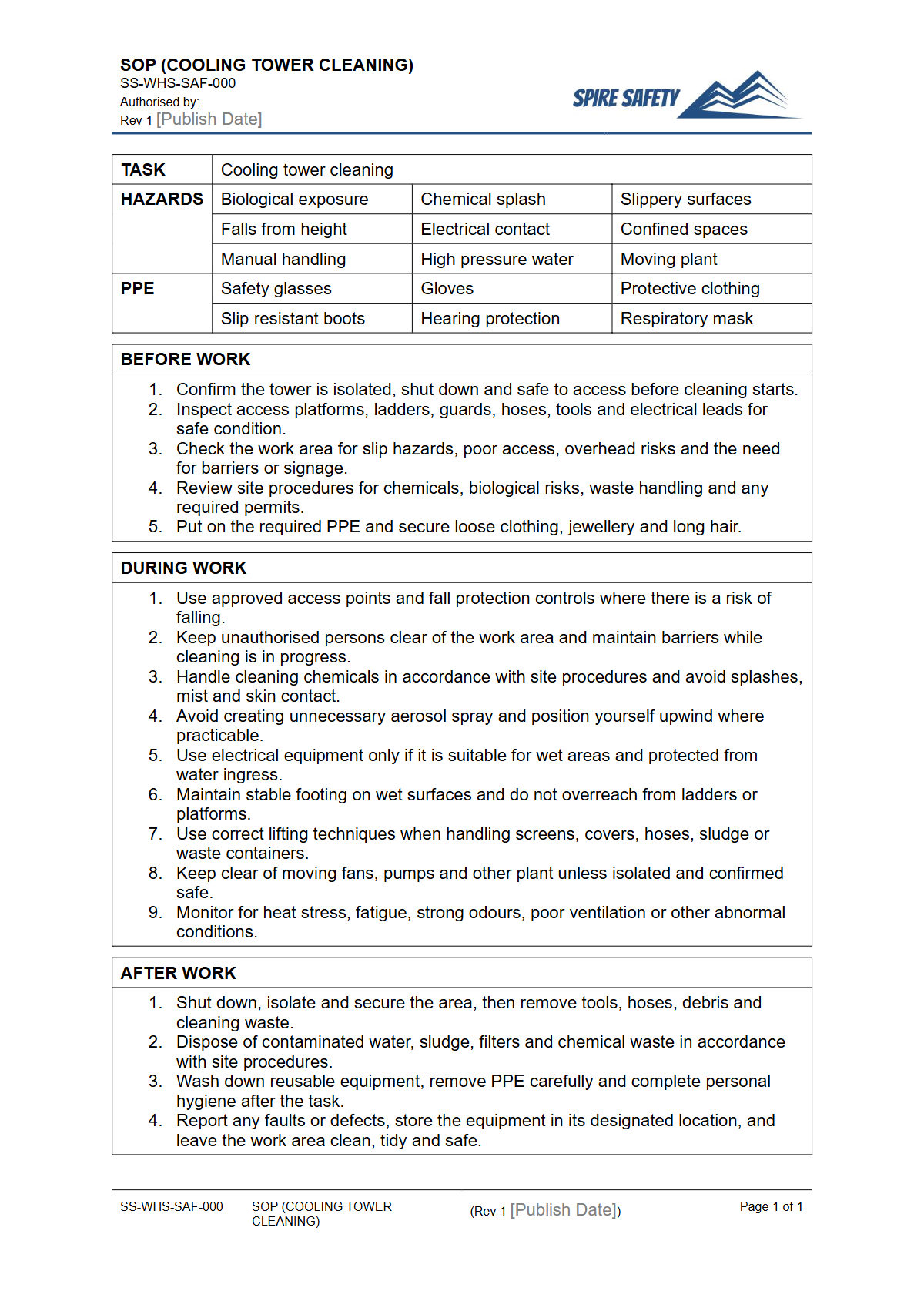
Effectively managing the risks associated with cooling tower maintenance is a critical WHS responsibility. This free Safe Operating Procedure (Cooling Tower Cleaning) Template provides a structured starting point for developing a documented process to protect your workers.
Cooling towers present significant hazards, most notably the risk of exposure to Legionella bacteria, which can cause the potentially fatal Legionnaires' disease. This SOP helps you outline the step-by-step process for cleaning, disinfection, and maintenance, ensuring tasks are performed consistently and safely every time.
A documented SOP is a key part of demonstrating a safe system of work. It helps in controlling biological hazards, managing exposure to hazardous chemicals used in water treatment, and mitigating physical risks like slips, falls, and electrical hazards during maintenance.
Using a formal procedure ensures that all personnel recognise the hazards and follow the correct control measures. This template can be adapted for various systems, forming part of a broader safety framework that may also cover other fixed plant, such as documented in our Free Air Compressor SOP.
Video walkthrough
How to use the Free Safe Operating Procedure (Cooling Tower Cleaning) Template
To use this Safe Operating Procedure, download the DOCX file and adapt it to your specific workplace. Your customisation should detail the make and model of your cooling tower system, the specific chemicals used for treatment and cleaning, and the unique environmental conditions of your site.
It is crucial to conduct a site-specific risk assessment to identify all potential hazards and implement appropriate controls, which should then be documented within this SOP.
Important: This document is a template designed to be a starting point. It is not a complete, ready-to-use procedure.
You must customise this SOP to reflect the specific equipment, chemicals, processes, and risks present in your workplace. We strongly recommend that a competent person, with experience in water systems and hazard management, reviews, customises, and approves the final document before it is implemented. Integrating procedures like this into your safety framework is a core part of building effective WHS management systems.
What should be included in your Safe Operating Procedure?
A comprehensive SOP for cooling tower cleaning should go beyond just the cleaning steps. To be effective, your procedure should include:
- Pre-start Checks: Including energy isolation (lockout-tagout), ensuring ventilation, and checking chemical safety data sheets (SDS).
- Personal Protective Equipment (PPE): Specify the exact PPE required, such as P2 respiratory protection, chemical-resistant gloves, eye protection, and non-slip footwear.
- Step-by-Step Cleaning and Disinfection Process: A clear, sequential guide from draining the system to refilling and treating it.
- Chemical Handling: Safe methods for storing, mixing, and applying water treatment chemicals.
- Emergency Procedures: Steps to take in case of a chemical spill, exposure, or other incident.
- Post-Cleaning Checks & Record Keeping: What to inspect after the job is done and how to log the cleaning and maintenance activities for compliance purposes. Regular WHS compliance auditing can help verify that these procedures are being followed correctly and are effective in controlling risks.
When to use it
This Safe Operating Procedure should be used every time cooling tower cleaning and disinfection tasks are performed. It serves as a practical guide for workers carrying out the task and a checklist for supervisors overseeing the work.
It is also an essential tool for worker training, inductions, and refresher courses to ensure everyone understands the risks and control measures. If your risk assessment identifies particularly complex hazards, or if you are dealing with an outbreak or positive Legionella test, seeking specialist WHS consulting is highly recommended.
Who should use it
This SOP is intended for use by any person involved in the maintenance and management of cooling tower systems. This includes:
- Maintenance Personnel and HVAC-R Technicians
- Facilities Managers and Building Managers
- WHS/OHS Managers and Advisors
- Persons Conducting a Business or Undertaking (PCBUs)
- Contractors engaged to perform cooling tower maintenance
By providing a clear, documented procedure, you help ensure that anyone who works on the system has the information they need to do so safely. This SOP is one of many documents a business may need to manage its safety obligations. For more templates and guides, browse our complete free WHS resources library.
Common mistakes
Common mistakes to avoid
- Using a generic SOP template without customising it for the specific site, system, and chemicals.
- Inadequate or incorrect use of Personal Protective Equipment (PPE), especially respiratory protection.
- Failing to implement proper lockout-tagout (LOTO) procedures before starting work, creating electrical or mechanical hazards.
- Neglecting proper documentation and record-keeping of cleaning, disinfection, and water quality tests.
Legal references
Legal considerations
The following legal requirements may be relevant to this type of work.
- Work Health and Safety Act (Harmonised) — Provides the primary duties for protecting workers and other people from work health and safety risks.
- Work Health and Safety Regulations (Harmonised) — Sets out requirements supporting the management of workplace hazards and risks.
The following codes may be relevant to this type of work.
- Managing WHS Risks Code of Practice — Provides practical guidance on identifying hazards, assessing risks and applying effective controls.
- Work Health and Safety Consultation, Cooperation and Coordination Code of Practice — Provides practical guidance on consulting workers and coordinating with other duty holders.
- Managing the Work Environment and Facilities Code of Practice — Provides practical guidance on safe work environments, workplace facilities and related controls.
Did you know
Legionella's Origin
Legionnaires' disease was named after an outbreak in 1976 at an American Legion convention in Philadelphia. The source was traced to bacteria breeding in the hotel's cooling tower water system.
Water Consumption
Cooling towers can be significant water consumers in commercial buildings, often accounting for nearly half of a building's total water use through evaporation.
FAQ
Frequently asked questions
01What are the main hazards of cleaning a cooling tower?
02Is a Safe Operating Procedure a legal requirement for cooling tower cleaning in Australia?
03How often should a cooling tower be cleaned?
04Who is a 'competent person' to perform or supervise cooling tower cleaning?
Share this resource
Free Safe Operating Procedure (Cooling Tower Cleaning) Template
Browse Categories
How To Use It
- 1Download and open in Word or PDF.
- 2Replace the placeholders with your business details.
- 3Get it reviewed by a WHS specialist before rollout.
Need it customised?
Our WHS consultants can adapt this template to your site, run a gap analysis, or audit what you already have in place.
Book a Free Consultation WHS consulting servicesor call 1300 156 382
Related templates
- Free Safe Operating Procedure (Cooling Tower Dosing) Template
- Free Safe Operating Procedure (Core Drill) Template
- Free Safe Operating Procedure (Core Drilling Rig) Template
- Free Safe Operating Procedure (Cotton Gin) Template
- Free Safe Operating Procedure (Council Bin Cleaning) Template
- Free Safe Operating Procedure (Council Depot Cleanup) Template