
Free Safe Operating Procedure (Council Depot Cleanup) Template
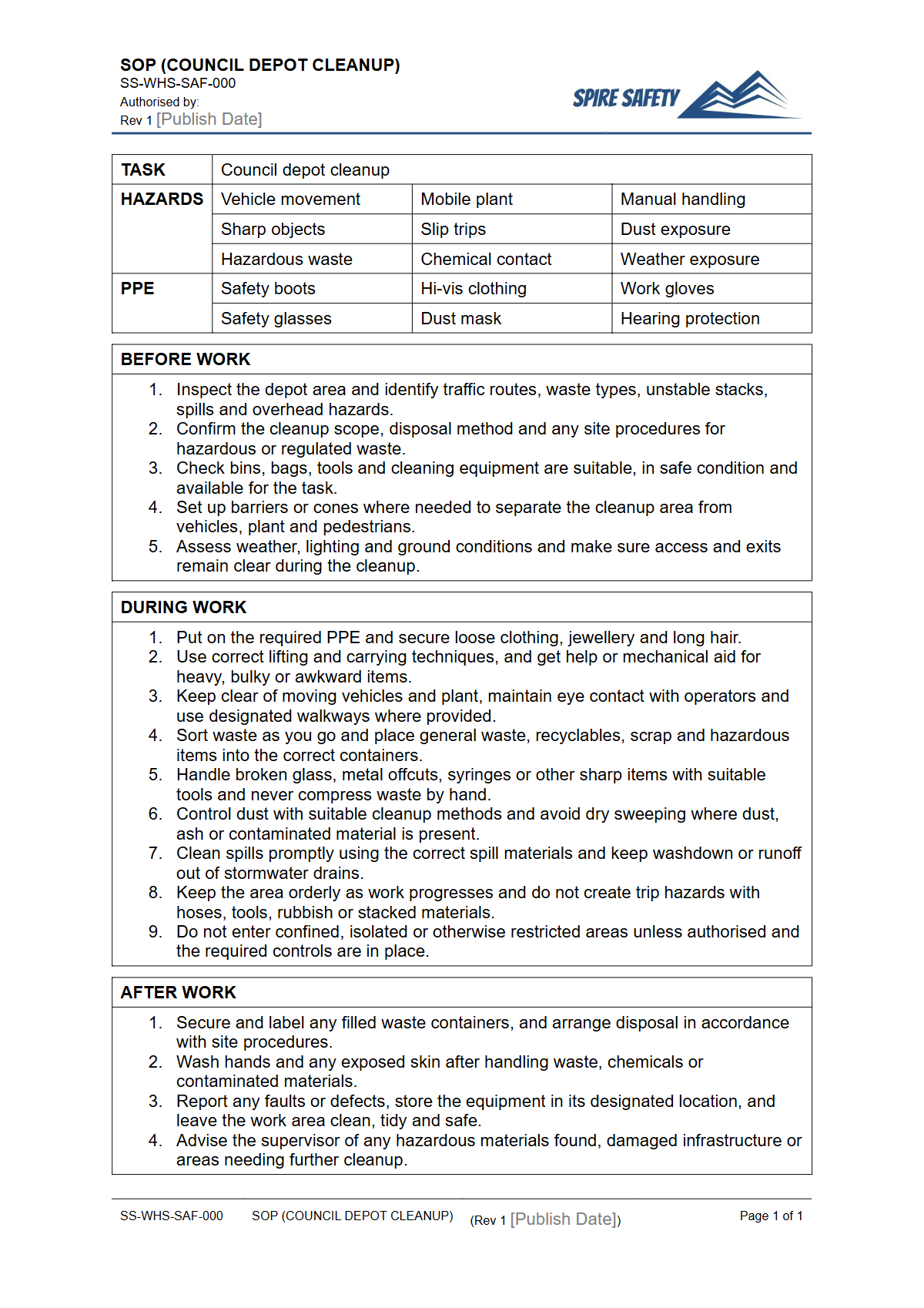
Download our free Safe Operating Procedure for Council Depot Cleanup. This template helps you document step-by-step instructions for a safer worksite.
Free Safe Operating Procedure (Council Depot Cleanup) Template
DOCX • 126 KB + PDF
Updated Oct 2026
No signup required
Purpose of the Free Safe Operating Procedure (Council Depot Cleanup) Template
Managing the various tasks involved in a council depot cleanup requires a systematic approach to safety. This Free Safe Operating Procedure (Council Depot Cleanup) Template provides a structured starting point for your organisation to document the required safety measures.
It is designed to help you outline the step-by-step processes for cleaning and maintaining depot areas, addressing common hazards such as vehicle interaction, manual handling, noise, dust, and exposure to chemicals.
Using a standardised SOP helps ensure that all workers understand the expected safe work methods, the personal protective equipment (PPE) required, and the emergency procedures. It forms a critical component of a proactive safety culture and is a key document within your overall WHS management systems. By formalising these procedures, you create a consistent, repeatable, and trainable process that reduces the risk of injury and promotes operational efficiency.
Video walkthrough
How to use the Free Safe Operating Procedure (Council Depot Cleanup) Template
This resource is available as a fully editable DOCX file and a print-ready PDF. To begin, download the template and open the DOCX version.
Review each section and add, remove, or modify the content to match the specific context of your depot. This includes listing the exact plant and equipment used, the specific chemicals handled, and the unique layout of your worksite.
Important: This document is a template and must be customised to reflect your specific workplace. We are not a law firm, and this document does not constitute legal advice.
You must consult with your workers and other stakeholders to identify all relevant hazards and implement appropriate control measures for your site. The effectiveness of this Safe Operating Procedure depends entirely on its correct customisation and implementation.
The SOP should detail pre-operational checks, the sequential steps for the cleanup task, and post-operational procedures like waste disposal and equipment cleaning. For tasks involving specific machinery, such as lifting waste bins or materials, it is crucial to reference separate, equipment-specific SOPs.
You might, for example, need to cross-reference a FREE Telehandler SOP Template if one is used during the cleanup process.
When to use it
A Council Depot Cleanup SOP should be used whenever cleanup activities are performed. This includes routine scheduled housekeeping, post-storm or emergency cleanups, and tidying up after specific projects or maintenance work.
It serves as a practical on-the-job guide for workers and a critical reference point for supervisors overseeing the work.
It is also an essential training document for new employees or for staff being inducted into depot operations. Regular toolbox talks can reference the SOP to reinforce safe work practices and discuss any new hazards that have been identified. For complex tasks involving heavy machinery like earthmoving equipment, workers must also be familiar with the relevant procedures, such as those outlined in a FREE Grader SOP (Safe Operating Procedure) Template.
Who should use it
This Safe Operating Procedure should be developed in consultation with and used by a range of personnel within a council organisation. This includes:
- Depot Managers and Supervisors: To plan, supervise, and ensure work is conducted safely.
- WHS/OHS Representatives and Officers: To assist in risk assessment, procedure development, and compliance monitoring.
- Workers and Plant Operators: As a direct guide for performing cleanup tasks safely and correctly.
Engaging the workers who will actually be performing the cleanup is vital for creating a practical and effective document. Their hands-on experience is invaluable for identifying real-world hazards and workable control measures.
Periodically, the use and effectiveness of the SOP should be reviewed as part of routine safety checks or more formal WHS compliance auditing activities to ensure it remains current and relevant.
Many cleanup tasks involve the use of powered equipment. For example, if workers are using compressed air for cleaning, they should be trained on the specific risks involved, which would be covered in a resource like our Free Air Compressor SOP (Safe Operating Procedure) Template. This comprehensive approach ensures all aspects of the job are managed safely. You can find more templates like this in our complete free WHS resources library.
Common mistakes
Common mistakes to avoid
- Failing to customise the template for site-specific equipment, waste types, and hazards.
- Not consulting with the workers who actually perform the cleanup tasks during development.
- Treating the SOP as a 'tick-and-flick' exercise without providing proper training and supervision.
- Forgetting to review and update the SOP after an incident or when new machinery is introduced.
Legal references
Legal considerations
The following legal requirements may be relevant to this type of work.
- Work Health and Safety Act (Harmonised) — Provides the primary duties for protecting workers and other people from work health and safety risks.
- Work Health and Safety Regulations (Harmonised) — Sets out requirements supporting the management of workplace hazards and risks.
The following codes may be relevant to this type of work.
- Managing WHS Risks Code of Practice — Provides practical guidance on identifying hazards, assessing risks and applying effective controls.
- Work Health and Safety Consultation, Cooperation and Coordination Code of Practice — Provides practical guidance on consulting workers and coordinating with other duty holders.
- Managing the Work Environment and Facilities Code of Practice — Provides practical guidance on safe work environments, workplace facilities and related controls.
Did you know
Common Depot Incidents
According to Safe Work Australia data, transport, postal, and warehousing (which includes many depot activities) is an industry with a high rate of serious injury claims, with body stressing and falls, trips and slips being the leading causes.
FAQ
Frequently asked questions
01What hazards are typically covered in a Council Depot Cleanup SOP?
02Is a Safe Operating Procedure legally required for depot cleanup in Australia?
03How often should we review our Council Depot Cleanup SOP?
04Can I use this template for other types of cleanup jobs?
Share this resource
Free Safe Operating Procedure (Council Depot Cleanup) Template
Browse Categories
How To Use It
- 1Download and open in Word or PDF.
- 2Replace the placeholders with your business details.
- 3Get it reviewed by a WHS specialist before rollout.
Need it customised?
Our WHS consultants can adapt this template to your site, run a gap analysis, or audit what you already have in place.
Book a Free Consultation WHS consulting servicesor call 1300 156 382
Related templates
- Free Safe Operating Procedure (Countertop Cleaning) Template
- Free Safe Operating Procedure (Courier Bag Handling) Template
- Free Safe Operating Procedure (Courier Route Handover) Template
- Free Safe Operating Procedure (Court Surface Cleaning) Template
- Free Safe Operating Procedure (Courtyard Washdown) Template
- Free Safe Operating Procedure (Crack Monitor) Template