
Free Safe Operating Procedure (Crack Monitor) Template
Download our free Safe Operating Procedure for crack monitors to formalise your inspection and monitoring processes. Get your DOCX and PDF template now.
Free Safe Operating Procedure (Crack Monitor) Template
DOCX • 126 KB + PDF
Updated Oct 2026
No signup required
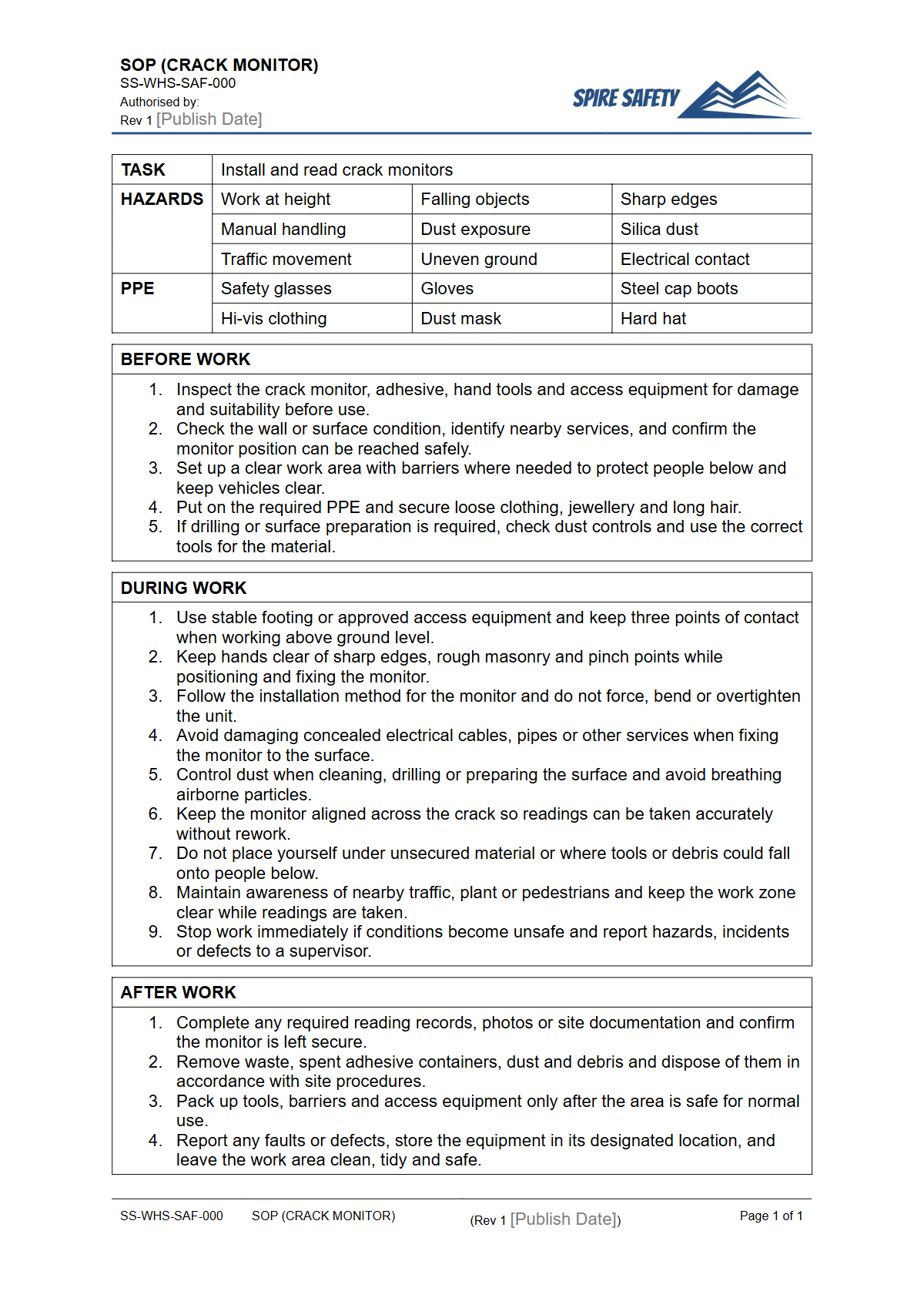
Purpose of the Free Safe Operating Procedure (Crack Monitor) Template
Monitoring structural cracks is a critical task for maintaining the safety and integrity of buildings, bridges, and other infrastructure. A Safe Operating Procedure (SOP) for this task provides a standardised, step-by-step guide for workers.
This free Safe Operating Procedure (Crack Monitor) Template helps your organisation formalise the process of installing, reading, and recording data from crack monitors. It ensures every check is performed consistently and accurately, reducing the risk of human error and providing reliable data for structural engineers.
Using a documented procedure helps fulfil your duty of care by managing risks associated with structural instability. It creates a clear record of monitoring activities, which is invaluable for long-term analysis, maintenance planning, and demonstrating due diligence.
Just as a free trencher SOP template provides clear guidance for excavation work, this document outlines the specific steps for structural monitoring, forming a key part of your site's safety documentation.
Video walkthrough
How to use the Free Safe Operating Procedure (Crack Monitor) Template
This template is a structured starting point, designed to be adapted to your specific operational needs. To use it, download the DOCX file and begin customising the content to align with your equipment, site conditions, and risk controls.
The procedure should be developed in consultation with the workers who will be performing the task, as well as structural engineers or other competent persons.
Key steps for implementation include:
- Adding your company name, logo, and relevant site details.
- Reviewing each step and modifying it to match the exact type of crack monitors you use (e.g., vibrating wire, tell-tale, single-axis).
- Defining the specific frequency of checks, data recording methods, and the thresholds that trigger an alert or require escalation.
- Including details of required Personal Protective Equipment (PPE), such as gloves, eye protection, or high-visibility clothing if working near traffic.
Please note: this template is a starting point. We recommend you customise it thoroughly to reflect the specific equipment, environment, and risks present in your workplace.
Once finalised, this SOP should be integrated into your organisation's broader WHS management systems, with all relevant personnel trained in its use.
When to Use a Crack Monitor SOP
A crack monitor SOP should be implemented whenever there is a need to systematically track the movement or propagation of cracks in a structure. This is not limited to buildings showing obvious signs of distress. Common scenarios include:
- Post-Construction: Monitoring for settlement cracks in new buildings or extensions.
- Adjacent Construction: Tracking any impact from nearby excavation, piling, or demolition work on neighbouring properties.
- Routine Maintenance: As part of a proactive structural health monitoring program for ageing assets like bridges, retaining walls, and car parks.
- Post-Incident: Assessing a structure's stability following an event such as an earthquake, flood, or impact.
Consistent use of the SOP ensures that a reliable, long-term dataset is built. This documentation is also vital during a WHS compliance audit, as it demonstrates a proactive and systematic approach to managing structural risks.
Who Should Use This Procedure
This SOP is designed for use by personnel tasked with overseeing or carrying out structural monitoring. This may include site engineers, building managers, maintenance teams, geotechnical technicians, and safety officers.
It is essential that anyone using this procedure is competent to do so. This includes being able to correctly identify the location for monitoring, install the device without damaging it, and accurately read and record the measurements.
The SOP also serves as a valuable training tool for new team members, ensuring they understand the approved methodology from day one. Many different tasks on site require similar procedural documentation, just as our free conveyer system SOP details steps for operating that specific machinery. Having clear, task-specific procedures is a cornerstone of a safe and organised workplace. You can find more examples in our free WHS resources library to help build out your safety systems.
Common mistakes
Common mistakes to avoid
- Incorrectly installing the monitor, such as not cleaning the surface or using the wrong adhesive, leading to inaccurate readings.
- Failing to establish and document an initial baseline measurement, making it impossible to track changes over time.
- Using the wrong type of monitor for the surface material (e.g., concrete vs. brick) or the expected movement.
- Infrequent or inconsistent data collection, leading to missed trends and poor record-keeping for analysis.
Legal references
Legal considerations
The following legal requirements may be relevant to this type of work.
- Work Health and Safety Act (Harmonised) — Provides the primary duties for protecting workers and other people from work health and safety risks.
- Work Health and Safety Regulations (Harmonised) — Sets out requirements supporting the management of workplace hazards and risks.
The following codes may be relevant to this type of work.
- Managing WHS Risks Code of Practice — Provides practical guidance on identifying hazards, assessing risks and applying effective controls.
- Work Health and Safety Consultation, Cooperation and Coordination Code of Practice — Provides practical guidance on consulting workers and coordinating with other duty holders.
- Managing the Work Environment and Facilities Code of Practice — Provides practical guidance on safe work environments, workplace facilities and related controls.
Did you know
Reading the Cracks
Cracks are categorised by their cause. Tensile cracks pull apart, shear cracks slide past each other, and compression cracks crush together. Identifying the type is the first step in diagnosing the structural issue.
Precision Matters
A change in crack width as small as 1mm can indicate significant underlying structural movement. This makes precise installation and consistent measurement critical for effective structural health monitoring.
FAQ
Frequently asked questions
01What key information should a Safe Operating Procedure for a crack monitor include?
02How often should crack monitors be checked and the data recorded?
03Is an SOP a legal requirement for using crack monitors in Australia?
04Can this template be adapted for digital or electronic crack monitoring systems?
Share this resource
Free Safe Operating Procedure (Crack Monitor) Template
Browse Categories
How To Use It
- 1Download and open in Word or PDF.
- 2Replace the placeholders with your business details.
- 3Get it reviewed by a WHS specialist before rollout.
Need it customised?
Our WHS consultants can adapt this template to your site, run a gap analysis, or audit what you already have in place.
Book a Free Consultation WHS consulting servicesor call 1300 156 382
Related templates
- Free Safe Operating Procedure (Crane Limit Switch Test) Template
- Free Safe Operating Procedure (Crane Outrigger Setup) Template
- Free Safe Operating Procedure (Crane Pendant Control) Template
- Free Safe Operating Procedure (Crane Radio Controls) Template
- Free Safe Operating Procedure (Crane Scale) Template
- Free Safe Operating Procedure (Crash Cart Restocking) Template