
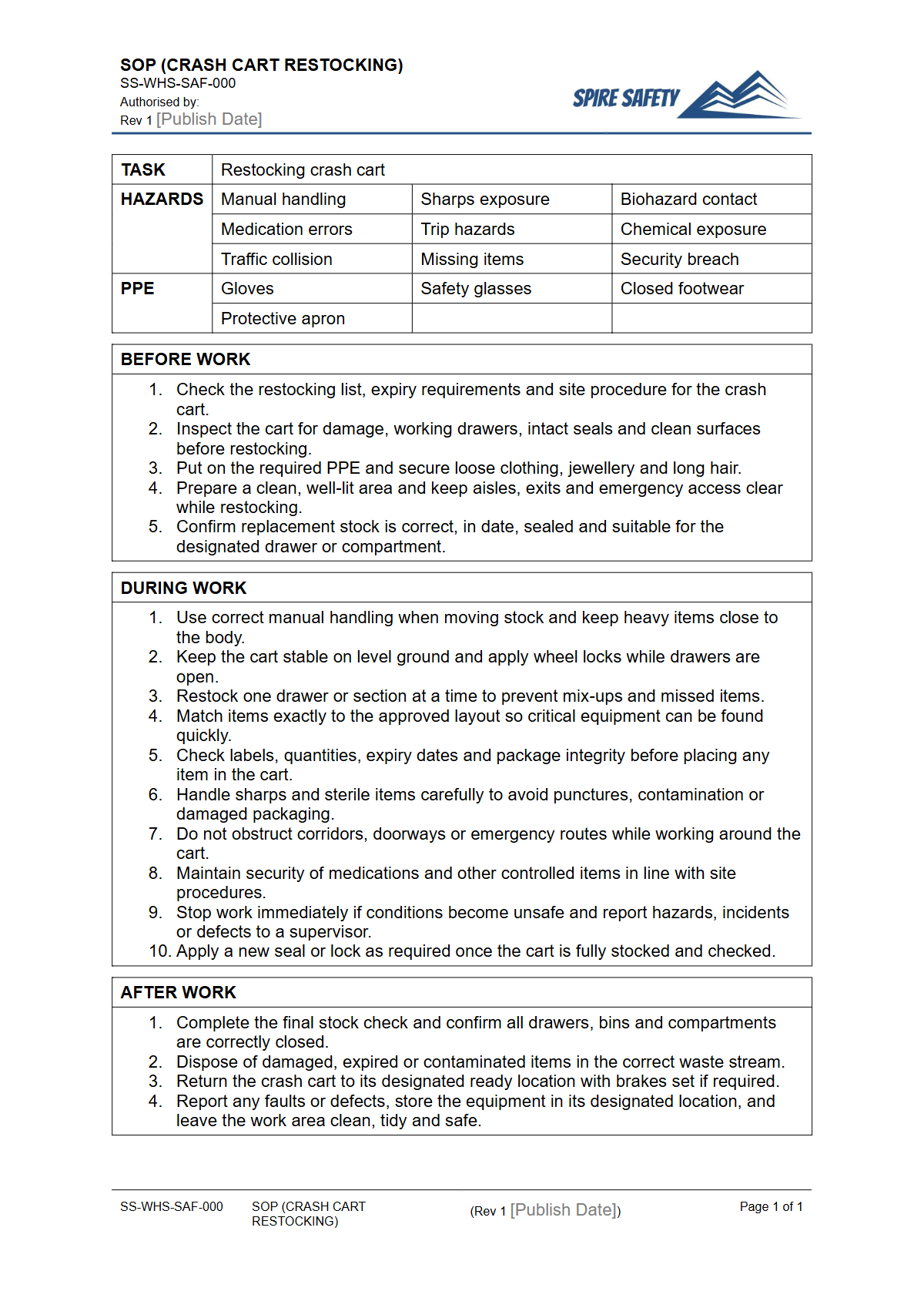
Free Safe Operating Procedure (Crash Cart Restocking) Template
Ensure your medical emergency trolley is always ready for use with a systematic restocking process.
Free Safe Operating Procedure (Crash Cart Restocking) Template
DOCX • 126 KB + PDF
Updated Oct 2026
No signup required
Purpose of the Free Safe Operating Procedure (Crash Cart Restocking) Template
In a medical emergency, a fully stocked and functional crash cart is non-negotiable. Seconds can mean the difference between life and death, and fumbling for missing supplies or discovering expired medication is an unacceptable risk.
This Free Safe Operating Procedure (Crash Cart Restocking) Template provides a structured framework for ensuring your organisation's emergency carts are consistently maintained, restocked, and ready for immediate deployment. It is designed to formalise processes, reduce human error, and support compliance with healthcare standards.
Using a standardised SOP helps to establish a clear, repeatable process that all relevant personnel can follow. This promotes accountability and ensures that every cart is checked and restocked to the same high standard after each use or during scheduled inspections.
It serves as a vital tool for risk management in clinical and healthcare environments, directly contributing to patient and worker safety. A documented procedure is also a key element of a robust safety framework, forming part of your broader WHS management systems.
Video walkthrough
How to use the Free Safe Operating Procedure (Crash Cart Restocking) Template
This document is a template and must be customised to meet the specific needs of your facility and the requirements of your state or territory's WHS legislation. Download the DOCX file and adapt it by incorporating your site-specific details, including the exact layout of your crash carts, specific medications and quantities, equipment models, and designated personnel roles.
It is crucial to consult with your clinical team, pharmacists, and WHS committee during this process to ensure the procedure is practical and effective.
To implement this Safe Operating Procedure:
- Step 1: Customise the content. Add your company name, logo, and specific details about the equipment, medications, and responsibilities at your workplace.
- Step 2: Consult with your workers. Involve the nurses, doctors, and other staff who will be using the SOP. Their feedback is essential for creating a procedure that works in practice.
- Step 3: Train all relevant personnel. Ensure everyone understands their responsibilities for checking, restocking, and documenting the status of the crash cart.
- Step 4: Review and approve. Have the final document formally approved by management and schedule regular reviews to keep it current. Effective implementation may require expert guidance, and our WHS consulting services can assist in tailoring safety documents to your specific operational risks.
When to use this Safe Operating Procedure
The crash cart restocking procedure should be initiated at several key moments to ensure constant readiness. The most critical trigger is immediately following any use of the crash cart, whether it was for a full cardiac arrest or just the removal of a single item.
A full inventory and restocking process must be completed to return it to a state of readiness. Beyond post-use checks, the SOP should be part of a regular, scheduled inspection routine.
Depending on facility policy and risk level, this may be daily, weekly, or at the start of every shift.
Additionally, the procedure should guide the management of items with expiry dates. Regular checks are necessary to identify and replace medications and sterile supplies that are approaching or have passed their expiration. This systematic approach helps prevent the use of compromised items during an emergency and can be verified through periodic safety reviews and WHS compliance auditing.
Who should use this Safe Operating Procedure
This SOP is intended for all personnel who have a responsibility for emergency preparedness and the maintenance of medical equipment in a healthcare setting. This typically includes registered nurses, clinical nurse managers, emergency department staff, and designated first aiders in corporate or industrial settings with advanced first aid facilities.
Pharmacists or pharmacy technicians may also be involved in the process, particularly for the management and replacement of medications.
Ultimately, the Person Conducting a Business or Undertaking (PCBU) is responsible for ensuring that adequate emergency resources are available and maintained. This procedure provides a practical tool for managers and supervisors to delegate the task while maintaining oversight and ensuring a consistent standard is met.
If you need more guidance on safety documentation, you can browse our complete free WHS resources library for other templates and guides.
Common mistakes
Common mistakes to avoid
- Failing to immediately restock the cart after an item has been used.
- Overlooking expiry dates on medications, batteries, and sterile supplies.
- Signing off on a checklist without physically verifying each item is present and correct.
- Storing the crash cart in a location that is cluttered, blocked, or not easily accessible.
Legal references
Legal considerations
The following legal requirements may be relevant to this type of work.
- Work Health and Safety Act (Harmonised) — Provides the primary duties for protecting workers and other people from work health and safety risks.
- Work Health and Safety Regulations (Harmonised) — Sets out requirements supporting the management of workplace hazards and risks.
The following codes may be relevant to this type of work.
- Managing WHS Risks Code of Practice — Provides practical guidance on identifying hazards, assessing risks and applying effective controls.
- Work Health and Safety Consultation, Cooperation and Coordination Code of Practice — Provides practical guidance on consulting workers and coordinating with other duty holders.
- Managing the Work Environment and Facilities Code of Practice — Provides practical guidance on safe work environments, workplace facilities and related controls.
Did you know
Defibrillator Function
Most modern crash carts include a defibrillator with a self-test function. The SOP should include a step to verify that the defibrillator has passed its daily self-test and is ready for operation.
Medication Segregation
Best practice involves organising medications within the crash cart drawers using dividers and clear labels. Paediatric-specific medications are often kept in separate, clearly marked drawers or kits to prevent dosage errors during an emergency.
FAQ
Frequently asked questions
01What is a crash cart?
02Why is a checklist essential for restocking a crash cart?
03How often should a crash cart be checked?
04Who is responsible for ensuring the crash cart SOP is followed?
Share this resource
Free Safe Operating Procedure (Crash Cart Restocking) Template
Browse Categories
How To Use It
- 1Download and open in Word or PDF.
- 2Replace the placeholders with your business details.
- 3Get it reviewed by a WHS specialist before rollout.
Need it customised?
Our WHS consultants can adapt this template to your site, run a gap analysis, or audit what you already have in place.
Book a Free Consultation WHS consulting servicesor call 1300 156 382
Related templates
- Free Safe Operating Procedure (Crawler Crane Setup) Template
- Free Safe Operating Procedure (Creek Bank Cleanup) Template
- Free Safe Operating Procedure (Crematorium Ash Handling) Template
- Free Safe Operating Procedure (Crew Bus Cleaning) Template
- Free Safe Operating Procedure (Cricket Pitch Cover) Template
- Free Safe Operating Procedure (Cricket Pitch Repair) Template