
Free Safe Operating Procedure (Cricket Pitch Repair) Template
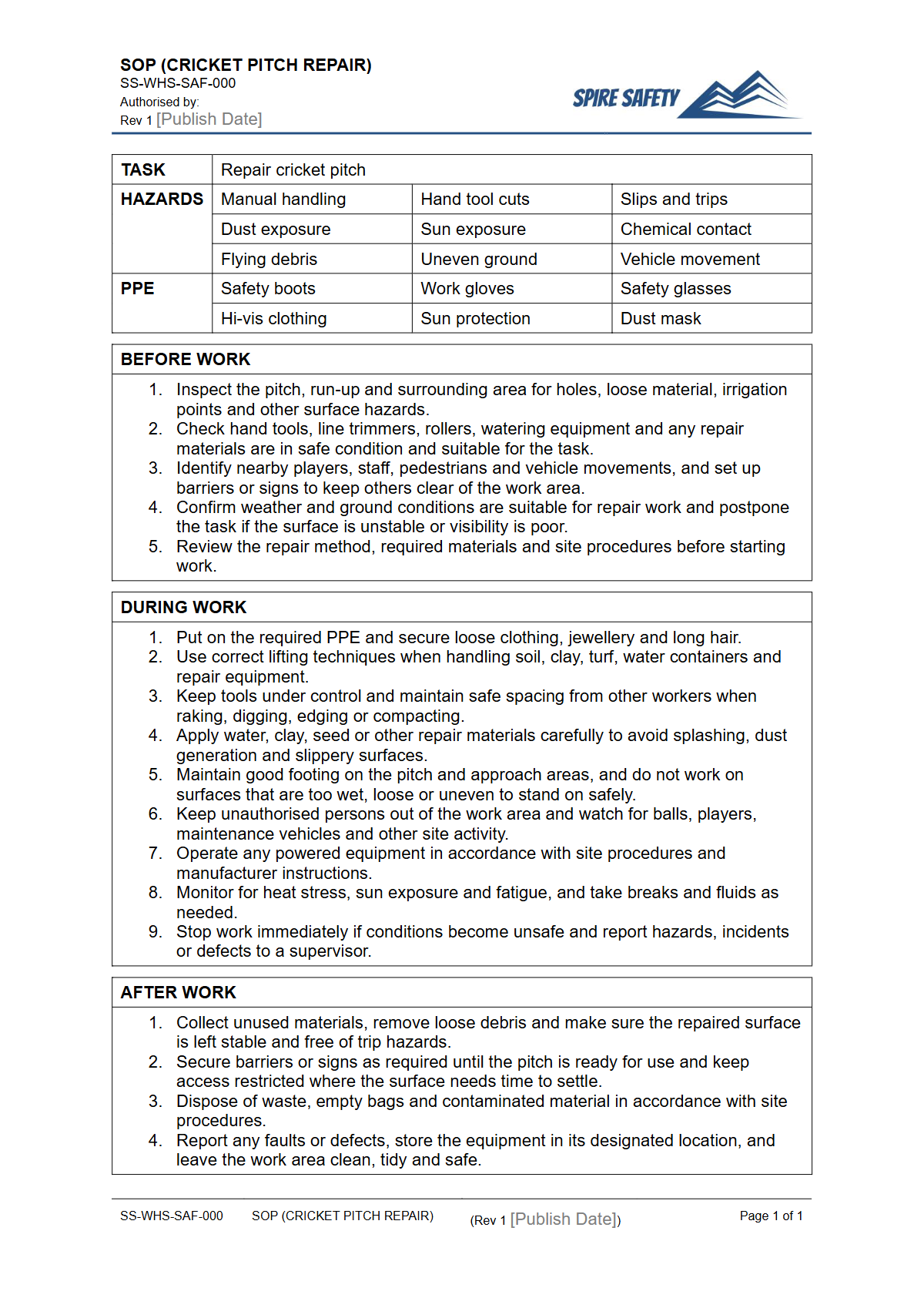
Download our free Safe Operating Procedure for cricket pitch repair. This template helps you document step-by-step instructions for groundskeepers and maintenance staff.
Free Safe Operating Procedure (Cricket Pitch Repair) Template
DOCX • 126 KB + PDF
Updated Oct 2026
No signup required
Purpose of the Free Safe Operating Procedure (Cricket Pitch Repair) Template
Maintaining a high-quality cricket pitch requires specific skills and carries inherent risks. This free Safe Operating Procedure (Cricket Pitch Repair) Template provides a structured framework for documenting the step-by-step process for repairing and renovating pitches safely.
By clearly outlining potential hazards—such as manual handling, chemical exposure, and machinery operation—and their corresponding control measures, this SOP helps organisations meet their work health and safety duties.
Using a documented procedure ensures that all tasks, from rolling and scarifying to top dressing and line marking, are performed consistently and safely by all staff. It serves as an essential training tool for new groundskeepers and a critical reference for experienced personnel.
Integrating such procedures is a cornerstone of effective WHS management systems, demonstrating a commitment to proactive risk management.
Video walkthrough
How to use the Free Safe Operating Procedure (Cricket Pitch Repair) Template
This template is available for download in both DOCX and PDF formats. The DOCX file is fully editable, allowing you to tailor the content to the specific machinery, materials, and environment at your facility.
The PDF version can be used as a handy, ready-to-print reference.
Important: This document is a template only. You must customise it to reflect the unique hazards and control measures relevant to your specific workplace.
We are not liable for any incidents that may arise from the use of this document. It is your responsibility to ensure all tasks are assessed, and that the procedure is safe, relevant, and understood by all workers involved.
When customising, you should detail the specific types of equipment used. For example, if your process involves applying top dressing or fertiliser, you might reference your own procedures or supplement this document with a specific FREE Spreader SOP (Safe Operating Procedure) Template.
When to use it
A Safe Operating Procedure for cricket pitch repair should be used whenever maintenance or renovation tasks are undertaken. This includes:
- Pre-season preparation: Getting the pitch ready for the playing season, which may involve extensive scarifying, aeration, and levelling.
- Mid-season repairs: Addressing wear and tear in high-traffic areas like the bowler's run-up and batsman's crease.
- End-of-season renovations: Major works to rejuvenate the pitch, which can include stripping the surface, cultivating, and re-seeding.
For larger-scale renovation projects that involve significant earthworks and levelling, this SOP should be used in conjunction with procedures for heavy machinery, such as our FREE Grader SOP (Safe Operating Procedure) Template.
Who should use it
This SOP is designed for use by all personnel involved in the maintenance and care of cricket facilities. This includes:
- Groundskeepers and turf managers: The primary users who perform the day-to-day tasks.
- Maintenance staff and contractors: Anyone hired to assist with specialised repair or renovation tasks.
- Supervisors and Club Managers: Those responsible for overseeing work, providing training, and ensuring WHS obligations are met.
Developing and implementing robust safe work procedures can be complex. If your organisation needs support in customising this template or developing a broader safety framework, consider our expert WHS consulting services.
Key Elements of the SOP
A comprehensive cricket pitch repair SOP should cover several critical areas. The template prompts you to include details on:
- Required Personal Protective Equipment (PPE): Such as steel-capped boots, gloves, eye protection, and respiratory protection for dust or chemicals.
- Pre-start checks: A checklist for inspecting machinery like rollers, aerators, and mowers before use.
- Hazard identification and control: Listing potential risks (e.g., crush injuries from rollers, chemical exposure from line-marking paint) and the measures to control them (e.g., exclusion zones, use of Safety Data Sheets).
- Emergency Procedures: Steps to take in case of an incident, injury, or equipment failure.
If your repair work involves installing or maintaining irrigation or drainage systems, you may also need a procedure for excavation work, which could be supported by resources like our FREE Trencher SOP (Safe Operating Procedure) Template.
Auditing and Reviewing your SOP
Once implemented, your SOP is not a 'set and forget' document. It should be regularly reviewed and updated—typically every one to two years, or after any incident, near miss, or change in equipment or process.
Regular reviews ensure the procedure remains effective and relevant. A formal process of WHS compliance auditing can help verify that your documented procedures are being followed correctly in practice.
This document is just one of many tools available to help you build a safer workplace. For more templates, checklists, and guides, explore our complete free WHS resources library.
Common mistakes
Common mistakes to avoid
- Failing to conduct pre-start checks on machinery like rollers, scarifiers, or aerators.
- Not consulting the Safety Data Sheet (SDS) before handling fertilisers, pesticides, or line-marking paints.
- Using incorrect manual handling techniques when lifting heavy soil bags or turf rolls.
- Neglecting to cordon off the work area, posing a risk to other ground users or the public.
Legal references
Legal considerations
The following legal requirements may be relevant to this type of work.
- Work Health and Safety Act (Harmonised) — Provides the primary duties for protecting workers and other people from work health and safety risks.
- Work Health and Safety Regulations (Harmonised) — Sets out requirements supporting the management of workplace hazards and risks.
The following codes may be relevant to this type of work.
- Managing WHS Risks Code of Practice — Provides practical guidance on identifying hazards, assessing risks and applying effective controls.
- Work Health and Safety Consultation, Cooperation and Coordination Code of Practice — Provides practical guidance on consulting workers and coordinating with other duty holders.
- Managing the Work Environment and Facilities Code of Practice — Provides practical guidance on safe work environments, workplace facilities and related controls.
Did you know
Pitch Perfect
The ideal cricket pitch has a specific soil composition, typically a high clay content (over 30%), to provide the right bounce and pace for the ball. This specialised soil is often sourced from specific regions known for its quality.
Heavy Rolling
Cricket pitch rollers can weigh several tonnes, making their operation a significant hazard. Incorrect or unsafe use can lead to serious crush injuries or damage the pitch surface, highlighting the need for a documented safe procedure.
FAQ
Frequently asked questions
01What are the main hazards involved in cricket pitch repair?
02Is this template suitable for both turf and synthetic cricket pitches?
03How often should a Safe Operating Procedure for cricket pitch repair be reviewed?
04What PPE is required for cricket pitch repair?
Share this resource
Free Safe Operating Procedure (Cricket Pitch Repair) Template
Browse Categories
How To Use It
- 1Download and open in Word or PDF.
- 2Replace the placeholders with your business details.
- 3Get it reviewed by a WHS specialist before rollout.
Need it customised?
Our WHS consultants can adapt this template to your site, run a gap analysis, or audit what you already have in place.
Book a Free Consultation WHS consulting servicesor call 1300 156 382
Related templates
- Free Safe Operating Procedure (Crimp Lug Press) Template
- Free Safe Operating Procedure (Crop Row Marking) Template
- Free Safe Operating Procedure (Crop Scouting) Template
- Free Safe Operating Procedure (Crop Thinning) Template
- Free Safe Operating Procedure (Cross Dock Transfer) Template
- Free Safe Operating Procedure (Crowd Barrier Handling) Template