
Free Safe Operating Procedure (Crop Row Marking) Template
Clearly define the steps for safe crop row marking operations on your farm. Download our free, editable Safe Operating Procedure template to get started.
Free Safe Operating Procedure (Crop Row Marking) Template
DOCX • 126 KB + PDF
Updated Oct 2026
No signup required
Purpose of the Free Safe Operating Procedure (Crop Row Marking) Template
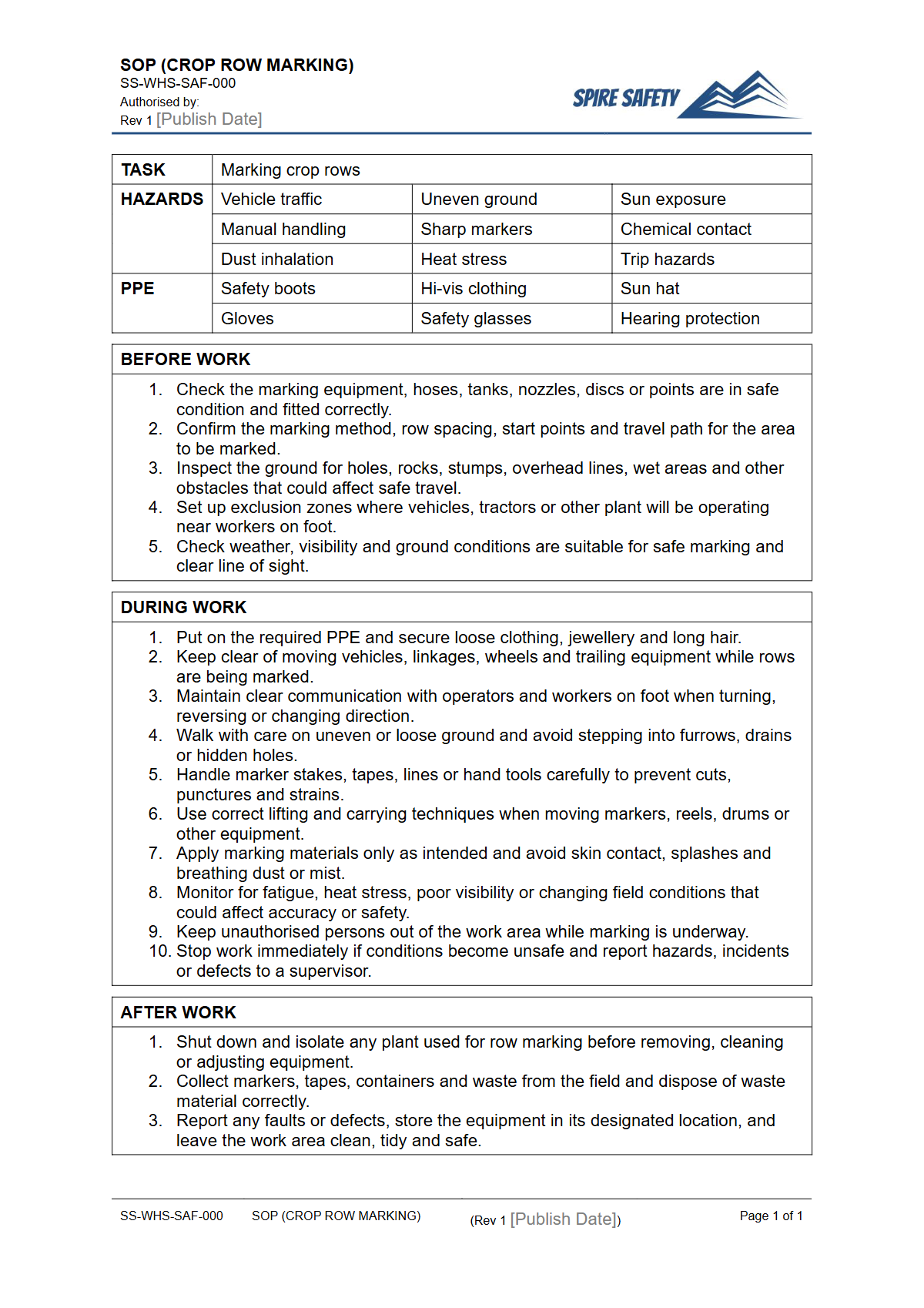
This Free Safe Operating Procedure (Crop Row Marking) Template provides a structured framework for documenting the required steps to perform crop row marking tasks safely. In modern agriculture, precision is key, but so is safety.
This SOP helps you identify and control hazards associated with using tractors, GPS guidance systems, and marking implements. By outlining a clear process, you can minimise risks such as vehicle rollovers on uneven terrain, entanglement in moving parts, and musculoskeletal injuries from manual adjustments or prolonged awkward postures.
It serves as a critical tool for ensuring workers understand the agreed-upon safe method for the task.
A well-drafted SOP is a fundamental part of a proactive safety culture. It formalises expectations and provides a consistent benchmark for training and supervision.
Using a template ensures all critical components are considered, from pre-start checks to shutdown procedures. This is similar to the structured approach needed for other agricultural tasks, such as those detailed in our free Planter SOP template. Documenting these procedures helps a Person Conducting a Business or Undertaking (PCBU) meet their primary duty of care under WHS legislation.
Video walkthrough
How to use the Free Safe Operating Procedure (Crop Row Marking) Template
This Safe Operating Procedure is provided as a starting point. It is available for download in both DOCX format for easy editing and PDF for straightforward printing and distribution.
To use it effectively, you must adapt the content to reflect the specific equipment, environment, and processes of your workplace. Generic procedures are insufficient; a site-specific risk assessment should inform the final document.
We have written this template to be comprehensive, but it cannot cover every possible variable on your farm. It is crucial that you consult with your workers—the operators who perform the task—during the customisation process.
Their direct experience is invaluable for identifying practical hazards and effective controls. Integrating this process into your broader safety framework is key for ongoing success.
Developing robust WHS management systems provides the structure needed to manage all your safety documentation, including SOPs, effectively.
When to use it
A Safe Operating Procedure for crop row marking should be used as a multi-purpose tool throughout your operations. Its primary function is as a training document for new workers or for retraining existing staff on the correct, safe procedure.
It should be a core part of any equipment-specific induction. The SOP also serves as a reference guide that operators can consult before starting a task, especially if it is performed infrequently.
Furthermore, it should be used as a key reference when conducting periodic risk assessments or investigating an incident or near miss involving the equipment.
Who should use it
This template is designed for anyone responsible for health and safety in an agricultural setting. This includes farm owners, operations managers, supervisors, and WHS officers.
These individuals can use the template to create a finalised SOP that forms part of their safety management system. The end-users of the finalised document are the equipment operators themselves.
The SOP provides them with clear, accessible instructions to follow, empowering them to work safely and consistently. For organisations seeking to ensure their overall safety approach is sound, engaging expert WHS consulting can help align procedures like this with strategic safety goals.
Key Elements of a Crop Row Marking SOP
Your customised SOP should include several critical sections to be effective. Ensure your final document details:
- Pre-operational Checks: A checklist for inspecting the tractor and marking implement, including hydraulics, tyres, guards, and GPS equipment.
- Step-by-Step Instructions: A logical sequence of actions from starting the equipment to completing the marking pattern and shutting down. This should cover actions on different types of terrain.
- Identified Hazards and Control Measures: A clear summary of potential risks (e.g., rollovers, entanglement, sun exposure) and the corresponding controls (e.g., use of seatbelts, ROPS, guarding, PPE).
- Emergency Procedures: Instructions on what to do in case of a breakdown, incident, or fire.
These principles apply to a wide range of agricultural machinery. For example, a similar level of detail is required when operating machinery covered by our Seed Drill SOP template. You can find more examples in our complete free WHS resources library to build a comprehensive set of documents for your farm.
Common mistakes
Common mistakes to avoid
- Failing to customise the template with site-specific details and hazards.
- Neglecting to consult with machinery operators during the drafting process.
- Not providing practical training on the finalised SOP.
- Letting the document become outdated by not reviewing it after changes or incidents.
Legal references
Legal considerations
The following legal requirements may be relevant to this type of work.
- Work Health and Safety Act (Harmonised) — Provides the primary duties for protecting workers and other people from work health and safety risks.
- Work Health and Safety Regulations (Harmonised) — Sets out requirements supporting the management of workplace hazards and risks.
The following codes may be relevant to this type of work.
- Managing WHS Risks Code of Practice — Provides practical guidance on identifying hazards, assessing risks and applying effective controls.
- Work Health and Safety Consultation, Cooperation and Coordination Code of Practice — Provides practical guidance on consulting workers and coordinating with other duty holders.
- Managing the Work Environment and Facilities Code of Practice — Provides practical guidance on safe work environments, workplace facilities and related controls.
Did you know
Precision Agriculture
Modern crop row marking often uses Real-Time Kinematic (RTK) GPS systems, which can provide centimetre-level accuracy, significantly improving planting efficiency and reducing input waste.
Tractor Rollovers
Tractor rollovers are the single most common cause of fatalities on Australian farms. A well-enforced SOP that mandates the use of Rollover Protective Structures (ROPS) and seatbelts is a critical control.
FAQ
Frequently asked questions
01What are the main hazards associated with crop row marking?
02Why do I need a specific SOP for crop row marking?
03Is this template suitable for all types of row marking equipment?
04How often should a Safe Operating Procedure for crop row marking be reviewed?
Share this resource
Free Safe Operating Procedure (Crop Row Marking) Template
Browse Categories
How To Use It
- 1Download and open in Word or PDF.
- 2Replace the placeholders with your business details.
- 3Get it reviewed by a WHS specialist before rollout.
Need it customised?
Our WHS consultants can adapt this template to your site, run a gap analysis, or audit what you already have in place.
Book a Free Consultation WHS consulting servicesor call 1300 156 382
Related templates
- Free Safe Operating Procedure (Crop Scouting) Template
- Free Safe Operating Procedure (Crop Thinning) Template
- Free Safe Operating Procedure (Cross Dock Transfer) Template
- Free Safe Operating Procedure (Crowd Barrier Handling) Template
- Free Safe Operating Procedure (Crowd Entry Screening) Template
- Free Safe Operating Procedure (Crowd Queue Control) Template