
Free Safe Operating Procedure (Crowd Barrier Handling) Template
Develop clear procedures for safely handling and installing crowd barriers. Download our free Safe Operating Procedure (Crowd Barrier Handling) Template to get started.
Free Safe Operating Procedure (Crowd Barrier Handling) Template
DOCX • 126 KB + PDF
Updated Oct 2026
No signup required
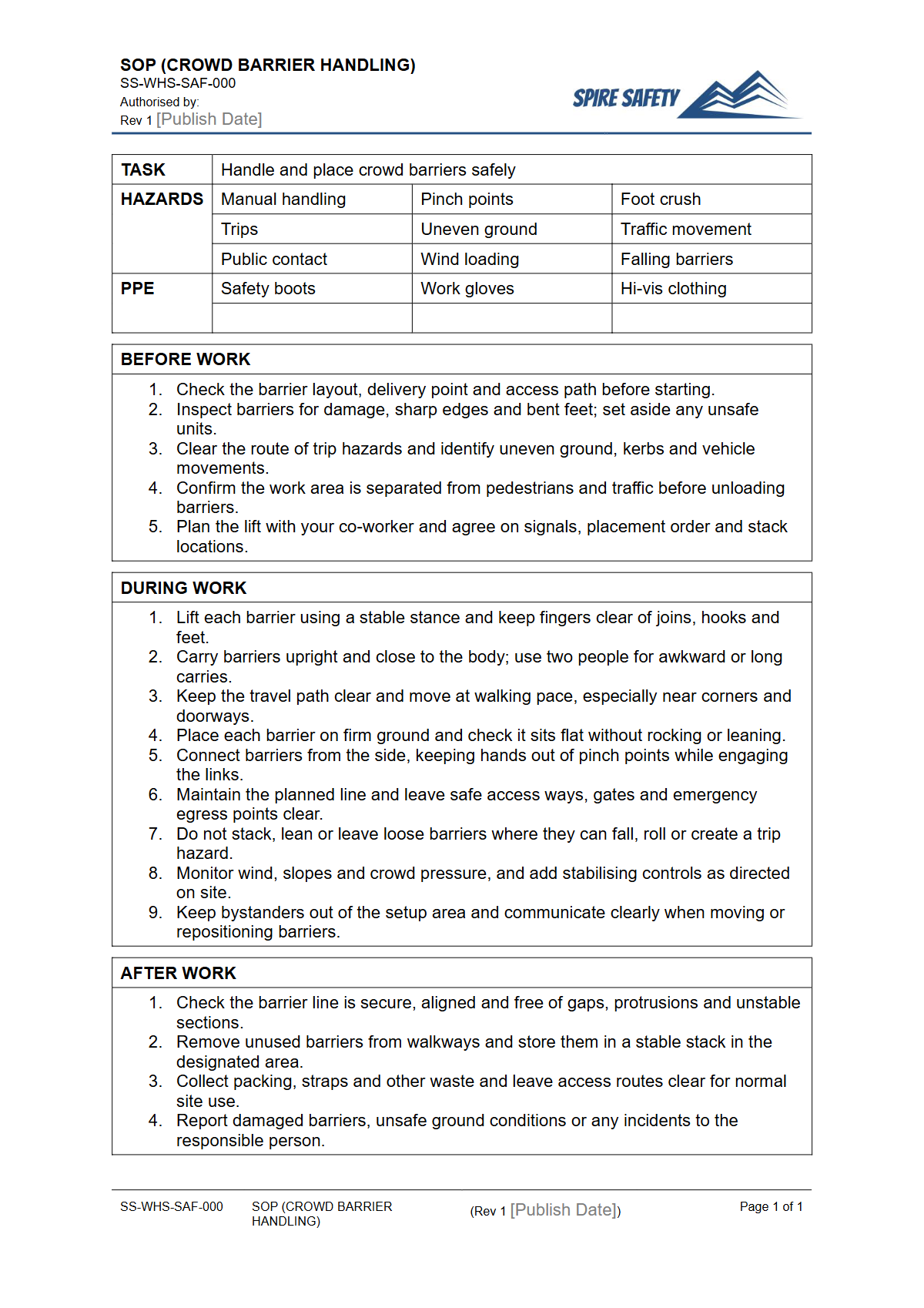
Purpose of the Free Safe Operating Procedure (Crowd Barrier Handling) Template
The manual handling, transport, and installation of crowd control barriers are common tasks at events, construction sites, and public spaces. Without a documented safe system of work, these activities expose workers to significant risks, including musculoskeletal injuries from lifting, crush injuries from falling barriers, and vehicle-related incidents during transport.
This Safe Operating Procedure for crowd barrier handling provides a structured framework for documenting the required steps to perform the task safely.
Using this template helps a Person Conducting a Business or Undertaking (PCBU) meet their primary duty of care. It assists in identifying potential hazards associated with barrier handling, outlining clear control measures to mitigate risks, and establishing a consistent, safe methodology for all workers to follow.
This formalises your organisation's commitment to safety, provides a crucial training tool for employees, and helps manage WHS obligations effectively.
Video walkthrough
How to use the Free Safe Operating Procedure (Crowd Barrier Handling) Template
This resource is available for immediate download in both DOCX and PDF formats. The DOCX version is fully editable, allowing you to adapt the content to the specific equipment, environment, and processes unique to your workplace.
To use the template, download the file and systematically work through each section, adding or removing information to reflect your operational reality. It is designed as a structured starting point, aligned with Australian WHS practice.
Important: This is a template only. For it to be effective and for you to meet your duties, you must customise it to your specific workplace.
This involves consulting with your workers and incorporating details about the actual barriers you use, the vehicles involved, your site conditions, and your emergency procedures. Once customised, it should be integrated into your broader WHS management system.
Customisation Steps:
- Site-Specific Hazards: Add details about hazards unique to your environment, such as uneven ground, public traffic, or overhead powerlines.
- Equipment Details: Specify the type and weight of the crowd barriers used.
- PPE: List the mandatory Personal Protective Equipment (PPE), such as high-visibility clothing, steel-capped boots, and protective gloves.
- Consultation: Review the draft SOP with the workers who will be performing the task to ensure it is practical and comprehensive. Their feedback is invaluable for creating a truly effective procedure.
If you require assistance tailoring this document or developing other safety procedures, our WHS consulting services can provide expert guidance.
When to use a Safe Operating Procedure for Crowd Barrier Handling
An SOP for crowd barrier handling should be developed and implemented before any workers are required to undertake the task. It is a proactive control measure, not a reactive one.
It should be used as a primary reference document during worker training and site-specific inductions to ensure everyone understands the approved method and associated risks.
The procedure should also be readily available in the workplace for supervisors and workers to reference as needed. It serves as a key piece of evidence during WHS compliance auditing, demonstrating that a safe system of work has been established and communicated.
The SOP must be reviewed and updated regularly, particularly after an incident, when new types of barriers are introduced, or if the work environment changes significantly.
Who should use this Safe Operating Procedure
This SOP is intended for use by anyone involved in the lifecycle of crowd barrier management. This includes:
- Workers and Labourers: The primary users who perform the physical task of moving, setting up, and dismantling the barriers.
- Site Supervisors and Foremen: Responsible for ensuring workers are trained on and adhere to the SOP.
- Event Managers and Coordinators: Accountable for overall site safety at public gatherings and events.
- WHS/OHS Officers: Use the SOP as part of risk assessments, training programs, and safety inspections.
If heavy machinery like a telehandler is used to move barriers in bulk, operators will require additional training and procedures, such as those outlined in our free Telehandler SOP Template. The SOP ensures all parties have a shared understanding of the safety requirements for the task. This document is one of many tools available in our free WHS resources library, designed to support Australian businesses in building robust safety practices.
Common mistakes
Common mistakes to avoid
- Using incorrect lifting techniques, such as twisting the back instead of pivoting with the feet.
- Failing to wear appropriate PPE, especially protective gloves and steel-capped boots.
- Setting up barriers on uneven or soft ground, leading to instability and collapse.
- Not inspecting barriers for sharp edges, broken welds, or damaged feet before handling.
Legal references
Legal considerations
The following legal requirements may be relevant to this type of work.
- Work Health and Safety Act (Harmonised) — Provides the primary duties for protecting workers and other people from work health and safety risks.
- Work Health and Safety Regulations (Harmonised) — Sets out requirements supporting the management of workplace hazards and risks.
The following codes may be relevant to this type of work.
- Managing WHS Risks Code of Practice — Provides practical guidance on identifying hazards, assessing risks and applying effective controls.
- Work Health and Safety Consultation, Cooperation and Coordination Code of Practice — Provides practical guidance on consulting workers and coordinating with other duty holders.
- Managing the Work Environment and Facilities Code of Practice — Provides practical guidance on safe work environments, workplace facilities and related controls.
Did you know
Manual Task Risk
According to Safe Work Australia, hazardous manual tasks are a leading cause of work-related injuries, with body stressing accounting for 37% of all serious workers' compensation claims.
Barrier Weight
A standard 2.2-metre steel crowd control barrier can weigh between 11kg and 20kg, making team lifting and correct technique essential for preventing strain and injury.
FAQ
Frequently asked questions
01What is a Safe Operating Procedure for crowd barrier handling?
02Are crowd barriers considered a hazardous manual task?
03Who is responsible for creating a crowd barrier SOP?
04How often should an SOP for crowd barriers be reviewed?
Share this resource
Free Safe Operating Procedure (Crowd Barrier Handling) Template
Browse Categories
How To Use It
- 1Download and open in Word or PDF.
- 2Replace the placeholders with your business details.
- 3Get it reviewed by a WHS specialist before rollout.
Need it customised?
Our WHS consultants can adapt this template to your site, run a gap analysis, or audit what you already have in place.
Book a Free Consultation WHS consulting servicesor call 1300 156 382
Related templates
- Free Safe Operating Procedure (Crowd Entry Screening) Template
- Free Safe Operating Procedure (Crowd Queue Control) Template
- Free Safe Operating Procedure (Crusher Operation) Template
- Free Safe Operating Procedure (Cryogenic Dewar) Template
- Free Safe Operating Procedure (Culvert Clearing) Template
- Free Safe Operating Procedure (Culvert Inspection) Template