
Free Safe Operating Procedure (Cryogenic Dewar) Template
Download our free Safe Operating Procedure (Cryogenic Dewar) template to manage risks associated with liquid nitrogen and other cryogens. Get your DOCX now.
Free Safe Operating Procedure (Cryogenic Dewar) Template
DOCX • 126 KB + PDF
Updated Oct 2026
No signup required
Purpose of the Free Safe Operating Procedure (Cryogenic Dewar) Template
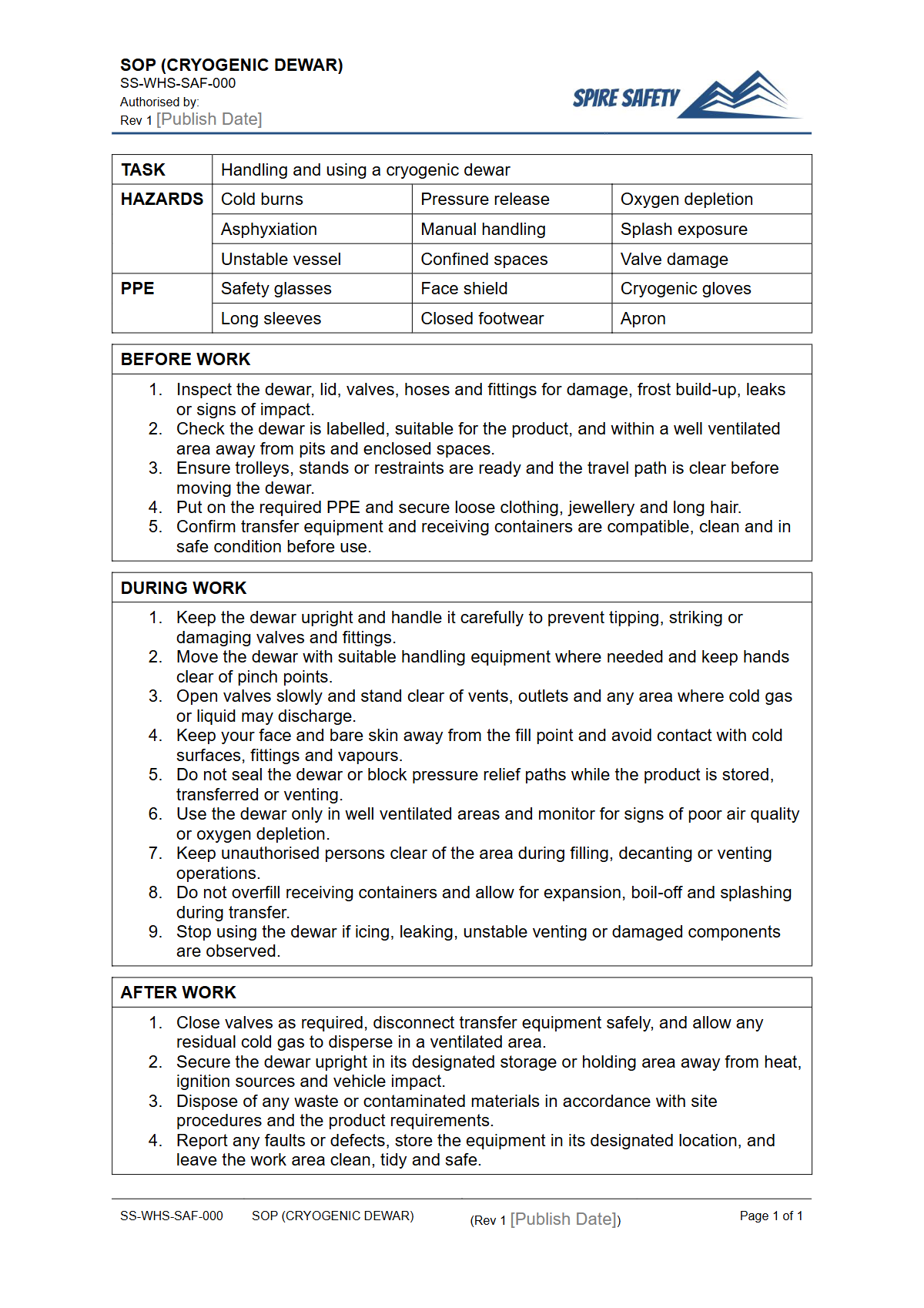
Working with cryogenic dewars, particularly those containing substances like liquid nitrogen, presents significant health and safety risks, including severe cold burns, asphyxiation, and over-pressurisation hazards. This Free Safe Operating Procedure (Cryogenic Dewar) Template provides a structured framework for documenting a safe system of work.
It is designed to help your organisation control these risks by outlining clear, step-by-step instructions for the safe handling, transport, and storage of cryogenic liquids in dewars.
Using this template helps you establish consistent procedures that align with Australian WHS best practices. It serves as a critical component within broader comprehensive WHS management systems, ensuring that all personnel are aware of the hazards and the required control measures.
The document guides you in formalising your approach to managing high-risk tasks, forming a key part of your safety documentation.
Video walkthrough
How to use the Free Safe Operating Procedure (Cryogenic Dewar) Template
This Safe Operating Procedure template is provided in both DOCX and PDF formats for your convenience. The DOCX version is fully editable, allowing you to tailor the content to your specific operational needs.
The procedure should be developed in consultation with workers who perform the task and reviewed by a competent person with expertise in cryogenics.
Important: This is a template, not a finished document. To ensure it is effective, we stress that you must customise this Safe Operating Procedure to reflect the specific types of dewars, cryogenic substances, transfer equipment, work areas, and emergency procedures relevant to your workplace.
A generic procedure is insufficient for managing your specific risks. Proper customisation is essential for fulfilling your duty of care.
Your finalised SOP should be used as a practical tool for training, inductions, and ongoing competency checks. It can also support your risk assessment process and is a document that should be reviewed during any regular WHS compliance auditing to verify its implementation and effectiveness.
When to use this Safe Operating Procedure
A Safe Operating Procedure for cryogenic dewars should be readily accessible and referenced before and during any task involving these vessels. It is a critical tool for ensuring tasks are performed correctly and safely every time. Specific situations for its use include:
- When decanting or transferring cryogenic liquids from a larger dewar to a smaller one.
- During the transport of dewars within a facility, whether manually or with handling aids.
- For the routine storage and inspection of both full and empty dewars.
- As a primary training document for new employees or workers new to handling cryogenics.
- As a reference guide for refresher training and pre-start checks.
Integrating this SOP with procedures for other relevant equipment, such as our free Air Compressor SOP template, can help build a more robust safety framework in laboratory or workshop environments.
Who should use it
This SOP is intended for a range of personnel within an organisation to ensure a shared understanding of safe work practices. Key users include:
- Persons Conducting a Business or Undertaking (PCBUs): To help meet their primary duty of care under WHS legislation by providing a safe system of work.
- Managers and Supervisors: To train workers, enforce safety protocols, and monitor compliance with the established procedure.
- Workers and Operators: As a clear, accessible guide on how to perform their tasks safely, understand the associated hazards, and respond correctly in an emergency.
- WHS Professionals: To integrate the SOP into the wider safety management system, especially for organisations pursuing ISO 45001 certification goals.
Key Hazards of Cryogenic Liquids
Understanding the specific dangers is the first step toward controlling them. Your SOP must address these primary hazards:
- Extreme Cold: Cryogenic liquids and the cold vapour they produce can cause severe cold burns, frostbite, and hypothermia upon contact with skin or eyes. Materials can also become brittle and fracture at these temperatures.
- Asphyxiation: Cryogens like nitrogen are inert gases that displace oxygen as they warm and turn into gas. In poorly ventilated or confined spaces, this can rapidly lead to an oxygen-deficient atmosphere, causing dizziness, unconsciousness, and death with little to no warning.
- Pressure Hazards: As a cryogenic liquid vaporises, it expands massively (e.g., liquid nitrogen expands by a factor of nearly 700). If a dewar is sealed or its pressure relief device is blocked, this can lead to a catastrophic vessel rupture and explosion. Moving vessels can introduce similar risks, which is why a dedicated SOP for a Conveyer System might be needed if they are transported this way.
Essential Control Measures for Cryogenic Dewars
Your customised SOP should detail specific controls based on a risk assessment. These typically fall into several categories:
- Engineering Controls: Ensuring the work area has adequate mechanical or natural ventilation to prevent oxygen displacement. Using pressure relief valves on all dewars and associated piping.
- Administrative Controls: Implementing this SOP, providing comprehensive training, using clear safety signage (e.g., "Asphyxiation Hazard"), and restricting access to trained personnel only.
- Personal Protective Equipment (PPE): Mandating the use of appropriate PPE is non-negotiable. This must include loose-fitting, insulated cryogenic gloves, a full-face shield worn over safety glasses, a lab coat or apron, and fully enclosed, non-absorbent footwear.
This document is one of many tools available to improve safety in your workplace. For more templates and guides, browse our free WHS resources library.
Common mistakes
Common mistakes to avoid
- Using incorrect or damaged PPE, such as standard leather gloves instead of rated cryogenic gloves.
- Handling cryogenic liquids in poorly ventilated rooms, cool rooms, or other confined spaces.
- Sealing or blocking the pressure relief vents on a dewar, risking catastrophic over-pressurisation.
- Failing to inspect dewars for signs of damage (e.g., external ice, loss of vacuum) before use.
Legal references
Legal considerations
The following legal requirements may be relevant to this type of work.
- Work Health and Safety Act (Harmonised) — Provides the primary duties for protecting workers and other people from work health and safety risks.
- Work Health and Safety Regulations (Harmonised) — Sets out requirements supporting the management of workplace hazards and risks.
The following codes may be relevant to this type of work.
- Managing WHS Risks Code of Practice — Provides practical guidance on identifying hazards, assessing risks and applying effective controls.
- Work Health and Safety Consultation, Cooperation and Coordination Code of Practice — Provides practical guidance on consulting workers and coordinating with other duty holders.
- Managing the Work Environment and Facilities Code of Practice — Provides practical guidance on safe work environments, workplace facilities and related controls.
Did you know
Massive Expansion
One litre of liquid nitrogen expands to approximately 700 litres of nitrogen gas at room temperature. This rapid expansion is why adequate ventilation and functioning pressure relief devices are critical safety features.
Colder Than Nature
Cryogenic liquids are colder than the lowest natural temperature ever recorded on Earth. Liquid nitrogen, a common cryogen, boils at a frigid -196°C (-321°F).
FAQ
Frequently asked questions
01What is a cryogenic dewar?
02What is the biggest risk when using liquid nitrogen?
03Is this Cryogenic Dewar SOP template ready to use immediately?
04What PPE is required for handling cryogenic liquids?
Share this resource
Free Safe Operating Procedure (Cryogenic Dewar) Template
Browse Categories
How To Use It
- 1Download and open in Word or PDF.
- 2Replace the placeholders with your business details.
- 3Get it reviewed by a WHS specialist before rollout.
Need it customised?
Our WHS consultants can adapt this template to your site, run a gap analysis, or audit what you already have in place.
Book a Free Consultation WHS consulting servicesor call 1300 156 382
Related templates
- Free Safe Operating Procedure (Culvert Clearing) Template
- Free Safe Operating Procedure (Culvert Inspection) Template
- Free Safe Operating Procedure (Customer Spill Cleanup) Template
- Free Safe Operating Procedure (Cut Flower Harvesting) Template
- Free Safe Operating Procedure (Cut To Length Line) Template
- Free Safe Operating Procedure (Cutlery Polishing) Template