
Free Safe Operating Procedure (Customer Spill Cleanup) Template
Manage spills in customer-facing areas safely and effectively with our free template. Download our Safe Operating Procedure for customer spill cleanup today.
Free Safe Operating Procedure (Customer Spill Cleanup) Template
DOCX • 126 KB + PDF
Updated Oct 2026
No signup required
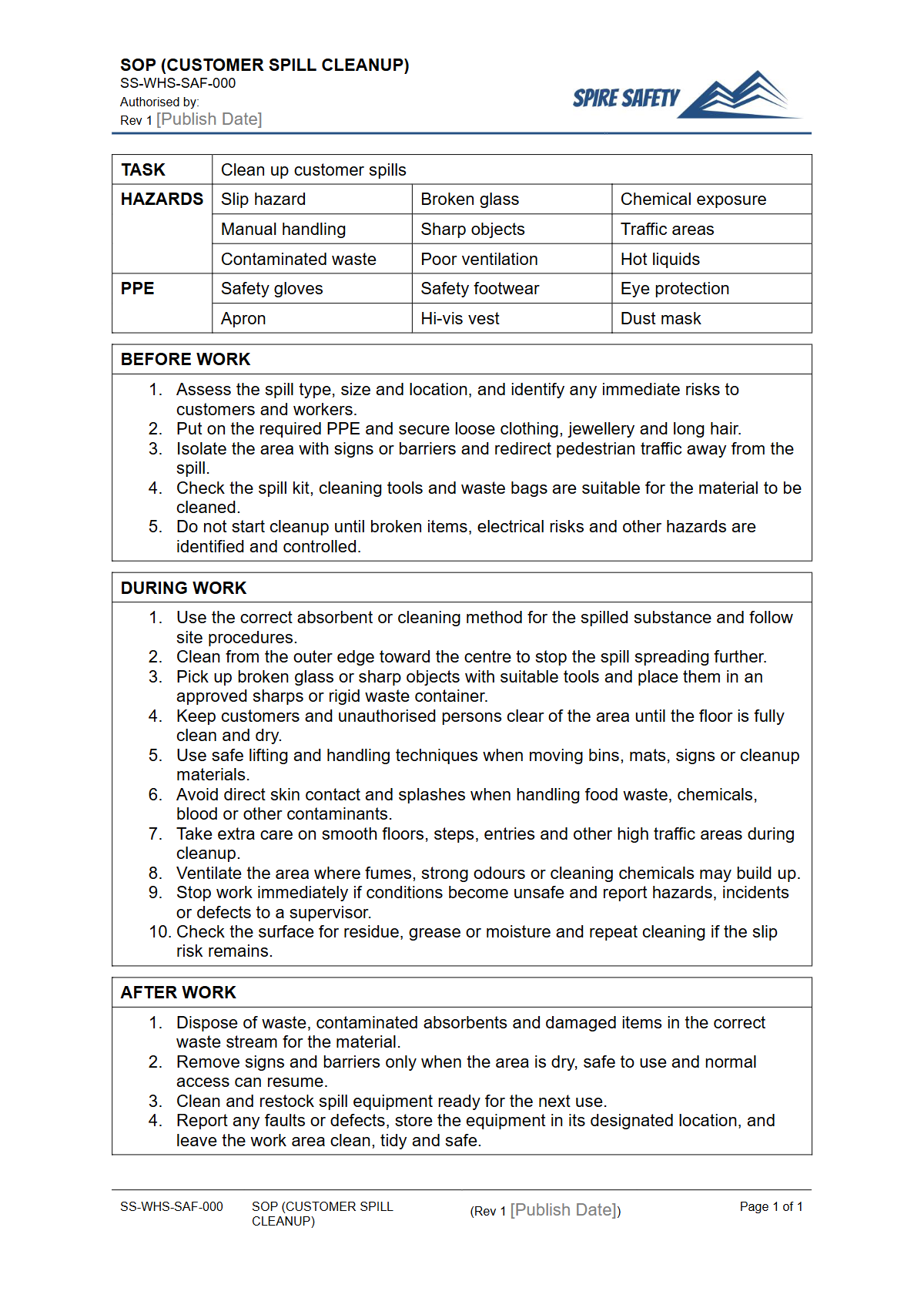
Purpose of the Free Safe Operating Procedure (Customer Spill Cleanup) Template
Spills are a common occurrence in any workplace accessible to the public, from retail stores and supermarkets to cafes and shopping centres. This Free Safe Operating Procedure (Customer Spill Cleanup) Template provides a structured framework for responding to these incidents swiftly and safely.
A documented SOP ensures that every worker knows exactly what to do, minimising the risk of slip and fall injuries to both customers and staff. It helps standardise the cleanup process, from initial assessment and hazard isolation to the final clean and disposal of waste, promoting a consistent and safe response every time.
Using a clear SOP is a fundamental part of managing workplace hazards. It serves as a vital training tool for new employees and a refresher for existing staff, forming an important part of your overall safety management system.
A well-defined procedure demonstrates your organisation's commitment to providing a safe environment for everyone on the premises, which is a key requirement under Australian WHS legislation.
Video walkthrough
How to use the Free Safe Operating Procedure (Customer Spill Cleanup) Template
This resource is available as a fully editable DOCX file, with a PDF version also provided for easy printing and sharing. To get started, download the template and open the DOCX file.
You will find pre-filled sections covering personal protective equipment (PPE), required equipment, step-by-step instructions, and post-cleanup checks. The goal is to create a procedure that is practical and specific to your operational needs.
It is crucial to understand that this is a template, not a finished document. You must customise it to reflect the specific layout, substances, equipment, and personnel responsibilities at your workplace.
We have included prompts and sections to guide this customisation. A thorough WHS compliance audit can help identify specific hazards and procedural gaps that your SOP should address.
When to use this Safe Operating Procedure
This SOP should be activated whenever a spill occurs in an area accessible to customers or the general public. It is designed primarily for non-hazardous liquid and solid spills that are common in retail and hospitality environments. This includes:
- Spilled drinks (water, soft drinks, coffee)
- Leaking refrigerated products
- Dropped food items (sauces, yoghurts, broken jars)
- Rainwater tracked into entranceways
- Minor leaks from non-hazardous containers
For large or hazardous chemical spills, a separate, more detailed emergency response procedure is required. This SOP is intended for the routine, everyday incidents that pose a significant slip, trip, and fall risk if not managed correctly.
Just as you need a clear process for specific machinery, like that outlined in our Free Air Compressor SOP, you need a clear process for common tasks like spill response.
Who should use it
This procedure is designed for any person responsible for maintaining safety and cleanliness in public-facing areas. This typically includes:
- Retail staff and team members
- Cleaning and maintenance personnel
- Hospitality workers (front of house)
- Facilities management teams
- Supervisors and managers responsible for WHS
Everyone on the team should be trained on the procedure so they can either perform the cleanup safely or secure the area and report the spill to the designated person immediately. Integrating this SOP into your broader WHS management systems ensures that responsibilities are clearly assigned and training is properly recorded.
This proactive approach helps build a strong safety culture within the organisation.
Implementing and Reviewing Your Procedure
Once you have customised the SOP, it should be made readily available to all relevant workers. Store a copy in a central location, such as a staff room or cleaning storeroom, and consider digital access for quick reference.
Regular toolbox talks are a great way to review the procedure and reinforce key steps.
Safe work methods are not static. It's essential to review your spill cleanup SOP annually, or whenever there is a change in your work environment, cleaning chemicals, or equipment.
Reviewing is also critical after any spill-related incident or near-miss to identify any opportunities for improvement. The principles of documenting processes apply across all workplace tasks, whether it's cleaning a spill or following our FREE Conveyer System SOP for plant operation.
If you require assistance tailoring documents to your specific operational risks, our WHS consulting team can provide expert guidance.
By implementing and maintaining a robust SOP, you are taking a practical step towards fulfilling your duty of care and protecting people from harm. For more templates and safety guides, you can browse our complete free WHS resources library.
Common mistakes
Common mistakes to avoid
- Forgetting to place 'wet floor' or other warning signs around the spill area before and after cleaning.
- Using the wrong cleaning agent or equipment for the type of substance spilled.
- Failing to wear appropriate personal protective equipment (PPE), such as gloves or safety glasses.
- Not documenting the incident, which prevents analysis and future improvements to safety procedures.
Legal references
Legal considerations
The following legal requirements may be relevant to this type of work.
- Work Health and Safety Act (Harmonised) — Provides the primary duties for protecting workers and other people from work health and safety risks.
- Work Health and Safety Regulations (Harmonised) — Sets out requirements supporting the management of workplace hazards and risks.
The following codes may be relevant to this type of work.
- Managing WHS Risks Code of Practice — Provides practical guidance on identifying hazards, assessing risks and applying effective controls.
- Work Health and Safety Consultation, Cooperation and Coordination Code of Practice — Provides practical guidance on consulting workers and coordinating with other duty holders.
- Managing the Work Environment and Facilities Code of Practice — Provides practical guidance on safe work environments, workplace facilities and related controls.
Did you know
A Common Hazard
According to Safe Work Australia, slips, trips and falls are a leading cause of serious injuries in Australian workplaces, resulting in thousands of workers compensation claims each year.
Check the SDS
Even common cleaning chemicals require a Safety Data Sheet (SDS), which provides critical information on safe handling, storage, and first aid measures. Always have the SDS for your cleaning agents readily accessible.
FAQ
Frequently asked questions
01What should be included in a spill cleanup SOP?
02How often should we review our spill cleanup procedure?
03Who is responsible for cleaning up a spill in a customer area?
04What's the difference between a minor and a major spill?
Share this resource
Free Safe Operating Procedure (Customer Spill Cleanup) Template
Browse Categories
How To Use It
- 1Download and open in Word or PDF.
- 2Replace the placeholders with your business details.
- 3Get it reviewed by a WHS specialist before rollout.
Need it customised?
Our WHS consultants can adapt this template to your site, run a gap analysis, or audit what you already have in place.
Book a Free Consultation WHS consulting servicesor call 1300 156 382
Related templates
- Free Safe Operating Procedure (Cut Flower Harvesting) Template
- Free Safe Operating Procedure (Cut To Length Line) Template
- Free Safe Operating Procedure (Cutlery Polishing) Template
- Free Safe Operating Procedure (CV Shaft Removal) Template
- Free Safe Operating Procedure (Cyclone Plant) Template
- Free Safe Operating Procedure (Cyclone Separator) Template