
Free Safe Operating Procedure (Cut To Length Line) Template
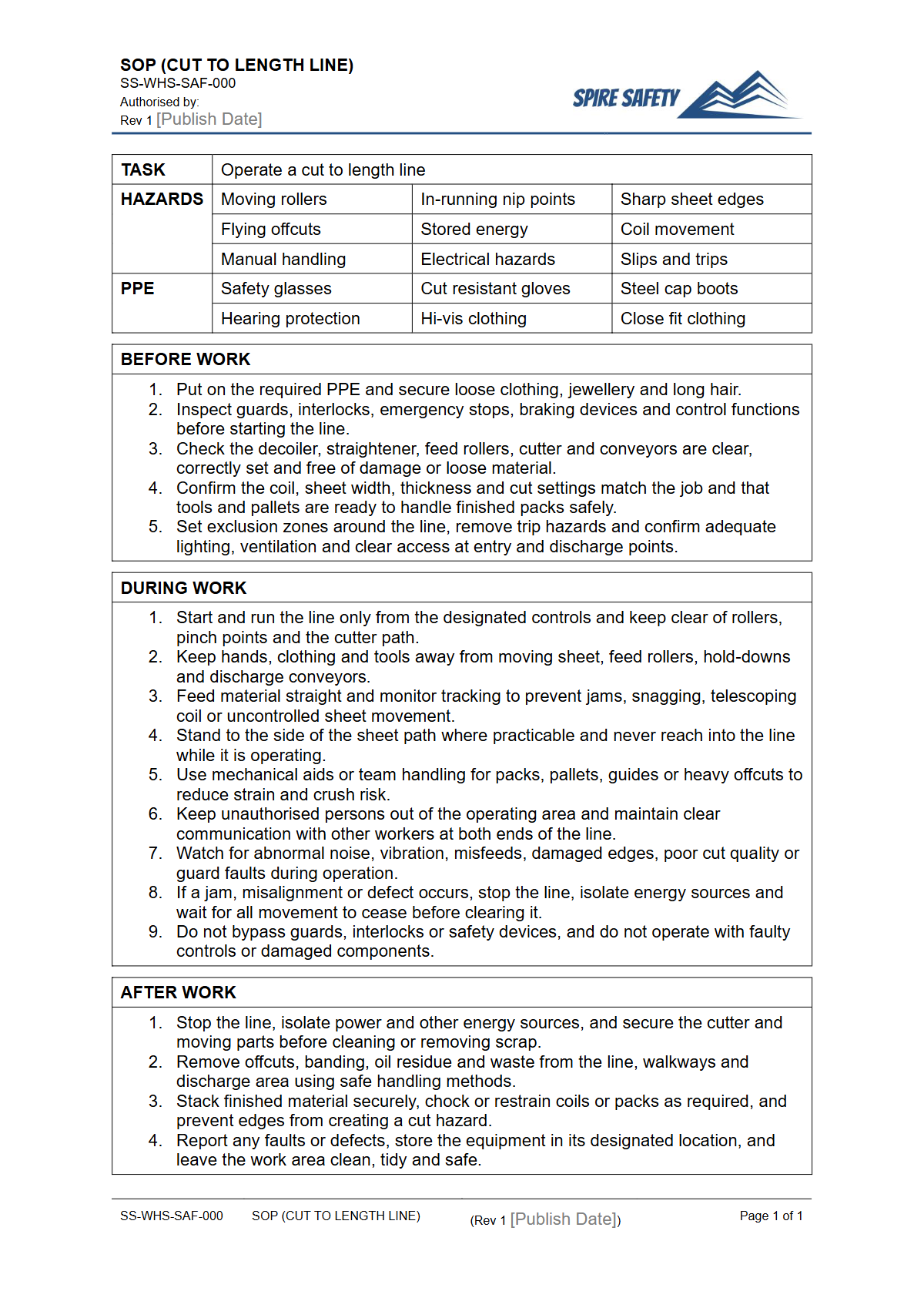
Download our free Safe Operating Procedure template for cut to length lines. This document helps you outline key steps and hazards for safe operation.
Free Safe Operating Procedure (Cut To Length Line) Template
DOCX • 126 KB + PDF
Updated Oct 2026
No signup required
Purpose of the Free Safe Operating Procedure (Cut To Length Line) Template
Operating a cut to length line involves significant risks, including entanglement in rollers, cuts from sharp metal edges, and crushing injuries from heavy coils. This Free Safe Operating Procedure (Cut To Length Line) Template provides a structured framework for documenting the required steps to operate this machinery safely.
It is designed to help your organisation identify hazards, implement risk controls, and establish a clear, repeatable process for workers. By formalising your procedures, you create a vital training tool and a reference point for safe work, aligning your operations with Australian WHS best practices.
This document is a starting point for managing risks associated with plant and machinery. Many cut to length lines incorporate automated feeding mechanisms, which share hazards with other types of machinery.
You may also find our free Conveyer System SOP useful for related processes.
Video walkthrough
How to use the Free Safe Operating Procedure (Cut To Length Line) Template
This template must be adapted to the specific context of your workplace. A generic procedure is not sufficient to control risks effectively.
To use this Safe Operating Procedure, download the DOCX file and consult with the workers who actually operate the machinery to ensure the steps reflect reality. You must conduct a specific risk assessment for your make and model of cut to length line and incorporate the findings into this document.
Important Note: We have provided this template as a starting point. It is your responsibility to ensure it is customised to reflect the specific equipment, processes, hazards, and controls in your workplace.
If you need expert assistance with risk assessments or developing your safety documentation, our WHS consulting services can provide tailored support.
Key Customisation Steps
- Plant and Equipment Details: Replace the placeholder text with the specific make, model, and location of your cut to length line.
- Pre-Operational Checks: Detail all checks required before starting the machine, such as inspecting emergency stops, ensuring guards are in place, and verifying the work area is clear. Loading heavy metal coils often requires other equipment; if a telehandler is used, consider documenting its use with a specific Telehandler SOP template.
- Step-by-Step Procedures: Clearly outline the sequence for starting, operating, and shutting down the line. Include instructions for loading coils, threading the material, setting the length, and managing the finished sheets.
- Personal Protective Equipment (PPE): List all mandatory PPE, such as cut-resistant gloves, safety glasses, steel-capped boots, and high-visibility clothing.
- Emergency Procedures: Document the process for emergency shutdowns, responding to injuries, and dealing with machine malfunctions.
When to use this Safe Operating Procedure
A Safe Operating Procedure for a cut to length line should be used as a core part of your safety management system. It is a critical document during worker induction and task-specific training.
It should also be readily available in the work area for operators to reference at any time. The SOP serves as a benchmark for workplace inspections and behavioural observations.
Furthermore, reviewing and updating this document should be a key action following any incident, near miss, or as part of regular WHS compliance auditing to ensure its continued relevance.
Who should use this Safe Operating Procedure
This document is intended for multiple roles within an organisation. Supervisors and WHS managers use it to ensure a standardised, safe procedure is established, communicated, and enforced.
Machine operators are the primary end-users, relying on it for training and as a daily reference to perform their tasks safely and correctly. Maintenance personnel may also refer to the SOP to understand the correct shutdown and isolation procedures before commencing work on the equipment.
Integrating the SOP into Your WHS Management System
A Safe Operating Procedure is most effective when it is part of a holistic safety framework, not a standalone document. It should be directly linked to your hazard register, risk assessments, and training records.
Effective integration means the controls listed in your risk assessment are the ones detailed in the SOP, and your training program teaches workers how to apply the SOP in practice. This document should be a living part of your comprehensive WHS management systems, subject to regular review and continuous improvement.
By embedding this procedure into your daily operations and broader safety systems, you move from merely having a document to actively managing risk. Explore our free WHS resources library for more templates and guides to support your safety objectives.
Common mistakes
Common mistakes to avoid
- Using a generic template without customising it for the specific make and model of the machine.
- Failing to consult with operators who have hands-on experience with the equipment's unique hazards.
- Treating the SOP as a static document instead of reviewing and updating it after incidents or process changes.
- Neglecting to provide practical, hands-on training on the SOP, assuming workers will just read and follow it.
Legal references
Legal considerations
The following legal requirements may be relevant to this type of work.
- Work Health and Safety Act (Harmonised) — Provides the primary duties for protecting workers and other people from work health and safety risks.
- Work Health and Safety Regulations (Harmonised) — Sets out requirements supporting the management of workplace hazards and risks.
The following codes may be relevant to this type of work.
- Managing WHS Risks Code of Practice — Provides practical guidance on identifying hazards, assessing risks and applying effective controls.
- Work Health and Safety Consultation, Cooperation and Coordination Code of Practice — Provides practical guidance on consulting workers and coordinating with other duty holders.
- Managing the Work Environment and Facilities Code of Practice — Provides practical guidance on safe work environments, workplace facilities and related controls.
Did you know
Nip Point Dangers
The rollers used to straighten metal in a cut to length line create powerful nip points. These can draw in loose clothing, hair, or limbs in a fraction of a second, making effective machine guarding a critical safety control.
Coil Weight
A single coil of steel processed by a cut-to-length line can weigh several tonnes. Incorrect handling during loading and unloading is a major cause of serious crushing injuries and musculoskeletal disorders.
FAQ
Frequently asked questions
01What is a cut to length line?
02Is a Safe Operating Procedure legally required for a cut to length line in Australia?
03Who is responsible for writing a cut to length line SOP?
04How often should an SOP for a cut to length line be reviewed?
Share this resource
Free Safe Operating Procedure (Cut To Length Line) Template
Browse Categories
How To Use It
- 1Download and open in Word or PDF.
- 2Replace the placeholders with your business details.
- 3Get it reviewed by a WHS specialist before rollout.
Need it customised?
Our WHS consultants can adapt this template to your site, run a gap analysis, or audit what you already have in place.
Book a Free Consultation WHS consulting servicesor call 1300 156 382
Related templates
- Free Safe Operating Procedure (Cutlery Polishing) Template
- Free Safe Operating Procedure (CV Shaft Removal) Template
- Free Safe Operating Procedure (Cyclone Plant) Template
- Free Safe Operating Procedure (Cyclone Separator) Template
- Free Safe Operating Procedure (Cylinder Cage Access) Template
- Free Safe Operating Procedure (Cylinder Leak Test) Template