
Free Safe Operating Procedure (Cylinder Leak Test) Template
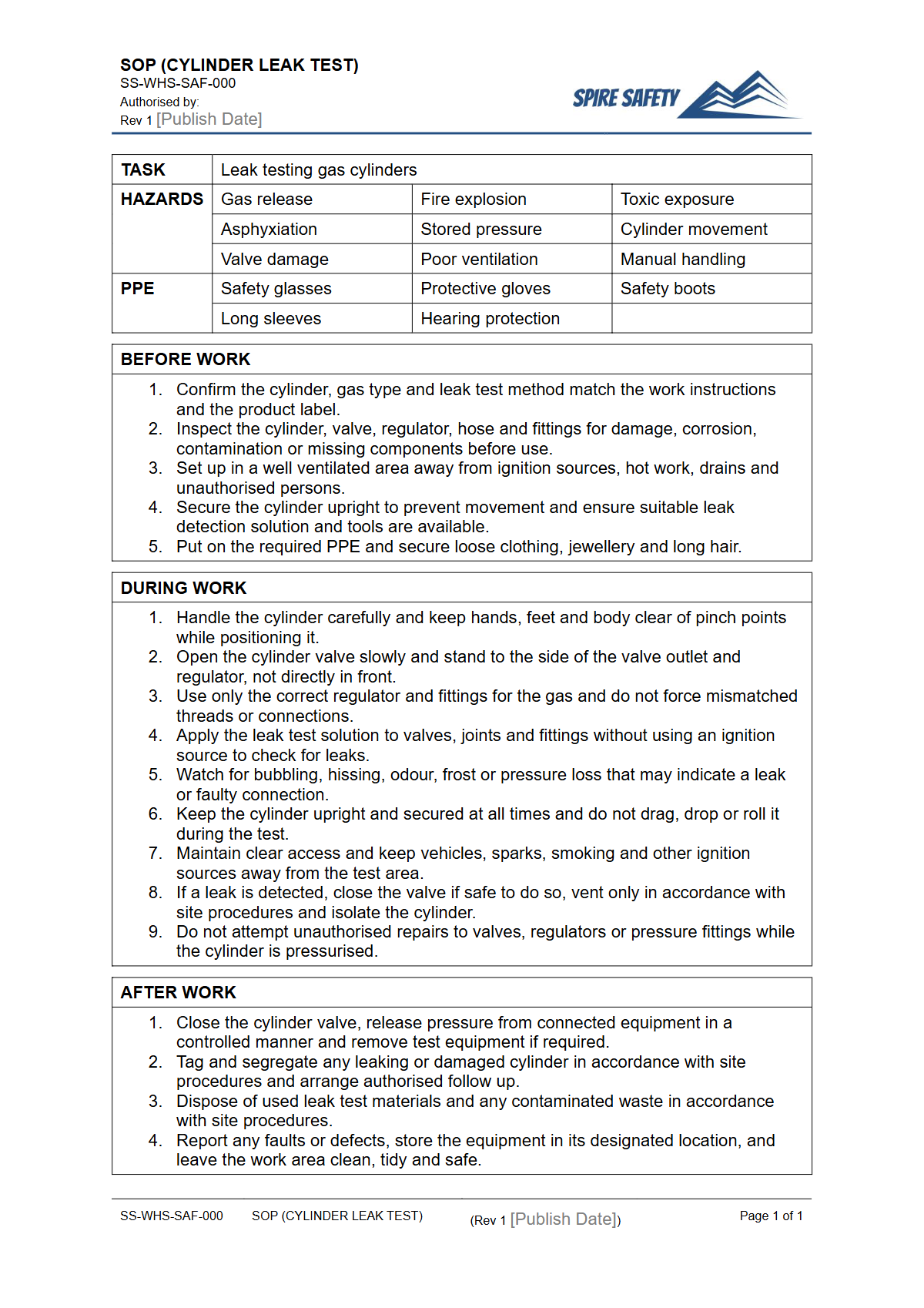
Download our free Safe Operating Procedure for cylinder leak testing to outline a safe system of work.
Free Safe Operating Procedure (Cylinder Leak Test) Template
DOCX • 126 KB + PDF
Updated Oct 2026
No signup required
Purpose of the Free Safe Operating Procedure (Cylinder Leak Test) Template
Handling compressed gas cylinders comes with significant risks, including fire, explosion, asphyxiation, and chemical hazards. This Free Safe Operating Procedure (Cylinder Leak Test) Template provides a structured framework for businesses to document a consistent, step-by-step process for safely checking gas cylinders for leaks.
A documented SOP is a fundamental control measure that helps your organisation manage the risks associated with stored energy in pressurised systems, ensuring workers are not exposed to unnecessary danger. Implementing this procedure helps formalise safety requirements, support worker training, and demonstrate a commitment to proactive risk management.
The primary purpose of this Safe Operating Procedure is to minimise the likelihood of an incident by outlining pre-start checks, the specific testing sequence, and appropriate actions if a leak is detected. Using this template helps standardise the task across all personnel, reducing the chance of errors or missed steps.
It serves as an excellent starting point for any workplace that uses gas cylinders, forming a key part of your overall safety management program. A clear process for testing cylinders is just as important as having one for machinery, like the process outlined in our Air Compressor SOP (Safe Operating Procedure) Template.
Video walkthrough
How to use the Free Safe Operating Procedure (Cylinder Leak Test) Template
This document is a template and not a finished procedure. To make it effective, you must customise it to reflect the specific hazards and work environment of your site.
After downloading the DOCX file, review each section and adapt the content. You should add details such as the specific types of gases and cylinders used, the designated storage and testing areas, the exact leak detection solution approved for use, and your site's emergency contacts and procedures.
We strongly recommend this customisation is done in consultation with the workers who will be performing the task, as well as their supervisors.
Once tailored to your operations, the SOP should be used as a training tool for all relevant employees to ensure they understand the process and risks involved. It should be made readily accessible in the work area where cylinder leak tests are performed.
This document forms a small but important part of wider comprehensive WHS management systems, which integrate all aspects of safety into your daily operations. Remember to review and update the SOP regularly, especially after an incident or when new equipment or gases are introduced.
When to perform a cylinder leak test
A cylinder leak test should be a routine part of your operational procedures. It is not a one-time check but a recurring activity that should be performed at several key points.
A test must be conducted each time a cylinder is connected to a regulator or equipment for the first time, and every time a cylinder is changed over. This ensures the integrity of both the cylinder valve and the connection points.
Additionally, tests should be integrated into your periodic inspection schedule for cylinders in storage or those attached to equipment but not in active use. It is also good practice to perform a test if a cylinder has been moved significant distances, has been potentially dropped or knocked, or if anyone smells or suspects a leak.
Documenting these checks provides a valuable record for compliance and can be a key component of your regular WHS compliance auditing program, demonstrating that controls are being consistently applied.
Who should use this Safe Operating Procedure
This Safe Operating Procedure should be used by any person required to handle, connect, or work with compressed gas cylinders. This includes workers in a wide range of industries such as welding and fabrication, automotive repair, hospitality (for beverage gases), laboratories, medical facilities, and construction.
It is essential that only workers who have received adequate information, training, and instruction on the specific procedures and hazards are permitted to perform these tests.
Supervisors and managers also have a critical role. They must ensure that the SOP is being followed correctly, that workers are competent to perform the task, and that all necessary equipment, including personal protective equipment (PPE) and leak detection fluid, is available and in good condition.
Implementing a clear SOP for cylinder testing is as fundamental as managing risks for other workshop tasks, such as those covered in our FREE Circular Saw SOP Template. For complex environments with multiple gas types, seeking external advice can help ensure all risks are covered; our professional WHS consulting services can provide tailored guidance.
For more procedural templates and safety resources, you can explore our complete free WHS resources library, which covers a broad range of equipment and high-risk activities. Standardising your processes with clear documentation is one of the most effective ways to build a strong safety culture in your organisation.
Common mistakes
Common mistakes to avoid
- Using an open flame or lighter to check for leaks instead of an approved solution.
- Performing leak tests in a poorly ventilated area or confined space.
- Overtightening valve connections with excessive force, which can damage threads and seals.
- Failing to wear appropriate personal protective equipment (PPE), such as safety glasses and gloves.
Legal references
Legal considerations
The following legal requirements may be relevant to this type of work.
- Work Health and Safety Act (Harmonised) — Provides the primary duties for protecting workers and other people from work health and safety risks.
- Work Health and Safety Regulations (Harmonised) — Sets out requirements supporting the management of workplace hazards and risks.
The following codes may be relevant to this type of work.
- Managing WHS Risks Code of Practice — Provides practical guidance on identifying hazards, assessing risks and applying effective controls.
- Work Health and Safety Consultation, Cooperation and Coordination Code of Practice — Provides practical guidance on consulting workers and coordinating with other duty holders.
- Managing the Work Environment and Facilities Code of Practice — Provides practical guidance on safe work environments, workplace facilities and related controls.
Did you know
Valve Protection
Cylinder valve caps aren't just for keeping the valve clean; they are a critical safety device designed to protect the fragile valve from being damaged or snapped off if the cylinder is knocked over.
The Smell of Gas
Many flammable gases like Liquefied Petroleum Gas (LPG) are naturally odourless. The distinct 'gas smell' is an odorant called mercaptan that is deliberately added to help in the early detection of leaks.
FAQ
Frequently asked questions
01What should I use to check for a gas cylinder leak?
02How often should cylinder leak tests be performed?
03Is this SOP template suitable for all types of gas cylinders?
04What's the most critical step in a cylinder leak test SOP?
Share this resource
Free Safe Operating Procedure (Cylinder Leak Test) Template
Browse Categories
How To Use It
- 1Download and open in Word or PDF.
- 2Replace the placeholders with your business details.
- 3Get it reviewed by a WHS specialist before rollout.
Need it customised?
Our WHS consultants can adapt this template to your site, run a gap analysis, or audit what you already have in place.
Book a Free Consultation WHS consulting servicesor call 1300 156 382
Related templates
- Free Safe Operating Procedure (Dairy Pasteuriser) Template
- Free Safe Operating Procedure (Dairy Yard Cleaning) Template
- Free Safe Operating Procedure (Damaged Freight Hold) Template
- Free Safe Operating Procedure (Dance Floor Cleaning) Template
- Free Safe Operating Procedure (Data Logger) Template
- Free Safe Operating Procedure (Davit Arm) Template