
Free Safe Operating Procedure (Davit Arm) Template
Clearly define the steps for safely operating a davit arm with our structured template. Download your free Safe Operating Procedure to standardise your processes.
Free Safe Operating Procedure (Davit Arm) Template
DOCX • 126 KB + PDF
Updated Oct 2026
No signup required
Purpose of the Free Safe Operating Procedure (Davit Arm) Template
Davit arms are critical pieces of safety and lifting equipment, used in situations from confined space rescue to materials handling at height. Operating them without a clear, documented process introduces significant risks, including structural failure, falls from height, and dropped objects.
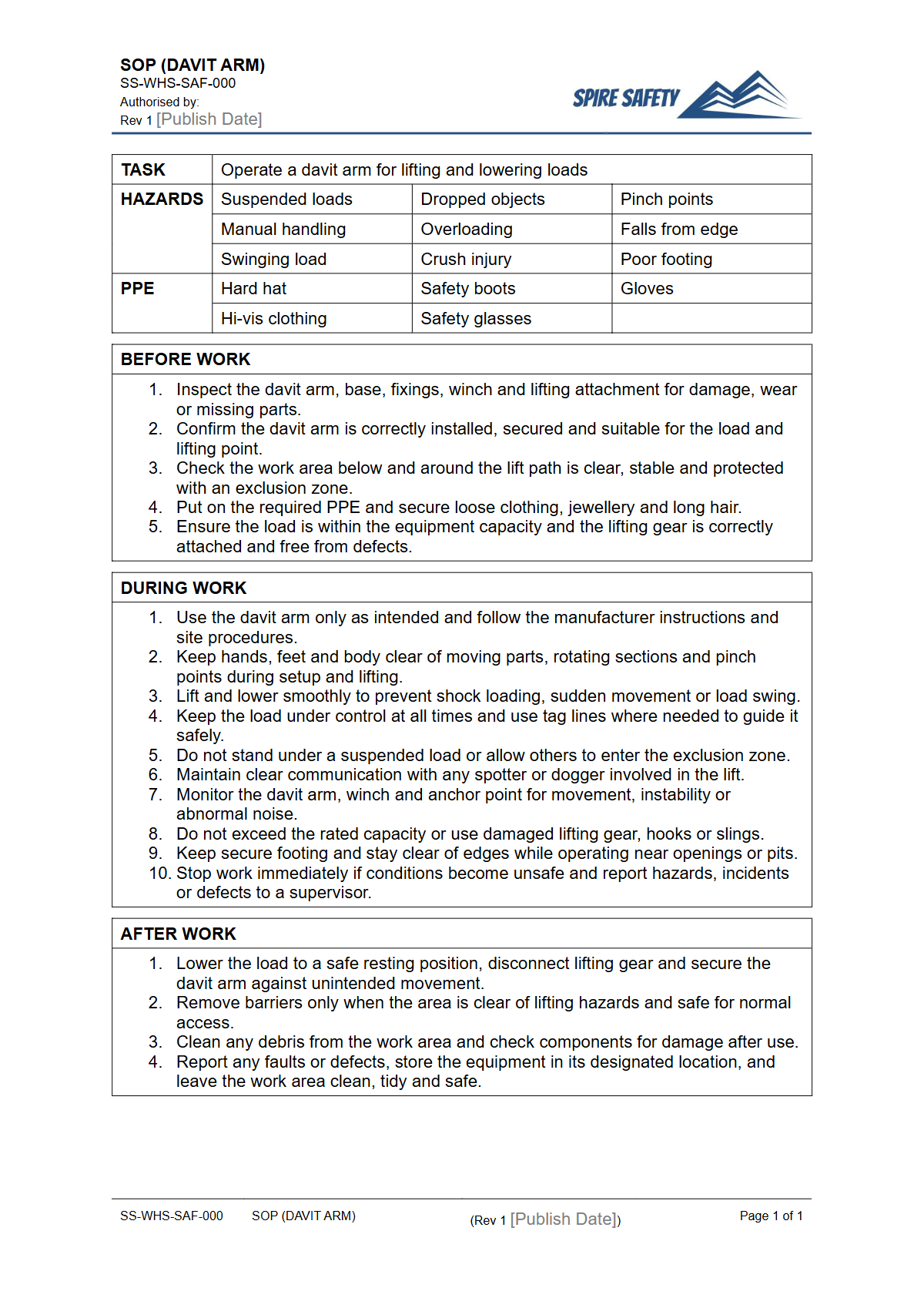
This Free Safe Operating Procedure (Davit Arm) Template provides a structured framework for outlining the required steps to use this equipment safely and effectively. By documenting pre-operational checks, setup instructions, and emergency actions, you create a consistent, repeatable process that reduces the likelihood of incidents.
An SOP is a fundamental component of effective WHS management systems, serving as both a guide for workers and evidence of your organisation's commitment to safety.
Video walkthrough
How to use the Free Safe Operating Procedure (Davit Arm) Template
This Safe Operating Procedure for davit arms is designed as a starting point. Download the DOCX file to edit and adapt it to your specific operational context.
Your procedure must account for the make and model of your davit systems, the environments they are used in (e.g., rooftops, excavations, marine settings), and the tasks being performed. It should be developed in consultation with workers and aligned with your existing risk assessments and the manufacturer's operating manual.
Similar to how you would customise a FREE Telehandler SOP Template for that specific machine, this document requires site-specific details to be effective.
Important: This template provides a solid foundation, but it is not a complete, ready-to-use document. We have not been to your workplace, so you MUST customise this SOP to reflect your specific davit arm models, site conditions, tasks, and control measures identified in your risk assessments.
When to use a Davit Arm SOP
A formal SOP should be in place and strictly followed whenever a davit arm is used. The risks associated with these operations are too high to rely on informal knowledge alone. Key applications demanding a documented procedure include:
- Confined Space Entry & Rescue: Lowering and raising personnel, and providing a secure anchor point for fall arrest systems.
- Fall Protection: Serving as an anchor point for workers operating near an exposed edge, such as on a roof or platform.
- Materials Handling: Lifting tools, equipment, or materials to and from different levels, particularly where cranes are not feasible.
- Marine & Offshore Operations: Launching and retrieving small craft or equipment from a vessel or platform.
Having a documented procedure is also critical for demonstrating due diligence. During a safety inspection or WHS compliance auditing process, regulators will expect to see formalised procedures for high-risk equipment.
Who should use it
Responsibility for the davit arm SOP extends across multiple roles within an organisation:
- PCBU (Person Conducting a Business or Undertaking): Holds the primary duty of care to ensure a safe system of work is provided, which includes developing and implementing the SOP.
- Supervisors and Managers: Are responsible for ensuring workers are trained on the SOP and that it is consistently followed on site. They must also enforce its requirements.
- Workers/Operators: Must be trained and deemed competent in the SOP's content before operating any davit arm. They are responsible for following the procedure, including conducting all required checks.
- Safety Officers: Use the SOP as a tool for training, inductions, and workplace inspections to verify correct processes are being followed.
Key Procedural Steps to Include
A robust davit arm SOP should be logical and easy to follow, covering the entire lifecycle of the task. While our template provides a comprehensive structure, ensure your final version clearly details your specific requirements for each stage.
Like our FREE Conveyer System SOP, this procedure should break down a complex task into manageable steps. Key sections include:
- Pre-Operational Checks: A detailed checklist for inspecting the davit base and anchor point, mast and arm, winch, cables or ropes, and any associated hardware before use.
- Setup and Assembly: Step-by-step instructions for assembling the davit arm correctly, ensuring all pins and locking mechanisms are secure.
- Work Area Preparation: Steps for establishing exclusion zones, checking for overhead or ground-level hazards, and ensuring stable footing.
- Lifting/Lowering Operations: Clear guidance on attaching the load, maintaining control, communicating with the team, and respecting the Safe Working Load (SWL).
- Emergency Procedures: Specific actions to take in the event of equipment failure, a fall, or other emergencies.
- Shutdown and Storage: Procedures for safely dismantling, cleaning, inspecting, and storing the davit arm and its components.
Integrating the SOP into Your Safety System
A Safe Operating Procedure is most effective when it is a living document integrated into your broader safety framework. It should not be a file that just sits on a shelf.
Use the davit arm SOP as a central document for practical, on-the-job training and competency assessments. Refer to it during toolbox talks before work commences, especially when site conditions change.
The procedure should also support and be referenced by other key safety documents, such as risk assessments and Safe Work Method Statements (SWMS) for any associated high-risk construction work. To discover other templates and checklists that can support your safety system, explore our complete free WHS resources library.
Common mistakes
Common mistakes to avoid
- Exceeding the rated Safe Working Load (SWL) of the davit arm or its components.
- Failing to conduct and document thorough pre-use inspections of the base, structure, and winch.
- Using incompatible components from different manufacturers for the base, mast, and winch.
- Neglecting to establish and maintain a clear exclusion zone below the lifting area.
Legal references
Legal considerations
The following legal requirements may be relevant to this type of work.
- Work Health and Safety Act (Harmonised) — Provides the primary duties for protecting workers and other people from work health and safety risks.
- Work Health and Safety Regulations (Harmonised) — Sets out requirements supporting the management of workplace hazards and risks.
The following codes may be relevant to this type of work.
- Managing WHS Risks Code of Practice — Provides practical guidance on identifying hazards, assessing risks and applying effective controls.
- Work Health and Safety Consultation, Cooperation and Coordination Code of Practice — Provides practical guidance on consulting workers and coordinating with other duty holders.
- Managing the Work Environment and Facilities Code of Practice — Provides practical guidance on safe work environments, workplace facilities and related controls.
Did you know
Naval Origins
The term 'davit' originates from 17th-century naval architecture, where pairs of davits were used to suspend, lower, and raise ship's boats, such as lifeboats.
Lifting Equipment Classification
Under Australian WHS Regulations, davit arms are classified as lifting equipment. This means they are subject to specific requirements for regular inspection, maintenance, and record-keeping by a competent person.
FAQ
Frequently asked questions
01What is a Safe Operating Procedure for a davit arm?
02Is a Davit Arm SOP a legal requirement in Australia?
03How often should a davit arm SOP be reviewed?
04Who is responsible for creating and implementing the Davit Arm SOP?
Share this resource
Free Safe Operating Procedure (Davit Arm) Template
Browse Categories
How To Use It
- 1Download and open in Word or PDF.
- 2Replace the placeholders with your business details.
- 3Get it reviewed by a WHS specialist before rollout.
Need it customised?
Our WHS consultants can adapt this template to your site, run a gap analysis, or audit what you already have in place.
Book a Free Consultation WHS consulting servicesor call 1300 156 382
Related templates
- Free Safe Operating Procedure (De-Icing Vehicle) Template
- Free Safe Operating Procedure (Dead Animal Handling) Template
- Free Safe Operating Procedure (Deck Washing) Template
- Free Safe Operating Procedure (Decoiler) Template
- Free Safe Operating Procedure (Deep Fryer - Standard Operation) Template
- Free Safe Operating Procedure (Defibrillator Operation) Template