
Free Safe Operating Procedure (De-Icing Vehicle) Template
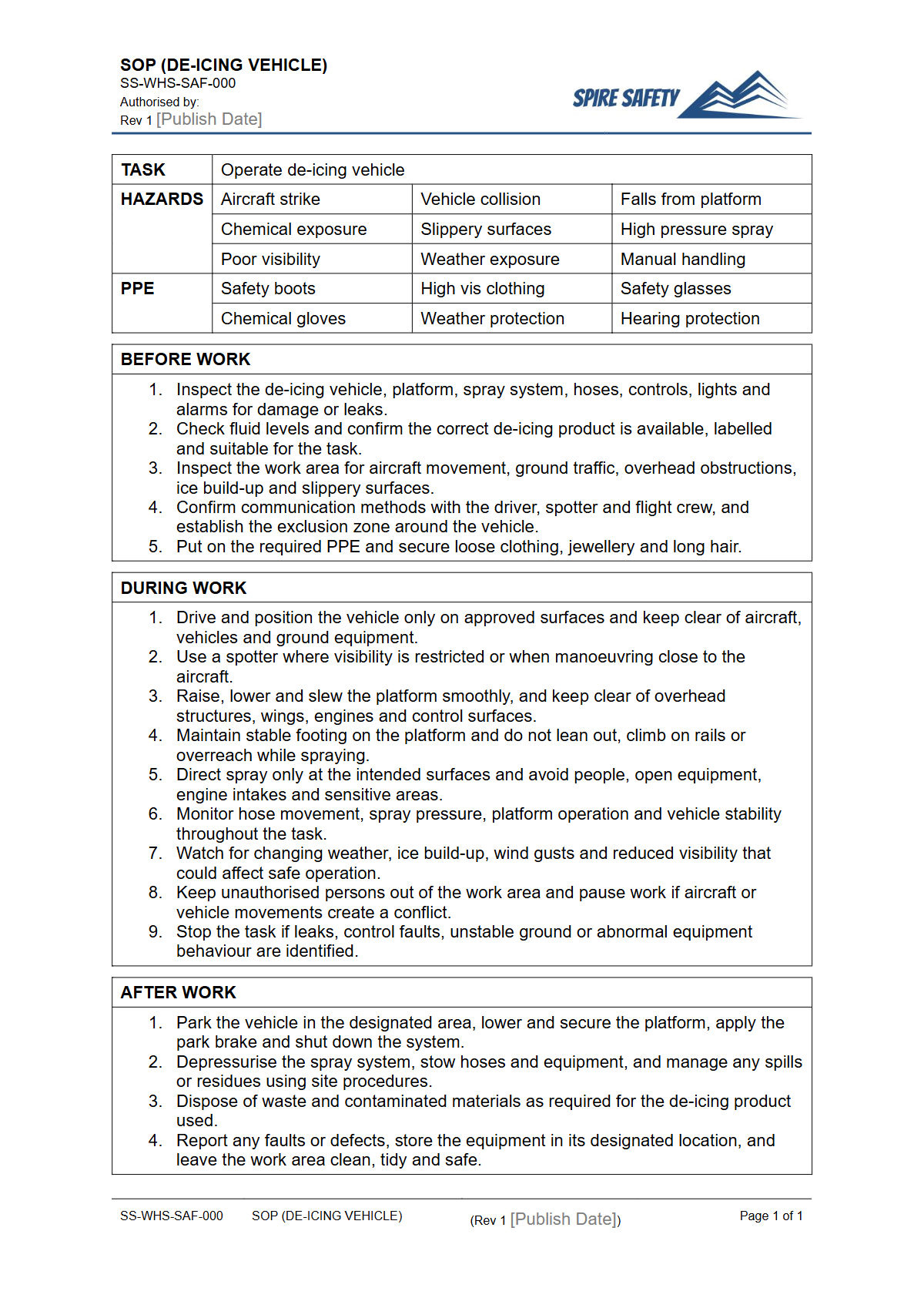
Formalise your procedures for operating de-icing vehicles safely with our structured template. Download your free Safe Operating Procedure to get started.
Free Safe Operating Procedure (De-Icing Vehicle) Template
DOCX • 126 KB + PDF
Updated Oct 2026
No signup required
Purpose of the Free Safe Operating Procedure (De-Icing Vehicle) Template
Operating a de-icing vehicle involves significant risks, including exposure to hazardous chemicals, working in cold and slippery conditions, and managing mobile plant in potentially busy operational areas like airports or transport depots. This Free Safe Operating Procedure (De-Icing Vehicle) Template provides a structured framework for documenting a clear, step-by-step process to perform this task safely.
By formalising your procedures, you can ensure all operators understand the required safety measures, from pre-start checks to clean-up.
A documented SOP is a critical tool for worker training, induction, and ongoing competency management. It helps standardise work methods, reduce the likelihood of incidents, and demonstrates a commitment to workplace health and safety.
Implementing clear procedures is a fundamental component of effective WHS management systems, helping your organisation meet its safety obligations.
Video walkthrough
How to use the Free Safe Operating Procedure (De-Icing Vehicle) Template
This template is designed as a comprehensive starting point, not a finished document. You can download it as a DOCX file for easy editing or as a PDF for reference.
It is crucial that you customise the content to align with the specific circumstances of your workplace.
Important: We provide this template as a guide. You must adapt it to reflect your specific de-icing vehicles (make and model), the types of de-icing and anti-icing fluids used, your site layout, local environmental factors, and relevant state or territory WHS regulations.
Key areas requiring customisation include Personal Protective Equipment (PPE) requirements, site-specific emergency contacts, and procedures based on the Safety Data Sheets (SDS) for your chemicals.
Like other specialised equipment, a de-icing vehicle has unique operational risks. Proper documentation is just as important for it as it is for equipment covered in our FREE Telehandler SOP Template.
Key Elements of a De-Icing Vehicle Safe Operating Procedure
A robust SOP for a de-icing vehicle should be logical, clear, and cover all stages of the task. Our template is organised to help you capture the essential details for each phase, ensuring nothing is overlooked.
Pre-Operational Checks
Before any de-icing fluid is sprayed, operators must conduct thorough pre-start inspections. This includes checking the vehicle's general condition (tyres, lights, brakes), verifying fluid levels (fuel, hydraulic oil, de-icing fluid), ensuring spray nozzles are clear and functioning correctly, and confirming that all safety equipment, such as flashing beacons and communication systems, is operational. This process is similar to the pre-start routines for other heavy equipment, such as those detailed in a FREE Grader SOP (Safe Operating Procedure) Template.
Chemical Handling and Preparation
This section outlines the safe procedures for handling, mixing, and loading de-icing fluids. It should reference the specific requirements listed in the product's Safety Data Sheet (SDS), including required PPE (e.g., chemical-resistant gloves, safety glasses), spill containment measures, and correct mixing ratios.
Clear instructions minimise the risk of chemical burns, inhalation injuries, and environmental contamination.
Operating Procedures
Detail the step-by-step process for the de-icing task itself. This includes establishing exclusion zones, communicating with other personnel, correct application techniques to ensure even coverage without wastage, and managing vehicle movement in potentially congested or low-visibility areas.
The procedure should specify speeds and safe following distances.
Post-Operational Tasks
Once the job is complete, the procedure should guide the operator through shutdown, cleaning, and storage. This involves safely parking the vehicle, cleaning spray equipment to prevent corrosion and blockages, restocking consumables, and reporting any defects or issues observed during operation. Proper shutdown is critical for all plant, including auxiliary systems which may rely on compressed air, a topic covered in our Free Air Compressor SOP (Safe Operating Procedure) Template.
Integrating the SOP into Your Safety System
A written procedure is only effective when it is actively used and integrated into your daily operations. This involves training all operators on the SOP's contents and verifying their understanding and competence before authorising them to operate the equipment.
Supervisors play a key role in ensuring the procedures are consistently followed on the ground.
The SOP should be a living document, subject to regular review—at least annually, or whenever there is a change in equipment, chemicals, processes, or following an incident. Periodic WHS compliance auditing can help verify that your documented procedures are being implemented effectively and continue to control risks.
This document is one of many tools available to support your safety framework. For a wider range of checklists, procedures, and guides, browse our complete free WHS resources library.
Common mistakes
Common mistakes to avoid
- Failing to conduct thorough pre-operational checks on the vehicle and spray system.
- Not wearing the correct Personal Protective Equipment (PPE) specified in the Safety Data Sheet (SDS) for the de-icing fluid.
- Neglecting to establish and maintain clear exclusion zones around the vehicle during operation.
- Using an incorrect fluid application rate, leading to waste, ineffectiveness, or environmental runoff.
Legal references
Legal considerations
The following legal requirements may be relevant to this type of work.
- Work Health and Safety Act (Harmonised) — Provides the primary duties for protecting workers and other people from work health and safety risks.
- Work Health and Safety Regulations (Harmonised) — Sets out requirements supporting the management of workplace hazards and risks.
The following codes may be relevant to this type of work.
- Managing WHS Risks Code of Practice — Provides practical guidance on identifying hazards, assessing risks and applying effective controls.
- Work Health and Safety Consultation, Cooperation and Coordination Code of Practice — Provides practical guidance on consulting workers and coordinating with other duty holders.
- Managing the Work Environment and Facilities Code of Practice — Provides practical guidance on safe work environments, workplace facilities and related controls.
Did you know
Not All Glycol is the Same
Aircraft de-icing fluids commonly use propylene glycol because it has lower toxicity than ethylene glycol, which is more prevalent in automotive antifreeze. Using the wrong type can have significant environmental and safety consequences.
Beet Juice and Brine
Some modern, eco-friendlier de-icing solutions for roads and pathways incorporate additives like beet juice or cheese brine. These substances help the salt mixture stick to surfaces better and work at lower temperatures.
FAQ
Frequently asked questions
01What are the main hazards involved in operating a de-icing vehicle?
02Is a Safe Operating Procedure legally required for de-icing vehicles in Australia?
03How often should a de-icing vehicle SOP be reviewed?
04Can this template be used for both ground vehicle and aircraft de-icing?
Share this resource
Free Safe Operating Procedure (De-Icing Vehicle) Template
Browse Categories
How To Use It
- 1Download and open in Word or PDF.
- 2Replace the placeholders with your business details.
- 3Get it reviewed by a WHS specialist before rollout.
Need it customised?
Our WHS consultants can adapt this template to your site, run a gap analysis, or audit what you already have in place.
Book a Free Consultation WHS consulting servicesor call 1300 156 382
Related templates
- Free Safe Operating Procedure (Dead Animal Handling) Template
- Free Safe Operating Procedure (Deck Washing) Template
- Free Safe Operating Procedure (Decoiler) Template
- Free Safe Operating Procedure (Deep Fryer - Standard Operation) Template
- Free Safe Operating Procedure (Defibrillator Operation) Template
- Free Safe Operating Procedure (Degreasing Bay) Template