
Free Safe Operating Procedure (Dead Animal Handling) Template
Handling deceased animals presents significant biological and manual handling risks. Download our free Safe Operating Procedure template to formalise your control measures.
Free Safe Operating Procedure (Dead Animal Handling) Template
DOCX • 126 KB + PDF
Updated Oct 2026
No signup required
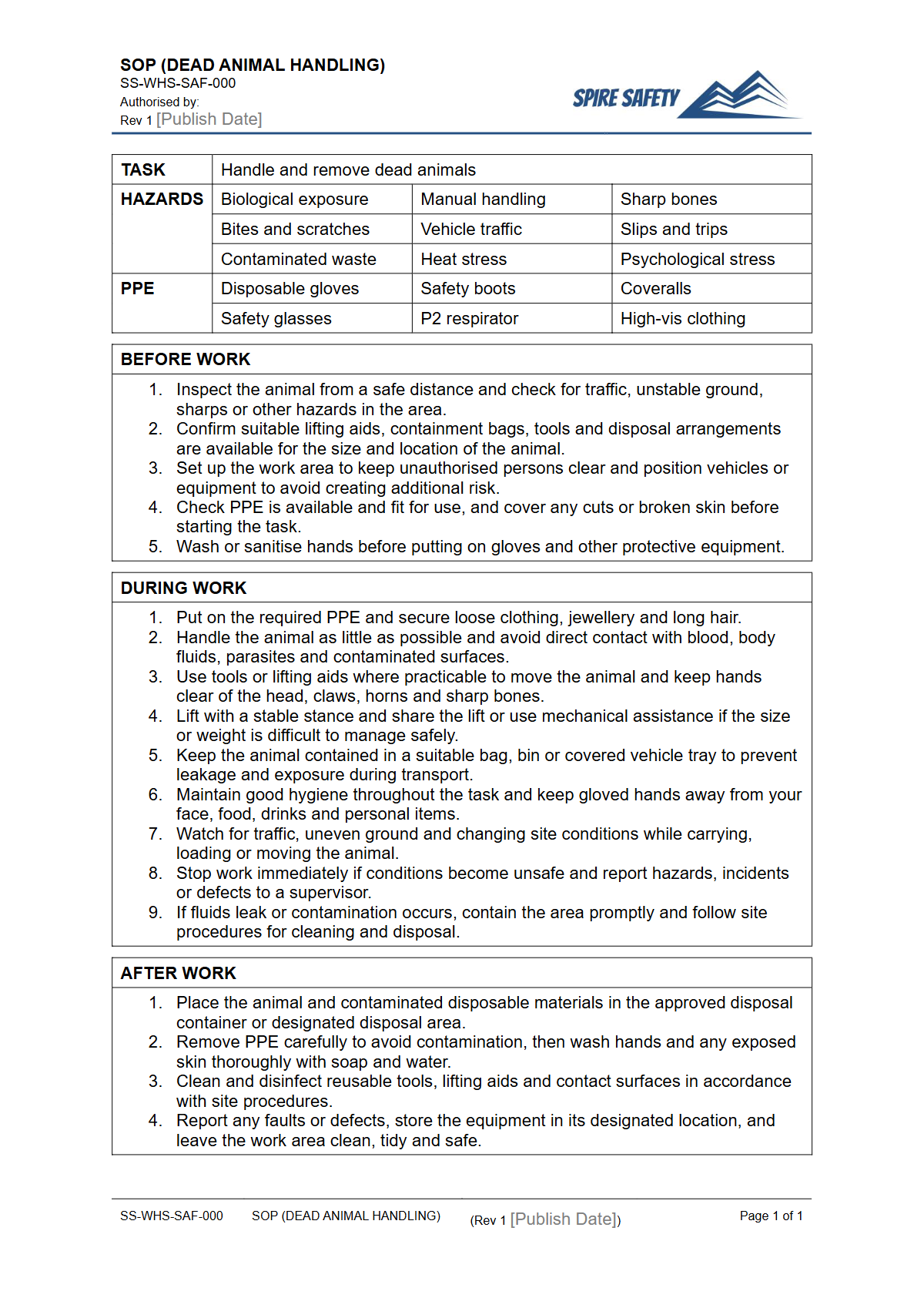
Purpose of the Free Safe Operating Procedure (Dead Animal Handling) Template
Handling and disposing of deceased animals presents a unique combination of health, safety, and environmental risks. This Free Safe Operating Procedure (Dead Animal Handling) Template provides a structured framework for organisations to document a safe system of work for this hazardous task.
Its purpose is to minimise worker exposure to serious risks such as zoonotic diseases (illnesses transmitted from animals to humans) like Q fever and leptospirosis, sharps injuries from bones or teeth, and musculoskeletal injuries from hazardous manual tasks.
A documented SOP helps ensure that every worker involved, from farmers to council staff, understands the required personal protective equipment (PPE), safe handling techniques, decontamination procedures, and approved disposal methods. By formalising these steps, you create a consistent, repeatable process that supports your duty of care and promotes a safer work environment.
This procedure also addresses the potential psychological impact on workers by establishing clear, professional protocols for a confronting task.
Video walkthrough
How to use the Free Safe Operating Procedure (Dead Animal Handling) Template
This template is available for download in both DOCX and PDF formats. The DOCX version is fully editable, allowing you to tailor it to the specific needs of your workplace.
To effectively implement this Safe Operating Procedure, you should identify the specific hazards present in your operational context—such as the types of animals, the common locations (e.g., roadsides, farms, processing facilities), and the equipment used. Your documented procedure should form a key part of your overall safety framework, integrated into your broader WHS management systems.
Please note: This template provides a structured starting point aligned with Australian WHS principles. You must customise it with your specific site details, equipment lists, PPE requirements, emergency contacts, and local council or state environmental regulations for disposal.
We have included comments throughout the document to guide your customisation process.
Reviewing and Auditing Your Safe Operating Procedure
A Safe Operating Procedure is a living document. It should be reviewed regularly—at least annually, or whenever there is a change in legislation, equipment, or work practices.
It should also be reviewed after any incident or near-miss. Conducting periodic internal checks ensures the procedure remains effective and relevant.
For a more thorough assessment of your safety systems, consider engaging professionals for a formal WHS compliance auditing service to identify any gaps.
When to use this Safe Operating Procedure
This SOP is designed for any task that involves the handling, moving, or disposal of animal carcasses. It is applicable across a wide range of scenarios, including:
- Removal of roadkill by local council or road maintenance crews.
- Disposal of livestock on farms due to natural causes or disease control measures.
- Management of deceased animals in veterinary clinics, animal shelters, and research facilities.
- Cleanup operations following pest control programs.
- Response to wildlife mortality events by park rangers or environmental agencies.
- Disposal of large animals, which may require specific machinery such as for creating burial pits. These tasks must also be covered by their own SOPs, such as our FREE Dozer SOP (Safe Operating Procedure) Template.
Who should use this Safe Operating Procedure
This document is intended for use by Persons Conducting a Business or Undertaking (PCBUs) to develop procedures for their workers. The final, customised SOP should be used by any worker or contractor tasked with handling animal carcasses. This includes, but is not limited to:
- Local Government Workers (Rangers, Parks and Gardens Staff, Waste Management)
- Agricultural Workers and Farmers
- Biosecurity Officers
- Veterinarians and Vet Nurses
- Emergency Services Personnel
- Abattoir and Meat Processing Workers
- Pest Management Technicians
- Wildlife Handlers and Rescuers
For complex or large-scale disposal challenges, such as those involving significant disease outbreaks or environmental contamination risks, it is recommended to seek specialised advice. Our WHS consulting services can provide expert guidance tailored to your specific situation.
If you're looking for other documents to support your operations, you can browse our complete free WHS resources library for more templates and guides.
Common mistakes
Common mistakes to avoid
- Underestimating the risk of disease and assuming a carcass is 'clean'.
- Using incorrect manual handling techniques, leading to strains and sprains.
- Failing to properly decontaminate vehicles, equipment, and PPE after the task.
- Neglecting local environmental regulations for carcass disposal, leading to fines or contamination.
Legal references
Legal considerations
The following legal requirements may be relevant to this type of work.
- Work Health and Safety Act (Harmonised) — Provides the primary duties for protecting workers and other people from work health and safety risks.
- Work Health and Safety Regulations (Harmonised) — Sets out requirements supporting the management of workplace hazards and risks.
The following codes may be relevant to this type of work.
- Managing WHS Risks Code of Practice — Provides practical guidance on identifying hazards, assessing risks and applying effective controls.
- Work Health and Safety Consultation, Cooperation and Coordination Code of Practice — Provides practical guidance on consulting workers and coordinating with other duty holders.
- Managing the Work Environment and Facilities Code of Practice — Provides practical guidance on safe work environments, workplace facilities and related controls.
Did you know
Invisible Danger
Q Fever, a serious zoonotic disease, can be contracted by inhaling dust or droplets from infected animal tissues, fluids, and waste. Symptoms are often flu-like, but it can lead to chronic illness.
Psychological Toll
The psychological impact of regularly handling deceased animals is a recognised workplace hazard. Providing support and clear, professional procedures can help mitigate stress and trauma for workers.
FAQ
Frequently asked questions
01What PPE is required for handling dead animals?
02What are the main hazards of handling animal carcasses?
03How do you safely dispose of a dead animal in Australia?
04Is a Safe Operating Procedure legally required for this task?
Share this resource
Free Safe Operating Procedure (Dead Animal Handling) Template
Browse Categories
How To Use It
- 1Download and open in Word or PDF.
- 2Replace the placeholders with your business details.
- 3Get it reviewed by a WHS specialist before rollout.
Need it customised?
Our WHS consultants can adapt this template to your site, run a gap analysis, or audit what you already have in place.
Book a Free Consultation WHS consulting servicesor call 1300 156 382
Related templates
- Free Safe Operating Procedure (Deck Washing) Template
- Free Safe Operating Procedure (Decoiler) Template
- Free Safe Operating Procedure (Deep Fryer - Standard Operation) Template
- Free Safe Operating Procedure (Defibrillator Operation) Template
- Free Safe Operating Procedure (Degreasing Bay) Template
- Free Safe Operating Procedure (Dehumidifier) Template