
Free Safe Operating Procedure (Decoiler) Template
Effectively manage hazards associated with decoiling machinery by documenting a clear, step-by-step process for safe operation.
Free Safe Operating Procedure (Decoiler) Template
DOCX • 126 KB + PDF
Updated Oct 2026
No signup required
Purpose of the Free Safe Operating Procedure (Decoiler) Template
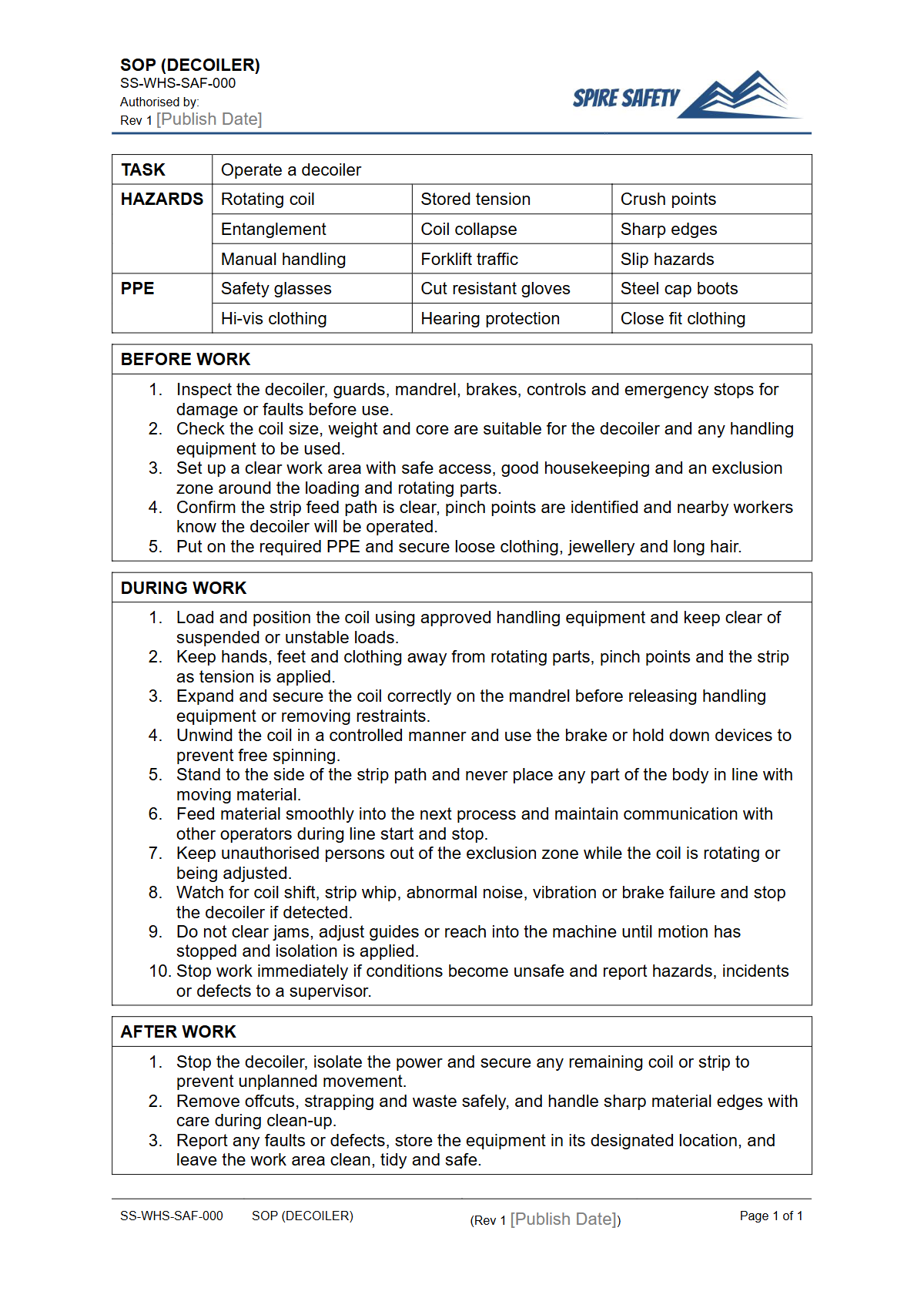
This Free Safe Operating Procedure (Decoiler) Template provides a structured framework for documenting the specific steps required to operate decoiling machinery safely. By formalising your process, you can standardise safe work practices, reduce the risk of incidents, and create a reliable tool for operator training and competency assessment.
A documented SOP ensures that every operator, regardless of experience, has a clear reference for performing tasks correctly and consistently.
Decoilers present significant workplace hazards, including entanglement in rotating parts, crushing from the coil or machine components, severe cuts from sharp metal edges, and musculoskeletal injuries from manual handling. This template helps you systematically address these risks by embedding critical safety checks and actions into the operational workflow.
An SOP is a critical component of effective WHS management systems, translating risk assessments into practical, on-the-floor instructions that protect your workers.
What is a Safe Operating Procedure?
A Safe Operating Procedure, or SOP, is a written document that provides detailed, step-by-step instructions on how to safely perform a specific task or operate a piece of machinery. It identifies potential hazards associated with the task and outlines the control measures required to eliminate or minimise them.
For equipment like a decoiler, an SOP typically covers pre-operational checks, the loading and operating sequence, shutdown procedures, and emergency responses. It serves as a cornerstone for training and a benchmark for safe performance.
Video walkthrough
How to use the Free Safe Operating Procedure (Decoiler) Template
Our template is available in an easily editable DOCX format and a print-ready PDF. The DOCX file is designed for you to add, remove, and modify sections to perfectly match your specific machinery and workplace context.
This customisation is not just recommended; it is essential for the document to be effective. Disclaimer: This is a template only. You must customise it to your specific plant, equipment, and operational context. We are not liable for any incidents arising from the use of this document.
To adapt this Safe Operating Procedure (Decoiler) Template, you should:
- Consult the manufacturer's manual for your specific decoiler model to incorporate its unique safety features and operating requirements.
- Conduct a risk assessment on the task of operating the decoiler in your environment to identify all relevant hazards.
- Detail the required Personal Protective Equipment (PPE), such as cut-resistant gloves, safety glasses, and steel-capped boots.
- List all pre-operational checks, including inspection of guards, emergency stops, and braking systems.
- Write a clear, sequential list of steps for loading a coil, feeding the material, and operating the machine.
- Outline the correct shutdown, cleaning, and lockout/tagout (LOTO) procedures.
- Define the appropriate response for common emergencies, like a material jam or power failure.
Once customised, the SOP should be used to train all operators. Regular reviews and WHS compliance auditing can help verify that the documented procedures are being followed correctly and remain effective in controlling risks.
When to use it
A decoiler SOP should be developed before the equipment is first used and be readily available at the operator's station at all times. It is a vital document for inducting and training new operators and serves as a key resource for refresher training to prevent complacency.
The procedure should also be reviewed and updated following any incident or near miss, or when there are changes to the equipment, materials, or process.
A decoiler is often the first step in a production line, feeding material into presses, slitters, or roll formers. A clear SOP ensures this initial stage is performed correctly, setting up the downstream processes for success.
You may need to develop related procedures, such as our FREE Conveyer System SOP, to cover the entire integrated workflow.
Who should use it
This Safe Operating Procedure template is primarily intended for Persons Conducting a Business or Undertaking (PCBUs) to adapt for their specific workplace. Once customised, the primary users are the machine operators who are directly responsible for running the decoiler.
Supervisors and managers should also use the SOP as a tool for training, monitoring work practices, and conducting safety conversations.
Only workers who have been properly trained and deemed competent should operate a decoiler. This training must cover the finalised SOP, specific machine controls, and emergency responses.
Competency may also extend to other common workshop equipment, for which documents like a free Air Compressor SOP would be necessary. The SOP supports, but does not replace, the need for hands-on, supervised training.
If you are unsure how to adequately assess the risks associated with your machinery or how to best customise this document to ensure it is effective, engaging external WHS consulting services can provide expert guidance and peace of mind. Download the free template to get started, and explore our entire free WHS resources library for more tools to support your safety management efforts.
Common mistakes
Common mistakes to avoid
- Failing to properly secure the coil before cutting the bands, leading to uncontrolled unwinding.
- Bypassing or disabling safety guards and interlocks to speed up production.
- Neglecting pre-start checks, such as verifying the condition of brakes and emergency stops.
- Using the SOP as a 'tick and flick' exercise without ensuring operators understand and follow it.
Legal references
Legal considerations
The following legal requirements may be relevant to this type of work.
- Work Health and Safety Act (Harmonised) — Provides the primary duties for protecting workers and other people from work health and safety risks.
- Work Health and Safety Regulations (Harmonised) — Sets out requirements supporting the management of workplace hazards and risks.
The following codes may be relevant to this type of work.
- Managing WHS Risks Code of Practice — Provides practical guidance on identifying hazards, assessing risks and applying effective controls.
- Work Health and Safety Consultation, Cooperation and Coordination Code of Practice — Provides practical guidance on consulting workers and coordinating with other duty holders.
- Managing the Work Environment and Facilities Code of Practice — Provides practical guidance on safe work environments, workplace facilities and related controls.
Did you know
Stored Energy
A tightly wound steel coil contains a massive amount of stored energy. Uncontrolled release during handling or decoiling can cause the outer wraps to spring open violently, posing a significant strike hazard.
Leading Injury Causes
According to Safe Work Australia, being hit by moving objects and muscular stress while handling objects are leading causes of serious injury claims in manufacturing, both of which are key risks in decoiler operation.
FAQ
Frequently asked questions
01What are the main hazards of a decoiler?
02Is an SOP a legal requirement for a decoiler in Australia?
03How often should a decoiler SOP be reviewed?
04Can a generic SOP be used for all decoilers?
Share this resource
Free Safe Operating Procedure (Decoiler) Template
Browse Categories
How To Use It
- 1Download and open in Word or PDF.
- 2Replace the placeholders with your business details.
- 3Get it reviewed by a WHS specialist before rollout.
Need it customised?
Our WHS consultants can adapt this template to your site, run a gap analysis, or audit what you already have in place.
Book a Free Consultation WHS consulting servicesor call 1300 156 382
Related templates
- Free Safe Operating Procedure (Deep Fryer - Standard Operation) Template
- Free Safe Operating Procedure (Defibrillator Operation) Template
- Free Safe Operating Procedure (Degreasing Bay) Template
- Free Safe Operating Procedure (Dehumidifier) Template
- Free Safe Operating Procedure (Deli Counter Cleaning) Template
- Free Safe Operating Procedure (Deli Scale Cleaning) Template