
Free Safe Operating Procedure (Deck Washing) Template
Download our free Safe Operating Procedure for deck washing to formalise your safety processes.
Free Safe Operating Procedure (Deck Washing) Template
DOCX • 126 KB + PDF
Updated Oct 2026
No signup required
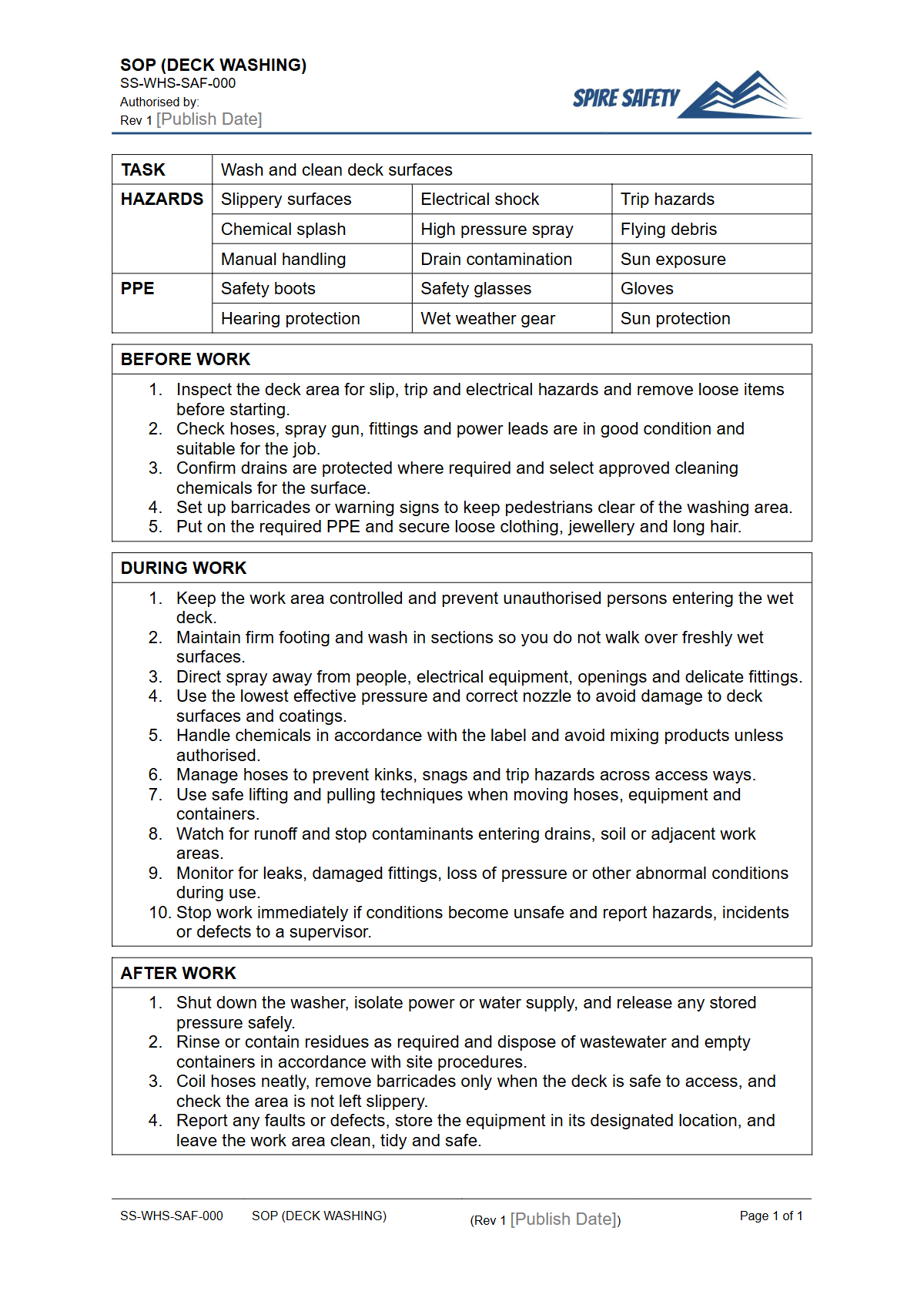
Purpose of the Free Safe Operating Procedure (Deck Washing) Template
Effectively managing workplace safety during cleaning and maintenance tasks is crucial. This free Safe Operating Procedure (Deck Washing) Template provides a structured framework for documenting the safety steps, hazards, and control measures required for pressure washing timber, composite, or concrete deck surfaces.
Using this SOP helps standardise your approach, ensuring that every worker understands the risks and follows a consistent, safe method every time.
A documented SOP is a key tool for preventing injuries from common deck washing hazards like slips on wet surfaces, high-pressure water injection, chemical exposure, and electrical shocks. It forms an essential part of your safety documentation, demonstrating due diligence and supporting your broader WHS management systems. This template is designed as a clear, easy-to-follow guide for workers and a critical record for supervisors and managers.
Video walkthrough
How to use the Free Safe Operating Procedure (Deck Washing) Template
This document is available for immediate download in both DOCX and PDF formats. While it is aligned with Australian WHS principles, it is a template and must be customised to your specific workplace.
Generic procedures are not sufficient to ensure safety; you must adapt the content to reflect the actual equipment, chemicals, environment, and personnel involved in the task at your site.
To use the template effectively:
- Download the DOCX file and open it in a word processor.
- Review each section, including pre-operational checks, the step-by-step procedure, and emergency responses.
- Consult with experienced operators, supervisors, and safety representatives to gather site-specific details.
- Add particulars about your pressure washer model, the specific cleaning agents used (and reference their Safety Data Sheets), and unique environmental factors (e.g., proximity to public areas, electrical sources).
- Once finalised, use the SOP for worker training, competency assessments, and pre-start meetings.
Note: We have created this document as a starting point. Your organisation is responsible for ensuring the final, customised procedure is safe, adequate for purpose, and compliant with relevant legislation.
If you require assistance, consider engaging professional WHS consulting services.
When to use a Deck Washing SOP
A Safe Operating Procedure for deck washing should be used as a primary reference document for the task. It should be consulted:
- Before work commences: As part of the pre-start risk assessment and toolbox talk to review hazards and controls.
- During worker training: When inducting new employees or training existing staff on how to perform the task safely.
- For competency verification: To assess and confirm a worker’s ability to follow the established safe procedure.
- After an incident or near-miss: As part of an investigation to determine if the procedure was followed and if it requires updates.
- During safety audits: To provide evidence of a formalised process for managing the risks associated with deck washing.
Who should use it
This SOP should be used by multiple roles within an organisation. Persons Conducting a Business or Undertaking (PCBUs) and their managers are responsible for ensuring safe systems of work are in place.
Supervisors and team leaders use it to instruct and monitor workers. Most importantly, the operators performing the deck washing task must use the SOP as their guide to work safely.
This principle of providing clear, task-specific instructions applies across all equipment, which is why we also provide resources like our free Circular Saw SOP for other common maintenance jobs.
Key Hazards & Risks in Deck Washing
Deck washing, particularly with a high-pressure washer, introduces several significant hazards that must be controlled. These include:
- Slips, trips, and falls: Caused by wet surfaces, trailing hoses, and electrical cords.
- High-pressure injection: The water jet can pierce skin and underlying tissues, causing severe injury that may not be immediately apparent.
- Chemical exposure: Cleaning agents can cause skin irritation, respiratory issues, or chemical burns if not handled correctly.
- Electrical shock: Using electrical equipment in a wet environment creates a high risk of electrocution if the equipment is faulty or used incorrectly.
- Noise: Petrol or electric pressure washers can generate high noise levels, potentially leading to hearing damage over time.
- Flying debris: The high-pressure stream can dislodge loose timber, stones, or other objects, creating projectiles.
Understanding the operational risks of powered equipment is fundamental to safety. The same rigorous approach to identifying hazards should be applied whether using a pressure washer or other machinery detailed in a free Air Compressor SOP.
Essential Control Measures
To mitigate these risks, your customised SOP should detail specific control measures. Key controls include:
- Equipment Inspection: Always complete pre-start checks on the pressure washer, hoses, nozzles, and electrical cords. Ensure safety features like thermal overloads and residual current devices (RCDs) are functional.
- Personal Protective Equipment (PPE): Mandate the use of appropriate PPE, such as safety glasses or a face shield, waterproof non-slip safety boots, gloves, and hearing protection.
- Area Demarcation: Barricade the work area and use warning signs to prevent unauthorised personnel from entering the slip-hazard zone.
- Safe Chemical Handling: Follow the Safety Data Sheet (SDS) for any cleaning agents, ensuring adequate ventilation and correct dilution ratios.
On larger or more complex worksites, access to the work area itself can present challenges. For instance, cleaning elevated decks on a construction site requires its own set of controls, similar in principle to the structured processes outlined in a free Telehandler SOP.
By thoroughly documenting these steps, you create a robust procedure that protects workers and helps the organisation meet its WHS obligations. You can find more templates and checklists in our complete free WHS resources library.
Common mistakes
Common mistakes to avoid
- Using a nozzle with a pressure setting that is too high, damaging the deck surface and creating projectiles.
- Neglecting to wear appropriate PPE, especially eye and foot protection.
- Failing to manage electrical hazards by not using a residual current device (RCD) and keeping connections dry.
- Not properly barricading the work area to prevent others from walking into the wet, slippery zone.
Legal references
Legal considerations
The following legal requirements may be relevant to this type of work.
- Work Health and Safety Act (Harmonised) — Provides the primary duties for protecting workers and other people from work health and safety risks.
- Work Health and Safety Regulations (Harmonised) — Sets out requirements supporting the management of workplace hazards and risks.
The following codes may be relevant to this type of work.
- Managing WHS Risks Code of Practice — Provides practical guidance on identifying hazards, assessing risks and applying effective controls.
- Work Health and Safety Consultation, Cooperation and Coordination Code of Practice — Provides practical guidance on consulting workers and coordinating with other duty holders.
- Managing the Work Environment and Facilities Code of Practice — Provides practical guidance on safe work environments, workplace facilities and related controls.
Did you know
Slips, Trips, and Falls
According to Safe Work Australia, slips, trips, and falls are the second leading cause of serious workers' compensation claims, making control of wet and slippery surfaces a critical safety priority.
Injection Injury
A high-pressure water jet from a pressure washer can penetrate the skin at just 100 bar (1450 psi). The injury may look minor initially but can cause severe damage to underlying tissues, requiring immediate medical attention.
FAQ
Frequently asked questions
01What are the main hazards involved in pressure washing a deck?
02Is a Safe Operating Procedure legally required for deck washing in Australia?
03What Personal Protective Equipment (PPE) is needed for deck washing?
04How often should a Deck Washing SOP be reviewed?
Share this resource
Free Safe Operating Procedure (Deck Washing) Template
Browse Categories
How To Use It
- 1Download and open in Word or PDF.
- 2Replace the placeholders with your business details.
- 3Get it reviewed by a WHS specialist before rollout.
Need it customised?
Our WHS consultants can adapt this template to your site, run a gap analysis, or audit what you already have in place.
Book a Free Consultation WHS consulting servicesor call 1300 156 382
Related templates
- Free Safe Operating Procedure (Decoiler) Template
- Free Safe Operating Procedure (Deep Fryer - Standard Operation) Template
- Free Safe Operating Procedure (Defibrillator Operation) Template
- Free Safe Operating Procedure (Degreasing Bay) Template
- Free Safe Operating Procedure (Dehumidifier) Template
- Free Safe Operating Procedure (Deli Counter Cleaning) Template