
Free Safe Operating Procedure (Damaged Freight Hold) Template
Manage damaged goods safely with our free Safe Operating Procedure (Damaged Freight Hold) Template. Download the DOCX and PDF to standardise your process.
Free Safe Operating Procedure (Damaged Freight Hold) Template
DOCX • 126 KB + PDF
Updated Oct 2026
No signup required
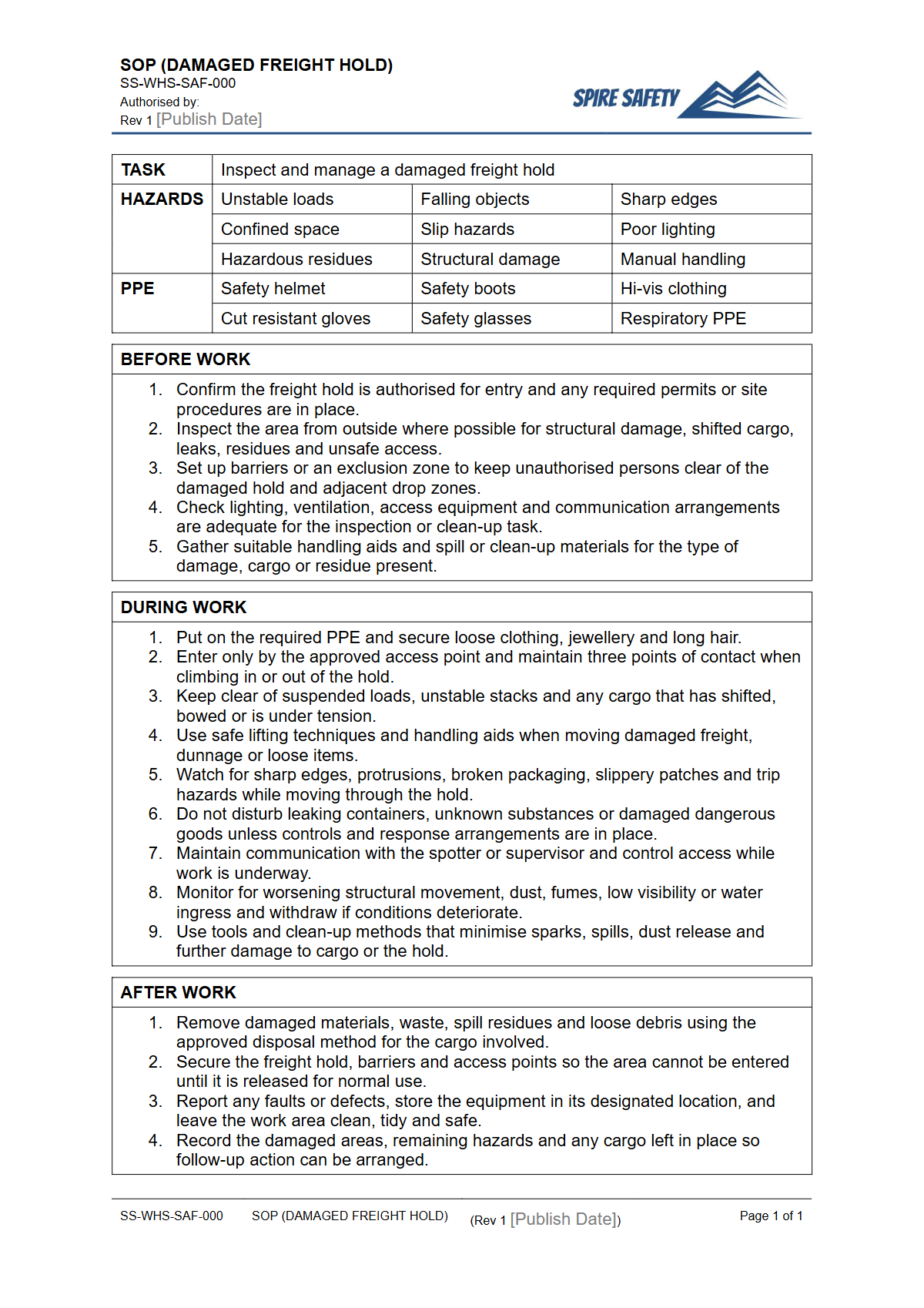
Purpose of the Free Safe Operating Procedure (Damaged Freight Hold) Template
Handling damaged freight presents unique and unpredictable risks, from chemical spills and sharp objects to unstable loads that can collapse. This free Safe Operating Procedure (Damaged Freight Hold) Template provides a structured framework for your team to safely identify, assess, quarantine, and manage damaged goods.
By implementing a formal SOP, you establish a consistent, safe method to control hazards, protect workers, and minimise further product loss, creating a safer environment in your warehouse, depot, or transport hub.
A documented procedure ensures that all workers, whether they are new or experienced, follow the same safety-critical steps. It serves as a vital training tool and demonstrates a commitment to proactive risk management.
Integrating this SOP is a key component of robust WHS management systems, helping your business meet its duty of care obligations under Australian WHS laws.
Video walkthrough
How to use the Free Safe Operating Procedure (Damaged Freight Hold) Template
This download includes both a DOCX file for easy editing and a PDF for quick reference. To make it effective, you must adapt it to the specific context of your workplace.
A generic procedure is not sufficient; customisation is essential for controlling your site's specific risks.
When customising the document, consider the following:
- The types of freight you typically handle (e.g., chemicals, bulk goods, fragile items).
- The specific equipment used at your site, such as forklifts or pallet jacks.
- Your facility's layout, including the location of designated quarantine or hold areas.
- Your specific emergency procedures and contact details.
- The roles and responsibilities within your team.
Important: This document is a template and is not a substitute for professional legal or safety advice. We strongly recommend you customise this Safe Operating Procedure with your site-specific details, consult with your workers, and seek expert advice to ensure it is fit for purpose for your operations.
When to use this Safe Operating Procedure
This SOP should be initiated whenever freight is identified as damaged or potentially unsafe. It is not limited to catastrophic damage; even minor issues can conceal greater risks. Specific triggers for using this procedure include:
- Observing leaks, spills, or powders coming from a package, pallet, or container.
- Noticing crushed, torn, or punctured packaging.
- Identifying an unstable or shifted load on a pallet.
- Discovering goods that have fallen from racking or during transit.
- Receiving freight that is audibly rattling (if it shouldn't be) or emitting strange odours.
Implementing the SOP immediately in these situations helps contain the problem before it can escalate into a serious incident. Regularly reviewing your safety processes through WHS compliance auditing ensures your procedures remain effective and relevant to your operational risks.
Who should use this Safe Operating Procedure
This procedure is intended for all personnel involved in the logistics chain who may encounter or be tasked with handling damaged goods. This includes, but is not limited to:
- Warehouse and store workers
- Forklift operators
- Dispatch and receiving staff
- Transport and delivery drivers
- Team leaders and supervisors
Competency is key. Anyone required to operate machinery to move quarantined goods, such as a forklift or a telehandler, must be appropriately licensed and trained.
For complex lifting tasks, our free Telehandler SOP template can provide additional guidance on equipment-specific safety protocols.
Key Steps in the Damaged Freight Procedure
While your customised SOP will contain specific details, it should follow a logical sequence to ensure all risks are managed. A typical procedure involves:
- Stop and Assess: Immediately stop work in the vicinity. Assess the situation from a safe distance, looking for signs of spills, dangerous goods placards, or structural instability.
- Report and Communicate: Notify a supervisor or manager immediately. Clearly communicate the location, nature of the damage, and any visible hazards.
- Isolate and Secure: Cordon off the area using cones, barrier tape, or signage to prevent unauthorised personnel from entering.
- Plan the Response: The supervisor, in consultation with trained personnel, determines the safest method for handling the item. This includes selecting the correct PPE and equipment.
- Execute the Handling: Trained workers, wearing appropriate PPE, carefully move the damaged freight to a designated, secure quarantine or hold area. This might involve manual handling or the use of machinery.
- Clean-up and Documentation: Clean up any spills according to safety data sheet (SDS) instructions. Complete an incident report to document the event, which helps in future risk assessments.
For facilities where goods are moved between processing stages, ensuring the integrity of freight is paramount. The interaction points with machinery, such as those detailed in our FREE Conveyer System SOP, are critical control points where damaged goods are often first identified.
If you require expert assistance in developing or refining your safety documentation to suit your specific operational needs, Spire Safety offers specialised WHS consulting services to help guide you.
This is just one of many templates designed to assist Australian businesses. You can explore our complete free WHS resources library for more checklists, procedures, and safety guides.
Common mistakes
Common mistakes to avoid
- Assuming packaging is intact and moving damaged pallets without a proper risk assessment.
- Failing to use appropriate Personal Protective Equipment (PPE) when dealing with unknown substances from a leak or spill.
- Neglecting to properly quarantine the affected area, allowing other workers to be exposed to the hazard.
- Poor communication between the staff who discover the damage and the team tasked with handling it.
Legal references
Legal considerations
The following legal requirements may be relevant to this type of work.
- Work Health and Safety Act (Harmonised) — Provides the primary duties for protecting workers and other people from work health and safety risks.
- Work Health and Safety Regulations (Harmonised) — Sets out requirements supporting the management of workplace hazards and risks.
The following codes may be relevant to this type of work.
- Managing WHS Risks Code of Practice — Provides practical guidance on identifying hazards, assessing risks and applying effective controls.
- Work Health and Safety Consultation, Cooperation and Coordination Code of Practice — Provides practical guidance on consulting workers and coordinating with other duty holders.
- Managing the Work Environment and Facilities Code of Practice — Provides practical guidance on safe work environments, workplace facilities and related controls.
Did you know
Manual Handling Risk
Manual handling injuries from lifting, carrying, and moving objects are a leading cause of serious workers' compensation claims in the Australian transport and storage industry.
Hidden Dangers
Punctured aerosol cans or damaged containers of seemingly harmless powders can create explosive or respiratory hazards in enclosed spaces like a freight container or warehouse.
FAQ
Frequently asked questions
01What is a Safe Operating Procedure for damaged freight?
02Why is a specific SOP for damaged freight necessary?
03Who is responsible for creating a Damaged Freight Hold SOP?
04How often should a Damaged Freight Hold SOP be reviewed?
Share this resource
Free Safe Operating Procedure (Damaged Freight Hold) Template
Browse Categories
How To Use It
- 1Download and open in Word or PDF.
- 2Replace the placeholders with your business details.
- 3Get it reviewed by a WHS specialist before rollout.
Need it customised?
Our WHS consultants can adapt this template to your site, run a gap analysis, or audit what you already have in place.
Book a Free Consultation WHS consulting servicesor call 1300 156 382
Related templates
- Free 3D Printer SOP (Safe Operating Procedure) Template
- FREE Agricultural Equipment SOP (Safe Operating Procedure) Template
- Free Air Compressor SOP (Safe Operating Procedure) Template
- Free Angle Grinder SOP (Safe Operating Procedure) Template
- FREE Backhoe SOP (Safe Operating Procedure) Template
- FREE Baler SOP (Safe Operating Procedure) Template