
Free Safe Operating Procedure (Dance Floor Cleaning) Template
Download our free Safe Operating Procedure for Dance Floor Cleaning to formalise safety steps. This customisable template helps you manage risks effectively.
Free Safe Operating Procedure (Dance Floor Cleaning) Template
DOCX • 126 KB + PDF
Updated Oct 2026
No signup required
Purpose of the Free Safe Operating Procedure (Dance Floor Cleaning) Template
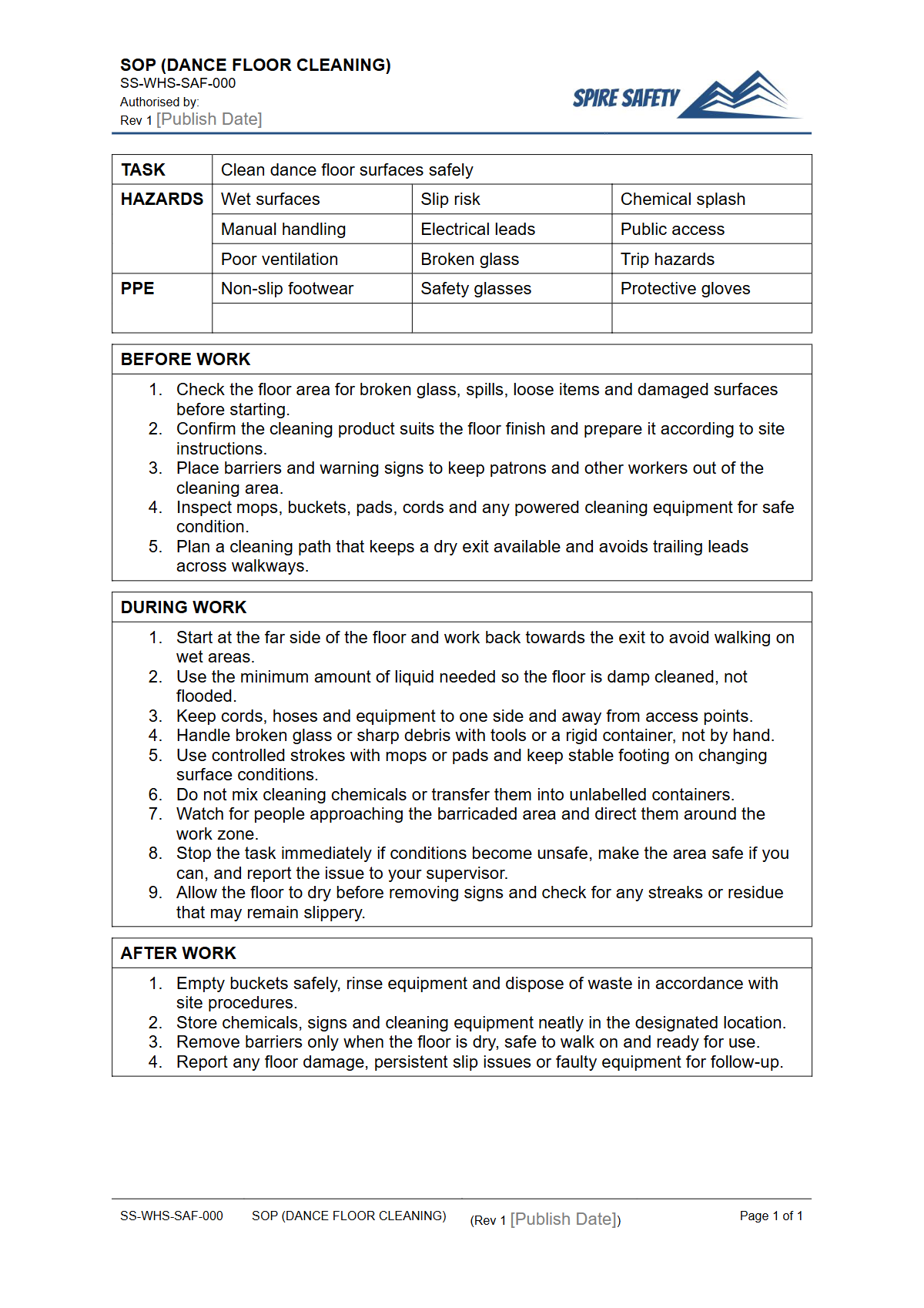
This Free Safe Operating Procedure (Dance Floor Cleaning) Template provides a structured framework for businesses to document the required safety measures for cleaning dance floors in venues like nightclubs, pubs, function centres, and dance studios. A Safe Operating Procedure (SOP) is a critical administrative control that outlines a step-by-step process for performing a task safely.
Using this template helps organisations identify hazards such as slips, trips, chemical exposure, and manual handling risks associated with floor maintenance. It formalises expectations for pre-cleaning checks, the cleaning process itself, and post-cleaning inspections, aiming to minimise the risk of injury to workers and patrons.
Implementing a documented SOP is a key part of demonstrating due diligence and is a fundamental component of effective WHS management systems. This template, available in both DOCX and PDF formats, serves as a practical starting point, aligned with Australian WHS principles, for creating a procedure specific to your operational needs.
Video walkthrough
How to use the Free Safe Operating Procedure (Dance Floor Cleaning) Template
This document is a template and must be customised to reflect the specific environment, equipment, chemicals, and processes used in your workplace. To use the Free Safe Operating Procedure (Dance Floor Cleaning) Template effectively, begin by conducting a thorough risk assessment of your dance floor cleaning tasks.
This should involve consultation with the workers who actually perform the cleaning.
Follow these steps to adapt the template:
- Review and Customise: Go through each section and replace the placeholder text with details relevant to your site. Specify the exact types of cleaning equipment (e.g., brand and model of floor buffer), the names of the approved cleaning chemicals, and the required Personal Protective Equipment (PPE) like non-slip footwear and gloves.
- Site-Specific Details: Add details about your venue's layout, the type of dance floor surface (e.g., polished wood, vinyl), and any unique hazards present.
- Training: Use the finalised SOP as a training tool for all relevant staff. Ensure they understand every step and the reasoning behind the safety controls. Keep a record of this training.
- Review and Update: The SOP is a living document. It should be reviewed regularly, and always after an incident or when a change in process or equipment occurs. Consider incorporating feedback from staff during these reviews.
Note: We have developed this resource as a guide. It is the responsibility of the Person Conducting a Business or Undertaking (PCBU) to ensure that the finalised SOP is suitable for their workplace and complies with all relevant legislation.
When to use it
A Safe Operating Procedure for dance floor cleaning should be developed and implemented before any staff are assigned the task. It is a proactive safety measure used to standardise procedures and manage foreseeable risks.
The SOP should be readily accessible to workers at all times, either in a printed format near the chemical storage area or digitally via a mobile device.
It is particularly important to refer to the SOP during worker induction and training, as a refresher tool, and as a reference point during safety audits or incident investigations. Regular use helps reinforce safe work habits and ensures consistency in how the task is performed, regardless of who is on shift. If your cleaning tasks involve specific machinery, you may need a more detailed document, such as a Safe Operating Procedure for Floor Scrubber Operation.
Who should use it
This SOP should be used by anyone involved in the cleaning and maintenance of dance floors. This includes:
- Cleaning Staff and Venue Workers: The primary users are the individuals performing the cleaning. The SOP provides them with clear, unambiguous instructions on how to complete their work safely.
- Supervisors and Managers: Line managers are responsible for ensuring staff are trained on and adhere to the SOP. They use it to monitor safe work practices and conduct workplace inspections.
- WHS/OH&S Officers: Safety professionals use the SOP as part of the overall risk management framework. They assist in its development, review, and integration into the broader safety system. Regular WHS compliance auditing can verify that the procedures outlined are being followed correctly.
- Business Owners (PCBUs): The PCBU holds the primary duty of care. Having a robust SOP in place is a key way they can meet their legal obligations to provide a safe working environment. For tailored advice on meeting these obligations, consider engaging WHS consulting services.
You can find many more templates and checklists by exploring our free WHS resources library to support your organisation's safety efforts.
Common mistakes
Common mistakes to avoid
- Using incorrect cleaning chemicals that damage the floor surface or leave a slippery residue.
- Failing to use 'Wet Floor' signs, or removing them before the floor is completely dry.
- Not providing adequate training on safe manual handling for moving tables, chairs, or cleaning equipment.
- Leaving electrical cords for buffers or vacuums across walkways, creating a significant trip hazard.
Legal references
Legal considerations
The following legal requirements may be relevant to this type of work.
- Work Health and Safety Act (Harmonised) — Provides the primary duties for protecting workers and other people from work health and safety risks.
- Work Health and Safety Regulations (Harmonised) — Sets out requirements supporting the management of workplace hazards and risks.
The following codes may be relevant to this type of work.
- Managing WHS Risks Code of Practice — Provides practical guidance on identifying hazards, assessing risks and applying effective controls.
- Work Health and Safety Consultation, Cooperation and Coordination Code of Practice — Provides practical guidance on consulting workers and coordinating with other duty holders.
- Managing the Work Environment and Facilities Code of Practice — Provides practical guidance on safe work environments, workplace facilities and related controls.
Did you know
Slip Risk
Slips, trips, and falls are a leading cause of workplace injuries in Australia. In the hospitality and entertainment industries, wet and slippery floors are a major contributor to these preventable incidents.
Chemical Safety
Incorrectly mixing cleaning chemicals can create toxic gases. A common and dangerous example is mixing a bleach-based product with an ammonia-based cleaner, which produces hazardous chloramine gas.
FAQ
Frequently asked questions
01What are the main hazards when cleaning a dance floor?
02Why is a specific SOP needed for dance floor cleaning?
03How often should a Safe Operating Procedure be reviewed?
04Can I use this template for cleaning office carpets or warehouse floors?
Share this resource
Free Safe Operating Procedure (Dance Floor Cleaning) Template
Browse Categories
How To Use It
- 1Download and open in Word or PDF.
- 2Replace the placeholders with your business details.
- 3Get it reviewed by a WHS specialist before rollout.
Need it customised?
Our WHS consultants can adapt this template to your site, run a gap analysis, or audit what you already have in place.
Book a Free Consultation WHS consulting servicesor call 1300 156 382
Related templates
- Free Safe Operating Procedure (Data Logger) Template
- Free Safe Operating Procedure (Davit Arm) Template
- Free Safe Operating Procedure (De-Icing Vehicle) Template
- Free Safe Operating Procedure (Dead Animal Handling) Template
- Free Safe Operating Procedure (Deck Washing) Template
- Free Safe Operating Procedure (Decoiler) Template