
Free Safe Operating Procedure (Data Logger) Template
Download our free Safe Operating Procedure (Data Logger) Template to document safe work methods for your team. Get your DOCX and PDF template today.
Free Safe Operating Procedure (Data Logger) Template
DOCX • 126 KB + PDF
Updated Oct 2026
No signup required
Purpose of the Free Safe Operating Procedure (Data Logger) Template
A data logger is a crucial tool for monitoring various workplace conditions, from temperature and humidity to noise and vibration levels. This free Safe Operating Procedure (Data Logger) Template provides a structured framework for documenting the step-by-step process required to use this equipment safely and effectively.
Using a documented SOP ensures that data collection is consistent, accurate, and conducted without exposing workers to unnecessary risks. It formalises pre-start checks, deployment methods, data retrieval, and shutdown protocols.
The primary goal is to minimise risks associated with the task, such as electrical hazards from mains-powered devices, ergonomic strains from awkward placement, or exposure to the very hazards being monitored. A well-defined procedure also supports data integrity, which is essential for making informed decisions about workplace safety controls.
This process of documentation and control is a fundamental part of building robust WHS management systems that protect both your people and your organisation.
Video walkthrough
How to use the Free Safe Operating Procedure (Data Logger) Template
This template is designed for easy adoption. After downloading the DOCX or PDF file, you can begin customising it to suit your operational needs.
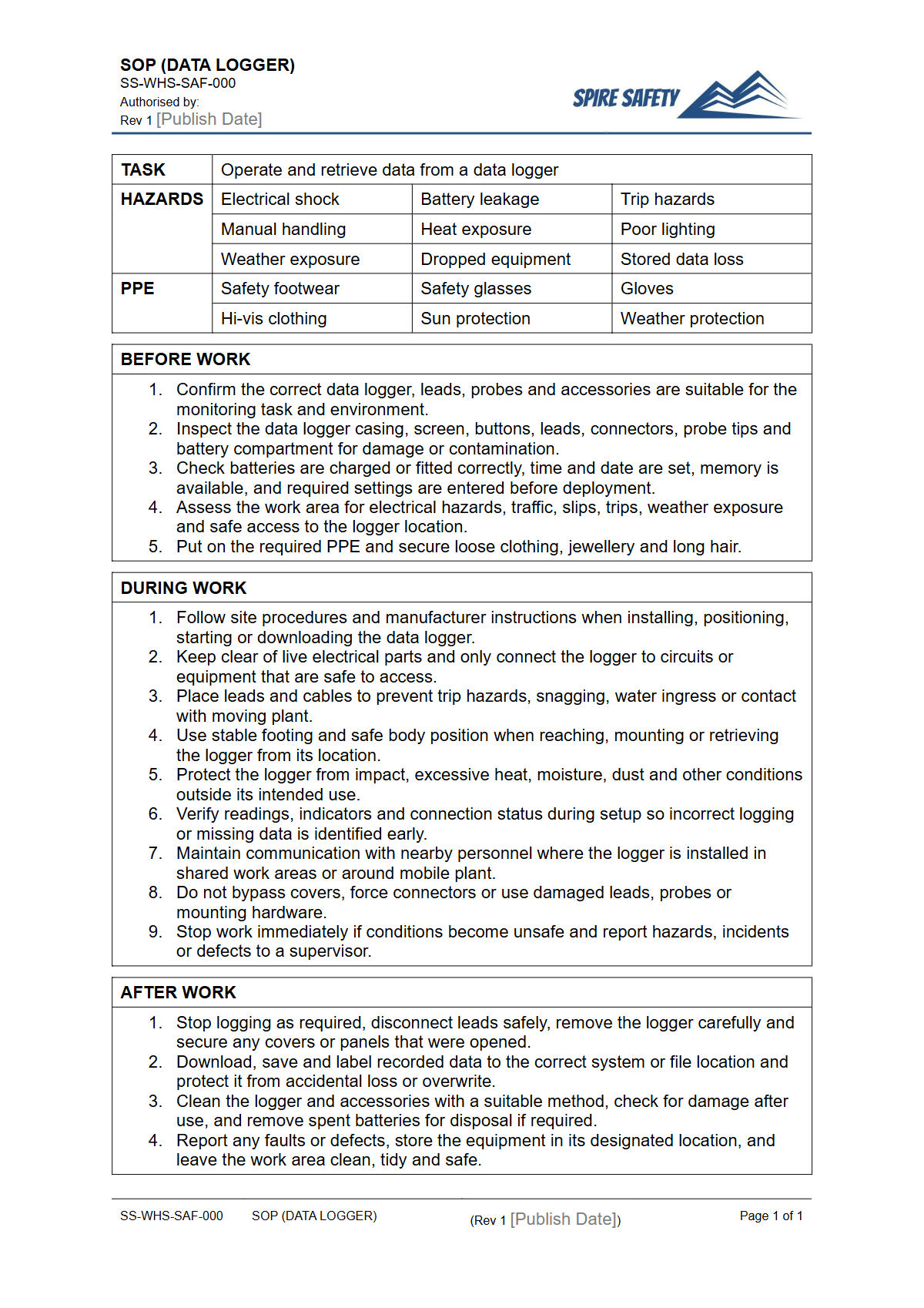
The document includes sections for outlining potential hazards, required personal protective equipment (PPE), and a logical sequence of work steps. You should populate these sections with information specific to the models of data loggers used in your workplace, the environments they are deployed in, and your internal safety protocols.
Important: We have provided this template as a starting point. You must customise the document to reflect the specific data logger models, software, tasks, and risks unique to your workplace.
A generic procedure is not sufficient to control specific hazards. Regular WHS compliance auditing can help verify that your documented procedures are being followed correctly in practice and remain effective over time.
When to use a Safe Operating Procedure for a Data Logger
An SOP for a data logger should be used whenever the equipment is deployed to monitor workplace conditions as part of a risk management program. This includes a wide range of applications, such as:
- Environmental Monitoring: Assessing thermal comfort by measuring temperature and humidity in offices or factories.
- Noise Surveys: Placing noise loggers in high-traffic or plant-heavy areas to determine average and peak noise exposure levels.
- Equipment Performance: Monitoring the operational parameters of machinery to identify faults or inefficiencies. For example, a data logger could track the pressure cycles of equipment covered by our Free Air Compressor SOP (Safe Operating Procedure) Template.
- Air Quality Testing: Using specialised loggers to measure levels of dust, gases, or other atmospheric contaminants.
- Vibration Analysis: Assessing hand-arm or whole-body vibration exposure from tools and vehicles, such as those used in demolition or construction.
Having a formal procedure ensures these critical monitoring tasks are performed correctly every time, providing reliable data for WHS decision-making. The SOP should be readily available to any worker assigned to use the equipment.
Who should use this Safe Operating Procedure
This SOP is intended for any person required to set up, deploy, or retrieve data from a data logger. This typically includes WHS advisors, maintenance personnel, technicians, and team leaders.
It is also a valuable resource for supervisors and managers responsible for overseeing monitoring programs and ensuring work is conducted safely. All personnel assigned to use data loggers must be trained on the contents of the finalised SOP to ensure they understand the correct procedures and associated risks.
Competency is key. Workers should not only be familiar with the procedure but also demonstrate their ability to perform the task safely.
This SOP can be used as a basis for training and competency assessments. For complex machinery that is being monitored, like a factory production line, the data logger SOP would be used alongside task-specific procedures such as a FREE Conveyer System SOP (Safe Operating Procedure) Template. For anyone else looking to build out their safety documentation, Spire Safety offers a wide selection of templates in our free WHS resources library.
Common mistakes
Common mistakes to avoid
- Failing to calibrate the data logger regularly, leading to inaccurate measurements.
- Placing the logger in a location that doesn't represent typical exposure (e.g., too close to a heater or in a dead-air zone).
- Not training users on the specific software required to download and interpret the data.
- Forgetting to document deployment times, locations, and unique environmental conditions, making the data difficult to analyse later.
Legal references
Legal considerations
The following legal requirements may be relevant to this type of work.
- Work Health and Safety Act (Harmonised) — Provides the primary duties for protecting workers and other people from work health and safety risks.
- Work Health and Safety Regulations (Harmonised) — Sets out requirements supporting the management of workplace hazards and risks.
The following codes may be relevant to this type of work.
- Managing WHS Risks Code of Practice — Provides practical guidance on identifying hazards, assessing risks and applying effective controls.
- Work Health and Safety Consultation, Cooperation and Coordination Code of Practice — Provides practical guidance on consulting workers and coordinating with other duty holders.
- Managing the Work Environment and Facilities Code of Practice — Provides practical guidance on safe work environments, workplace facilities and related controls.
Did you know
Early Data Logging
One of the earliest forms of data logging was the 'strip chart recorder', which used a pen on a moving roll of paper to graph measurements over time. Modern digital loggers can store millions of data points in a device smaller than a matchbox.
Cold Chain Management
Data loggers are essential in the 'cold chain' industry for monitoring the temperature of food and pharmaceuticals during transport. A single temperature breach recorded by a logger can prevent contaminated or ineffective products from reaching consumers.
FAQ
Frequently asked questions
01What is a Safe Operating Procedure for a data logger?
02Why is it critical to customise this data logger SOP template?
03How often should a Safe Operating Procedure be reviewed?
04Who is responsible for implementing the data logger SOP on site?
Share this resource
Free Safe Operating Procedure (Data Logger) Template
Browse Categories
How To Use It
- 1Download and open in Word or PDF.
- 2Replace the placeholders with your business details.
- 3Get it reviewed by a WHS specialist before rollout.
Need it customised?
Our WHS consultants can adapt this template to your site, run a gap analysis, or audit what you already have in place.
Book a Free Consultation WHS consulting servicesor call 1300 156 382
Related templates
- Free Safe Operating Procedure (Davit Arm) Template
- Free Safe Operating Procedure (De-Icing Vehicle) Template
- Free Safe Operating Procedure (Dead Animal Handling) Template
- Free Safe Operating Procedure (Deck Washing) Template
- Free Safe Operating Procedure (Decoiler) Template
- Free Safe Operating Procedure (Deep Fryer - Standard Operation) Template