
Free Safe Operating Procedure (Dairy Pasteuriser) Template
Ensure safe operation of your dairy pasteurisation equipment with our structured template. Download our free Safe Operating Procedure (Dairy Pasteuriser) today.
Free Safe Operating Procedure (Dairy Pasteuriser) Template
DOCX • 126 KB + PDF
Updated Oct 2026
No signup required
Purpose of the Free Safe Operating Procedure (Dairy Pasteuriser) Template
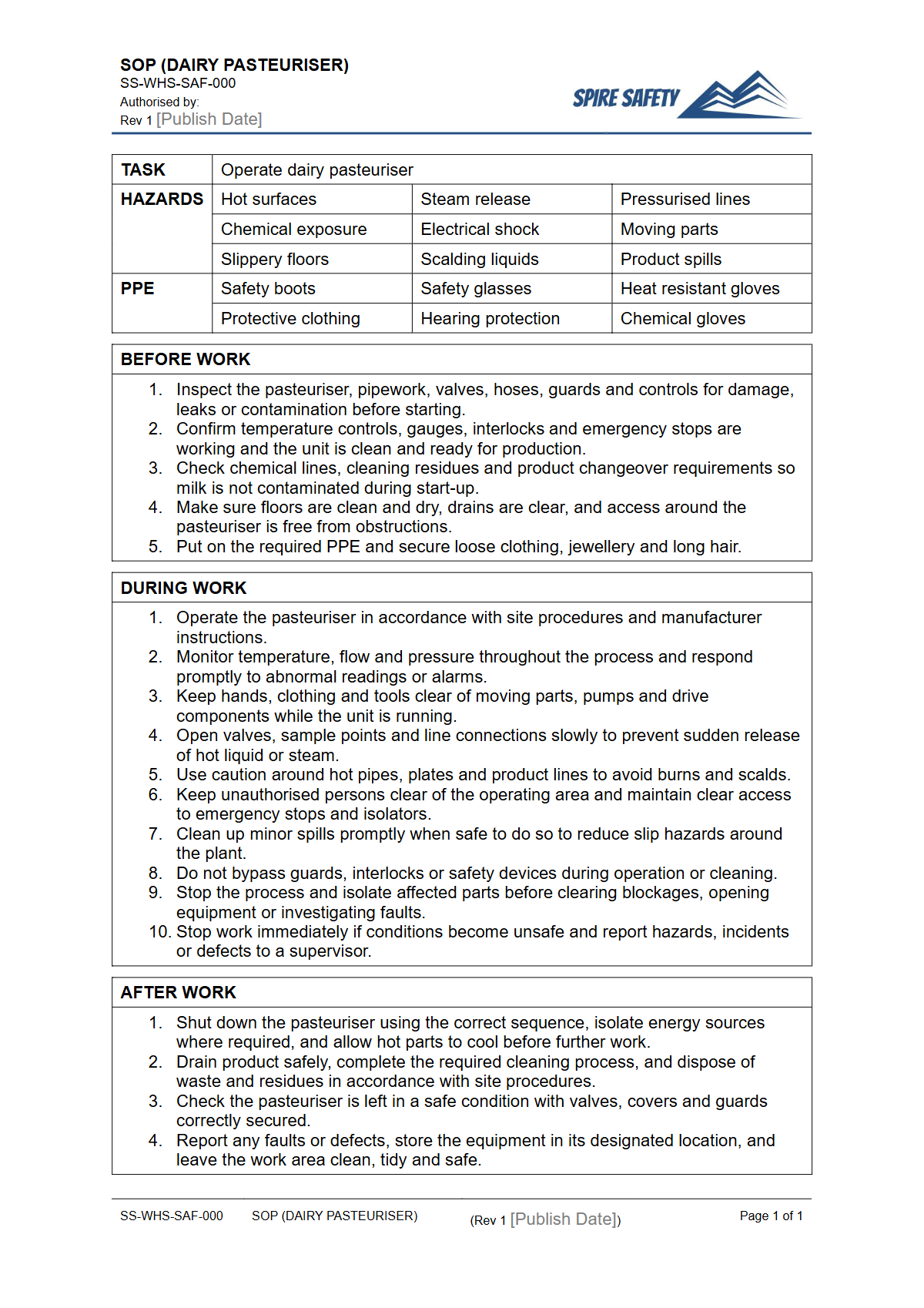
Operating a dairy pasteuriser involves significant risks, including high temperatures, pressurised systems, and hazardous chemicals used for cleaning. This free Safe Operating Procedure (Dairy Pasteuriser) Template provides a structured framework for documenting the required steps to perform the task safely.
A well-developed Safe Operating Procedure (SOP) is a critical administrative control that helps your organisation meet its duties under Australian WHS laws by clearly outlining hazards and control measures.
This template is designed to help you detail pre-operational checks, step-by-step operating instructions, and post-operational shutdown and cleaning tasks. By systematically identifying risks such as burns from hot surfaces, scalds from steam or hot liquids, chemical exposure during Clean-In-Place (CIP) cycles, and mechanical entanglement, this document serves as a vital tool for worker training and risk management.
It acts as a key component of your overall safety management system, ensuring that all operators follow a consistent, safe, and efficient process every time.
Video walkthrough
How to use the Free Safe Operating Procedure (Dairy Pasteuriser) Template
This document is provided as a starting point in both DOCX and PDF formats. It is essential that you adapt it to the unique circumstances of your workplace.
A generic procedure is not sufficient to ensure safety or compliance. Integrating specific, customised SOPs is a fundamental part of building robust WHS management systems that effectively protect your people and your business.
Important: To be effective, you must customise this template to reflect the specific make and model of your equipment, your workplace environment, and your existing safety protocols. We have provided a framework, but the specific details must come from your own risk assessments.
This includes adding details on required Personal Protective Equipment (PPE), site-specific emergency shutdown procedures, and detailed Lock-Out Tag-Out (LOTO) requirements for maintenance tasks.
When to use it
A Dairy Pasteuriser SOP should be used as a constant reference point for safe work practices. It must be formally integrated into your operational workflows and used during several key activities.
This includes the initial training and onboarding of new operators, ensuring they understand the correct procedures before they ever touch the equipment. It should also be used for conducting refresher training for existing staff to prevent complacency and reinforce safe behaviour.
The SOP serves as a checklist for pre-start inspections and a guide during operation, especially for non-routine tasks. Furthermore, it should be reviewed and referenced after any incident or near miss, or when any changes are made to the pasteuriser, its associated chemicals, or the production process.
Regular reviews can also form part of a scheduled WHS compliance auditing program to verify that documented procedures are being followed correctly on the floor.
Who should use it
This Safe Operating Procedure should be used by all personnel involved with the dairy pasteuriser. This primarily includes the machine operators, who must be trained on and follow the procedure for every task.
Supervisors and team leaders should also use the SOP to oversee operations, conduct safety observations, and ensure consistent application across all shifts. Maintenance personnel must be familiar with the SOP, particularly the sections on shutdown, isolation, and energy control, before commencing any repair or service work.
WHS managers and committee members will use the document as part of risk assessments, incident investigations, and safety audits. In a typical dairy processing plant, equipment does not operate in isolation.
It is good practice to have clear procedures for all key equipment, which might include a FREE Conveyer System SOP for product transport or a Free Air Compressor SOP for plant utilities.
By creating a comprehensive library of machine-specific procedures, you build a safer and more organised work environment. You can explore our complete free WHS resources library for more templates to support your safety management efforts.
Common mistakes
Common mistakes to avoid
- Using a generic template without customising it for the specific pasteuriser model.
- Failing to include detailed Clean-In-Place (CIP) and sanitation steps with chemical specifics.
- Neglecting to train all operators and supervisors on the finalised SOP.
- Not reviewing and updating the SOP after equipment modifications or near misses.
Legal references
Legal considerations
The following legal requirements may be relevant to this type of work.
- Work Health and Safety Act (Harmonised) — Provides the primary duties for protecting workers and other people from work health and safety risks.
- Work Health and Safety Regulations (Harmonised) — Sets out requirements supporting the management of workplace hazards and risks.
The following codes may be relevant to this type of work.
- Managing WHS Risks Code of Practice — Provides practical guidance on identifying hazards, assessing risks and applying effective controls.
- Work Health and Safety Consultation, Cooperation and Coordination Code of Practice — Provides practical guidance on consulting workers and coordinating with other duty holders.
- Managing the Work Environment and Facilities Code of Practice — Provides practical guidance on safe work environments, workplace facilities and related controls.
Did you know
Pasteurisation's Origins
Louis Pasteur first developed the process in the 1860s to prevent spoilage in wine and beer, not milk. It was adapted for milk in the late 19th century to combat foodborne diseases like tuberculosis and typhoid fever.
HTST Method
Most modern dairies use High-Temperature Short-Time (HTST) pasteurisation, heating milk to a minimum of 72°C for at least 15 seconds. This method is highly effective at killing harmful bacteria while preserving the milk's nutritional value and flavour.
FAQ
Frequently asked questions
01What is a Safe Operating Procedure for a dairy pasteuriser?
02Who is responsible for writing a Dairy Pasteuriser SOP?
03How often should a Dairy Pasteuriser SOP be reviewed?
04Does this template cover cleaning and sanitation (CIP) procedures?
Share this resource
Free Safe Operating Procedure (Dairy Pasteuriser) Template
Browse Categories
How To Use It
- 1Download and open in Word or PDF.
- 2Replace the placeholders with your business details.
- 3Get it reviewed by a WHS specialist before rollout.
Need it customised?
Our WHS consultants can adapt this template to your site, run a gap analysis, or audit what you already have in place.
Book a Free Consultation WHS consulting servicesor call 1300 156 382
Related templates
- Free Safe Operating Procedure (Dairy Yard Cleaning) Template
- Free Safe Operating Procedure (Damaged Freight Hold) Template
- Free Safe Operating Procedure (Dance Floor Cleaning) Template
- Free Safe Operating Procedure (Data Logger) Template
- Free Safe Operating Procedure (Davit Arm) Template
- Free Safe Operating Procedure (De-Icing Vehicle) Template