
Free Safe Operating Procedure (Cutlery Polishing) Template
Formalise your safety processes with our free Safe Operating Procedure for cutlery polishing.
Free Safe Operating Procedure (Cutlery Polishing) Template
DOCX • 126 KB + PDF
Updated Oct 2026
No signup required
Purpose of the Free Safe Operating Procedure (Cutlery Polishing) Template
Polishing cutlery is a routine task in many hospitality venues, but it carries inherent risks that must be managed. Hazards include cuts from damaged items, burns from hot water or machinery, ergonomic strain from repetitive movements, and exposure to cleaning chemicals.
This Safe Operating Procedure (SOP) template provides a structured framework to document the safest way to perform this task, helping you standardise your process and meet your WHS obligations.
A documented SOP serves several key functions: it acts as a vital training tool for new kitchen hands and stewards, a consistent reference for experienced staff, and evidence of your commitment to providing a safe system of work. By formally identifying hazards and outlining control measures, you create a safer environment for your team.
Integrating such procedures is a fundamental aspect of building robust WHS management systems that protect both your workers and your business.
Video walkthrough
How to use the Free Safe Operating Procedure (Cutlery Polishing) Template
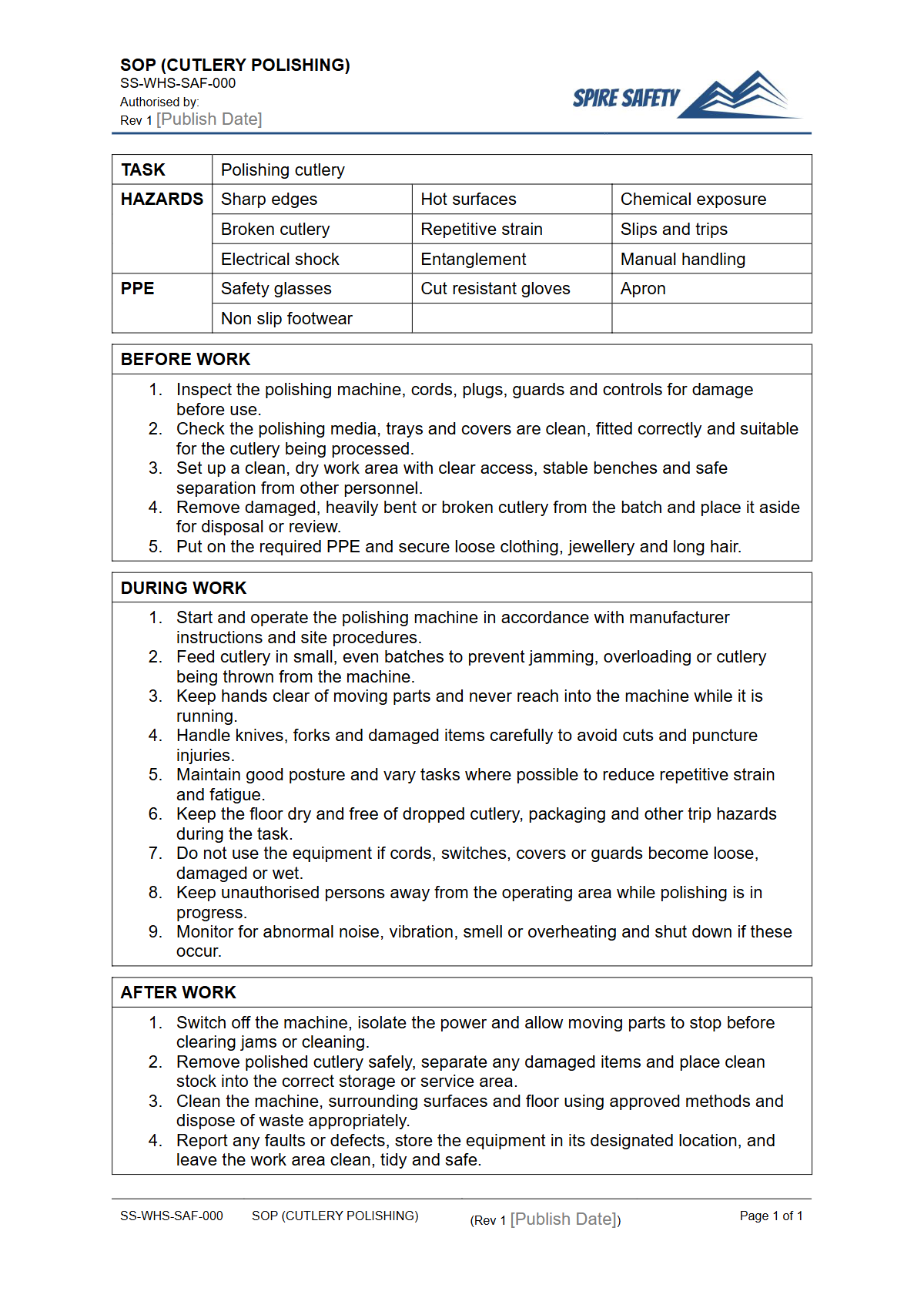
This resource is available for download in both DOCX and PDF formats. The DOCX version is fully editable, allowing you to tailor the content to the specific equipment, chemicals, and environment of your workplace.
The SOP template includes sections for outlining required PPE, pre-operational checks, a step-by-step task breakdown, and post-task cleaning and shutdown procedures.
Important: This document is a template, not a finished procedure. To be effective, you must customise it to reflect your unique operational context.
We strongly recommend conducting a risk assessment in consultation with your team to ensure all specific hazards are identified and that the control measures you document are practical and effective for your business. The effectiveness of these procedures can be periodically verified as part of a formal WHS compliance auditing schedule.
When to use a Cutlery Polishing SOP
A Safe Operating Procedure for cutlery polishing should be a living document that is used consistently within your operations. It is essential for inducting and training new staff to ensure they learn the correct, safe method from their first day.
It should also be used as a tool for refresher training with existing team members to prevent complacency and bad habits from forming.
Furthermore, the SOP is an invaluable reference during safety observations or if an incident occurs. It provides a clear benchmark against which actual work practices can be compared, helping to identify procedural gaps or areas for improvement.
A comprehensive safety framework requires documented procedures for all hazardous tasks across the organisation. For example, a maintenance department would require a FREE Circular Saw SOP (Safe Operating Procedure) Template to manage its own distinct risks.
Who should use this template
This template is designed for anyone responsible for workplace safety and training in the hospitality sector. This includes:
- Restaurant and Café Owners
- Hotel General Managers
- Kitchen Managers and Head Chefs
- Food and Beverage Supervisors
- WHS Managers and Coordinators
It empowers supervisors to provide clear, consistent instructions and helps business owners demonstrate due diligence in managing workplace risks. In larger establishments, this document would form part of a wider system of procedural controls, potentially sitting alongside a FREE Conveyer System SOP (Safe Operating Procedure) Template for high-volume dishwashing areas.
The principles of documenting safe work methods extend to all equipment used on site, not just primary production machinery. For instance, procedures should also cover ancillary or maintenance equipment, which may require documents like an air compressor SOP for cleaning tasks. By downloading and customising this template, you are taking a proactive step toward a more systematic approach to safety. Explore our full range of templates in our free WHS resources library to build a comprehensive safety system for your organisation.
Common mistakes
Common mistakes to avoid
- Using chipped, bent, or damaged cutlery which can damage the machine and pose a cutting hazard.
- Overloading the cutlery polishing machine, leading to ineffective polishing and potential jams.
- Failing to wear appropriate heat-resistant gloves when handling cutlery straight from the machine.
- Neglecting to regularly clean the machine and change the polishing granulate or solution.
Legal references
Legal considerations
The following legal requirements may be relevant to this type of work.
- Work Health and Safety Act (Harmonised) — Provides the primary duties for protecting workers and other people from work health and safety risks.
- Work Health and Safety Regulations (Harmonised) — Sets out requirements supporting the management of workplace hazards and risks.
The following codes may be relevant to this type of work.
- Managing WHS Risks Code of Practice — Provides practical guidance on identifying hazards, assessing risks and applying effective controls.
- Work Health and Safety Consultation, Cooperation and Coordination Code of Practice — Provides practical guidance on consulting workers and coordinating with other duty holders.
- Managing the Work Environment and Facilities Code of Practice — Provides practical guidance on safe work environments, workplace facilities and related controls.
Did you know
Repetitive Strain Risk
Hospitality workers are at high risk for musculoskeletal disorders due to repetitive tasks. A well-designed cutlery polishing station and procedure can significantly reduce the risk of ergonomic injuries.
Hidden Contaminants
Cutlery polishers that use heated granulate can become a breeding ground for bacteria if not properly maintained. Regular cleaning and granulate replacement are critical for food safety.
FAQ
Frequently asked questions
01What personal protective equipment (PPE) is typically required for cutlery polishing?
02How often should a Safe Operating Procedure for cutlery polishing be reviewed?
03Can this cutlery polishing SOP template be used for both machine and manual methods?
04Why is an SOP necessary for a seemingly simple task like cutlery polishing?
Share this resource
Free Safe Operating Procedure (Cutlery Polishing) Template
Browse Categories
How To Use It
- 1Download and open in Word or PDF.
- 2Replace the placeholders with your business details.
- 3Get it reviewed by a WHS specialist before rollout.
Need it customised?
Our WHS consultants can adapt this template to your site, run a gap analysis, or audit what you already have in place.
Book a Free Consultation WHS consulting servicesor call 1300 156 382
Related templates
- Free Safe Operating Procedure (CV Shaft Removal) Template
- Free Safe Operating Procedure (Cyclone Plant) Template
- Free Safe Operating Procedure (Cyclone Separator) Template
- Free Safe Operating Procedure (Cylinder Cage Access) Template
- Free Safe Operating Procedure (Cylinder Leak Test) Template
- Free Safe Operating Procedure (Dairy Pasteuriser) Template