
Free Safe Operating Procedure (CV Shaft Removal) Template
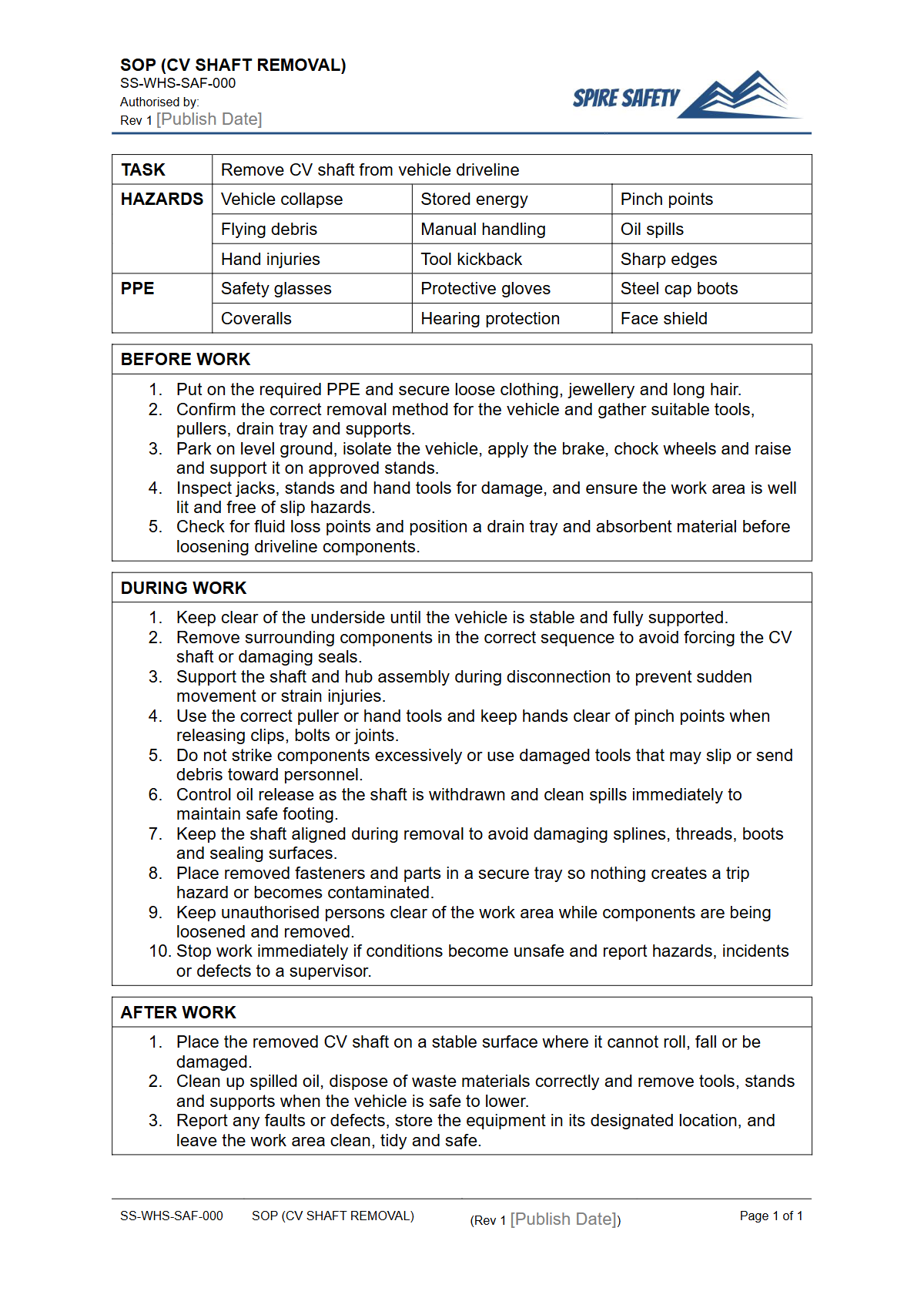
Download our free Safe Operating Procedure for CV shaft removal, a key document for any auto workshop. Start building a safer work process for your team today.
Free Safe Operating Procedure (CV Shaft Removal) Template
DOCX • 126 KB + PDF
Updated Oct 2026
No signup required
Purpose of the Free Safe Operating Procedure (CV Shaft Removal) Template
Effectively managing workshop risks begins with clear, documented procedures. Our Free Safe Operating Procedure (CV Shaft Removal) Template provides a structured starting point for mechanical workshops to control the hazards associated with this common but potentially dangerous task.
This downloadable document helps you outline a step-by-step process for safely removing and replacing constant velocity (CV) shafts, ensuring consistency and safety for your team.
A Safe Operating Procedure (SOP) for CV shaft removal serves as a critical control measure to protect workers from injury. This task involves significant risks, including the vehicle falling if not properly supported, musculoskeletal injuries from awkward postures and forceful exertions, and being struck by components under tension.
This template helps your organisation systematically identify these hazards, assess the risks, and document the required control measures, such as correct vehicle jacking procedures, tool selection, and the use of appropriate Personal Protective Equipment (PPE). Implementing a formal SOP demonstrates a commitment to a proactive safety culture and forms a key part of your overall WHS management systems.
Video walkthrough
How to use the Free Safe Operating Procedure (CV Shaft Removal) Template
This document is provided in DOCX format for easy customisation. To use it effectively, you must adapt the content to your specific workplace.
Add details about the types of vehicles you service, the specific lifting equipment (e.g., two-post hoist, jack stands) and hand or power tools used by your team. We have included comments and prompts within the template to guide you.
Remember, this template is a starting point, not a finished document. Its effectiveness depends on how well it reflects your actual work practices and environment.
It is crucial to consult with your mechanics during the drafting process to ensure the procedure is practical and accurate. Regular reviews, potentially as part of your WHS compliance auditing program, will ensure the SOP remains current and effective.
When to use this Safe Operating Procedure
This Safe Operating Procedure should be a core part of your daily workshop operations. It should be used as a reference guide before any mechanic, particularly an apprentice or a new employee, undertakes a CV shaft removal task.
It also serves as a valuable training tool for inducting new staff on your workshop's safety standards and expected work methods. In the event of a near miss or incident, the SOP provides a benchmark for investigation to determine if procedures were followed. Standardising procedures for common tasks is essential; you might also develop similar documents for other high-risk equipment, such as by using our Free Air Compressor SOP (Safe Operating Procedure) Template.
Who should use this Safe Operating Procedure
This document is intended for use by several key roles within an automotive service or repair organisation. Qualified mechanics should use it to ensure they follow a consistent and safe process.
Workshop supervisors and managers are responsible for implementing the SOP, providing the necessary training, and ensuring it is followed correctly. Apprentices and trainees must use the SOP under the direct supervision of a qualified tradesperson as part of their on-the-job training.
WHS officers can also use the document as part of their risk assessment and safety management activities. For businesses needing help to integrate these documents into their broader safety framework, specialist WHS consulting can provide valuable guidance and support.
By ensuring everyone understands their role in relation to the SOP, you create a more coordinated and safety-conscious team. You can find more templates and guides like this one in our comprehensive free WHS resources library to build out your safety documentation.
Common mistakes
Common mistakes to avoid
- Failing to properly support the vehicle on correctly rated jack stands.
- Using the wrong tools for the job, such as pry bars instead of slide hammers, leading to component damage.
- Not cleaning the hub and surrounding area before disassembly, causing contamination of new parts.
- Neglecting to wear appropriate PPE, especially safety glasses to protect from debris and grease.
Legal references
Legal considerations
The following legal requirements may be relevant to this type of work.
- Work Health and Safety Act (Harmonised) — Provides the primary duties for protecting workers and other people from work health and safety risks.
- Work Health and Safety Regulations (Harmonised) — Sets out requirements supporting the management of workplace hazards and risks.
The following codes may be relevant to this type of work.
- Managing WHS Risks Code of Practice — Provides practical guidance on identifying hazards, assessing risks and applying effective controls.
- Work Health and Safety Consultation, Cooperation and Coordination Code of Practice — Provides practical guidance on consulting workers and coordinating with other duty holders.
- Managing the Work Environment and Facilities Code of Practice — Provides practical guidance on safe work environments, workplace facilities and related controls.
Did you know
Stored Energy Risk
A CV shaft is connected to the vehicle's suspension, which can store significant energy. Uncontrolled release during removal can cause components to spring out unexpectedly, posing a serious strike hazard.
Grease and Dermatitis
The specialised grease used in CV joints can cause contact dermatitis with prolonged exposure. Using appropriate nitrile gloves is essential to protect skin from irritation and chemical absorption.
FAQ
Frequently asked questions
01What are the main hazards involved in CV shaft removal?
02Is a Safe Operating Procedure a legal requirement in Australia?
03How often should a CV shaft removal SOP be reviewed?
04Can this template be used for heavy vehicles like trucks?
Share this resource
Free Safe Operating Procedure (CV Shaft Removal) Template
Browse Categories
How To Use It
- 1Download and open in Word or PDF.
- 2Replace the placeholders with your business details.
- 3Get it reviewed by a WHS specialist before rollout.
Need it customised?
Our WHS consultants can adapt this template to your site, run a gap analysis, or audit what you already have in place.
Book a Free Consultation WHS consulting servicesor call 1300 156 382
Related templates
- Free Safe Operating Procedure (Cyclone Plant) Template
- Free Safe Operating Procedure (Cyclone Separator) Template
- Free Safe Operating Procedure (Cylinder Cage Access) Template
- Free Safe Operating Procedure (Cylinder Leak Test) Template
- Free Safe Operating Procedure (Dairy Pasteuriser) Template
- Free Safe Operating Procedure (Dairy Yard Cleaning) Template