
Free Safe Operating Procedure (Cyclone Plant) Template
Establish clear, step-by-step instructions for the safe operation of cyclone plants in your workplace. Download our free Safe Operating Procedure template now.
Free Safe Operating Procedure (Cyclone Plant) Template
DOCX • 126 KB + PDF
Updated Oct 2026
No signup required
Purpose of the Free Safe Operating Procedure (Cyclone Plant) Template
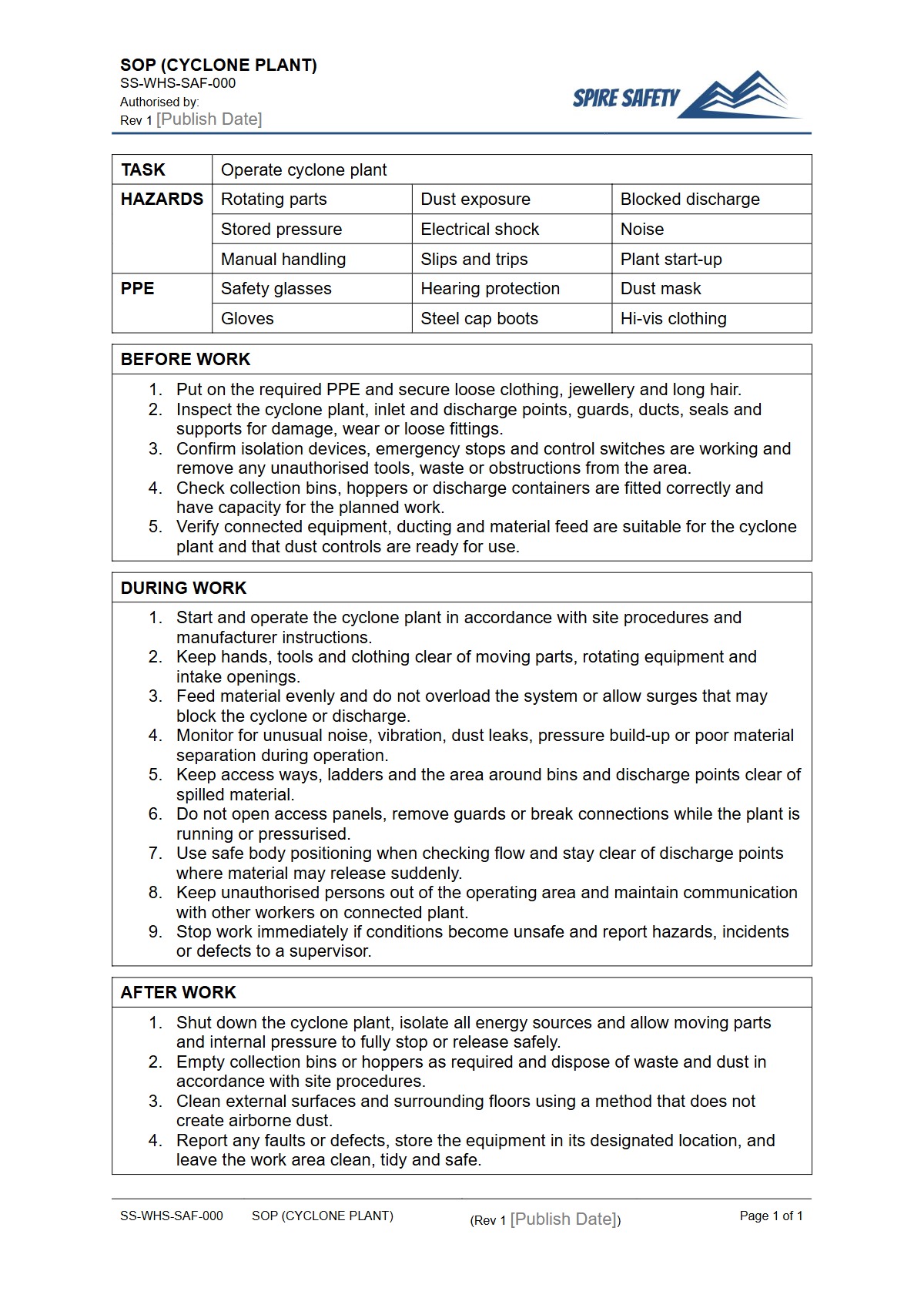
This free Safe Operating Procedure (Cyclone Plant) Template provides a structured framework for documenting the required steps to safely operate industrial cyclone separators. Cyclone plants are common in mining, quarrying, agriculture, and manufacturing for separating particulate matter from an air, gas, or liquid stream.
Operating them introduces significant risks, including exposure to hazardous dust (like silica), high-pressure systems, rotating parts, and potential blockages that require manual intervention.
A documented Safe Operating Procedure (SOP) is a key administrative control measure that formalises your organisation's approved process for completing this task safely. It serves as an essential tool for worker training, competency assessment, and daily operational guidance.
Using a standardised procedure helps ensure that all operators follow the same safety-critical steps, reducing the likelihood of incidents caused by procedural error or unsafe shortcuts.
Video walkthrough
How to use the Free Safe Operating Procedure (Cyclone Plant) Template
This SOP template is provided in both DOCX and PDF formats for your convenience. To use it effectively, download the file and integrate it into your organisation's safety management system.
The document outlines a logical sequence for cyclone plant operation, including pre-start checks, startup, monitoring, shutdown, and basic cleaning procedures.
It is crucial to understand that this is a generic template. We strongly advise that you customise this document in consultation with workers to reflect the specific make and model of your cyclone plant, the materials being processed, and the unique environmental and operational hazards of your site. Effective SOPs form a vital part of comprehensive WHS management systems, ensuring that documented procedures accurately reflect on-the-ground reality.
When to use a Cyclone Plant Safe Operating Procedure
A Safe Operating Procedure for a cyclone plant should be used as the primary reference for all operational tasks. Its application includes:
- Worker Training: For inducting new operators and providing refresher training for existing staff.
- Pre-Start Inspections: Guiding operators through a systematic check of the equipment before it is energised.
- Routine Operation: Providing a clear, step-by-step guide for the startup, monitoring, and shutdown sequences.
- Incident Investigation: Serving as a benchmark to determine if procedural deviations contributed to an incident or near miss.
- Work Planning: Assisting supervisors in planning work and conducting pre-task risk assessments like a Take 5.
The SOP should be readily accessible to all operators at or near the plant's control station. It is a living document that should be reviewed and updated regularly, particularly after any modifications to the plant or process.
Who should use this SOP
This procedure is intended for use by all personnel involved with the cyclone plant. This includes:
- Plant Operators: The primary users who follow the procedure for daily tasks.
- Supervisors and Line Managers: Responsible for ensuring operators are trained and adhering to the SOP.
- Maintenance Personnel: To understand safe shutdown and isolation procedures before commencing maintenance work. Any maintenance tasks, such as work on associated equipment, will require their own specific procedures, like an SOP for air compressors used for tooling or cleaning.
- WHS Managers and Advisors: For use in risk assessments, training development, and safety audits.
Consultation is a mandatory part of creating and reviewing SOPs. The most valuable input will come from the experienced operators who use the equipment every day.
Their practical knowledge is essential for creating a procedure that is both safe and workable.
Integrating SOPs with other plant procedures
Cyclone plants rarely operate in isolation. They are typically part of a larger material processing circuit that can include crushers, screens, and various types of conveyors.
It is critical that the SOP for the cyclone plant aligns with the procedures for interconnected equipment. For example, the shutdown sequence must be coordinated with upstream and downstream processes, which should be detailed in a corresponding safe operating procedure for conveyer systems to prevent material build-up or blockages.
Similarly, the worksite may involve the use of mobile plant for loading stockpiles or clearing areas. The interaction between fixed plant like a cyclone and mobile equipment must be managed carefully.
A Dozer SOP template can help formalise the rules for mobile equipment operating in the vicinity of fixed processing infrastructure. Regularly scheduled WHS compliance audits can help verify that these integrated procedures are being implemented correctly and are effective at controlling cross-operational risks.
Common mistakes
Common mistakes to avoid
- Failing to customise the template for site-specific machinery, materials, and hazards.
- Neglecting to consult with experienced operators and maintenance crew during the drafting process.
- Treating the SOP as a 'set and forget' document without scheduling regular reviews.
- Providing inadequate training on the finalised SOP, or failing to ensure it is readily accessible.
Legal references
Legal considerations
The following legal requirements may be relevant to this type of work.
- Work Health and Safety Act (Harmonised) — Provides the primary duties for protecting workers and other people from work health and safety risks.
- Work Health and Safety Regulations (Harmonised) — Sets out requirements supporting the management of workplace hazards and risks.
The following codes may be relevant to this type of work.
- Managing WHS Risks Code of Practice — Provides practical guidance on identifying hazards, assessing risks and applying effective controls.
- Work Health and Safety Consultation, Cooperation and Coordination Code of Practice — Provides practical guidance on consulting workers and coordinating with other duty holders.
- Managing the Work Environment and Facilities Code of Practice — Provides practical guidance on safe work environments, workplace facilities and related controls.
Did you know
Centrifugal Force
Cyclone separators work without filters, using vortex separation. As the gas spins, heavy dust particles are thrown outwards by centrifugal force, hit the wall, and fall to the collection hopper below.
Efficiency Factors
The collection efficiency of a cyclone is highly dependent on particle size and density. They are most effective at removing larger, coarse particles and are often used as a 'pre-cleaner' to protect finer, more expensive filtration systems downstream.
FAQ
Frequently asked questions
01What is a Safe Operating Procedure for a cyclone plant?
02Why is an SOP for cyclone plants so important?
03How often should a cyclone plant SOP be reviewed?
04Does this SOP template guarantee WHS compliance?
Share this resource
Free Safe Operating Procedure (Cyclone Plant) Template
Browse Categories
How To Use It
- 1Download and open in Word or PDF.
- 2Replace the placeholders with your business details.
- 3Get it reviewed by a WHS specialist before rollout.
Need it customised?
Our WHS consultants can adapt this template to your site, run a gap analysis, or audit what you already have in place.
Book a Free Consultation WHS consulting servicesor call 1300 156 382
Related templates
- Free Safe Operating Procedure (Cyclone Separator) Template
- Free Safe Operating Procedure (Cylinder Cage Access) Template
- Free Safe Operating Procedure (Cylinder Leak Test) Template
- Free Safe Operating Procedure (Dairy Pasteuriser) Template
- Free Safe Operating Procedure (Dairy Yard Cleaning) Template
- Free Safe Operating Procedure (Damaged Freight Hold) Template