
Free Safe Operating Procedure (Cyclone Separator) Template
Download our free Safe Operating Procedure (Cyclone Separator) Template to establish clear, safe work instructions.
Free Safe Operating Procedure (Cyclone Separator) Template
DOCX • 126 KB + PDF
Updated Oct 2026
No signup required
Purpose of the Free Safe Operating Procedure (Cyclone Separator) Template
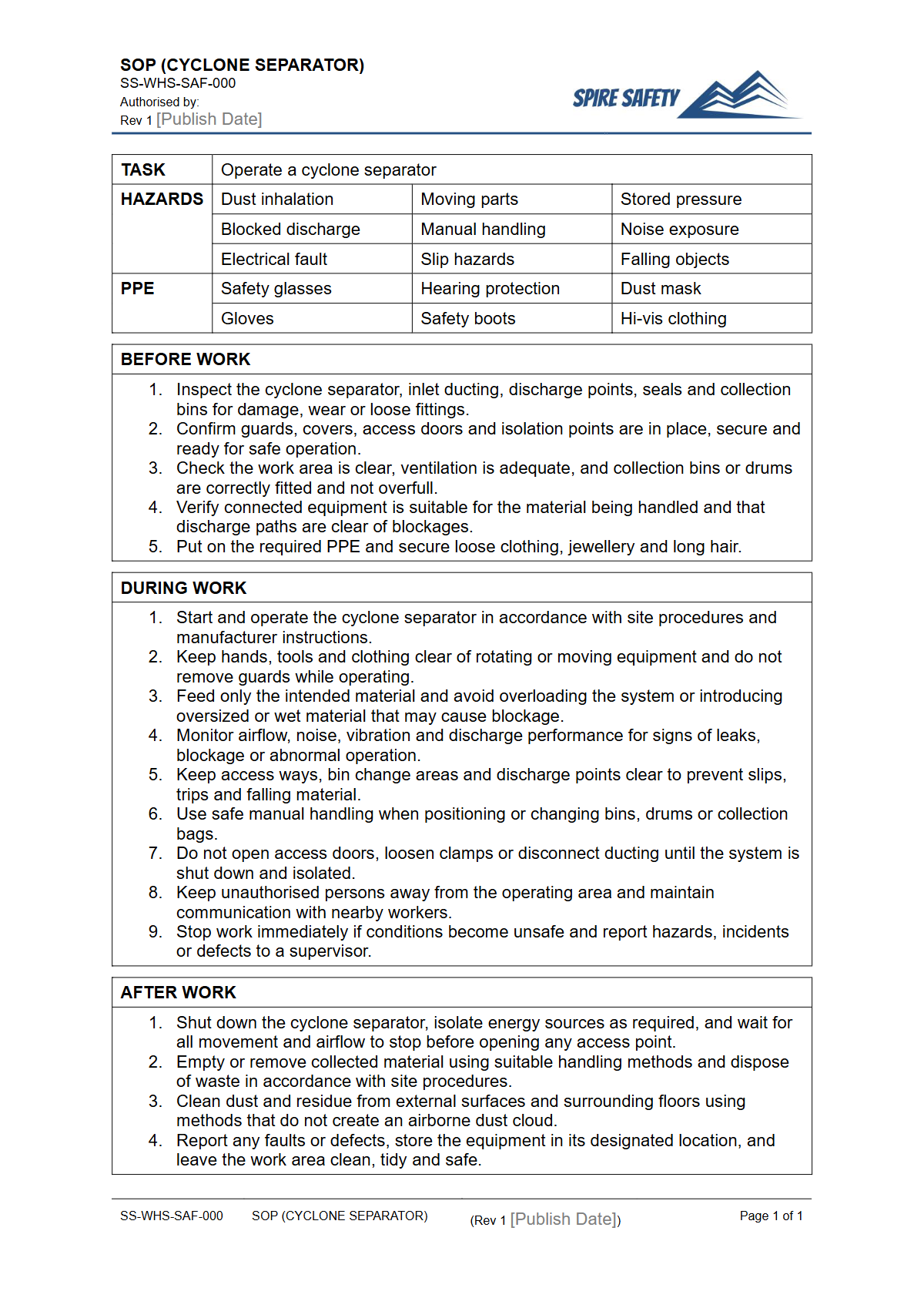
A cyclone separator is a critical piece of equipment for dust and particle collection in many industrial settings, but it also introduces significant workplace hazards. This Free Safe Operating Procedure (Cyclone Separator) Template provides a structured framework for documenting safe work methods to control these risks.
It helps your organisation meet its duty of care by outlining step-by-step instructions for operation, maintenance, and emergency response. Properly implemented, this SOP is a vital tool for preventing incidents related to airborne contaminants, mechanical entanglement, high-pressure systems, and noise exposure.
Using a documented procedure ensures that all workers follow a consistent, pre-approved method for interacting with the cyclone separator. It forms a key part of your overall safety management system, providing a foundation for worker training, competency assessments, and incident investigations.
The template is designed to be adapted to your specific equipment and operational context, helping you manage risks effectively.
Video walkthrough
How to use the Free Safe Operating Procedure (Cyclone Separator) Template
This document is a starting point, not a finished product. To implement it correctly, you must download the template and customise it with information specific to your workplace, the model of cyclone separator you use, and the materials it processes.
Consult with the workers who operate and maintain the equipment—their direct experience is essential for creating a practical and effective procedure. Once customised, the SOP should be formally approved, and all relevant personnel must be trained on its contents before it is put into practice.
A well-drafted SOP is a fundamental component of systematic safety management. Integrating this procedure into your broader WHS management systems ensures that it connects with other safety processes like risk assessments, training records, and maintenance schedules.
This holistic approach embeds safe work practices into your organisation's daily operations.
Important: We have created this template as a guide. You must customise this Safe Operating Procedure to reflect the specific hazards and control measures relevant to your workplace.
Consultation with your team is essential.
Key Elements of a Cyclone Separator SOP
A comprehensive Safe Operating Procedure for a cyclone separator should cover the entire lifecycle of the task. Our template prompts you to detail the critical safety elements required for safe operation.
Hazard Identification
The first step is to clearly identify the potential hazards associated with the cyclone separator. These commonly include:
- Airborne Dust: Inhalation of hazardous dusts (e.g., respirable crystalline silica, wood dust) leading to respiratory diseases.
- Mechanical Entanglement: Moving parts such as rotary valves, augers, or associated fans and motors.
- Pressurised Systems: Risk of sudden release of pressure or material during operation or maintenance.
- Noise: High noise levels from fans and air movement, which can cause hearing loss.
- Fire and Explosion: Combustible dusts can create an explosive atmosphere under certain conditions.
- Hazardous Manual Tasks: When accessing parts for cleaning or maintenance.
For related machinery often used with dust extraction systems, our Free Air Compressor SOP Template provides additional guidance on managing pressurised air hazards.
Personal Protective Equipment (PPE)
The SOP must specify the mandatory PPE required for tasks involving the cyclone separator. This is determined by a risk assessment and may include P2/P3 respiratory protection, hearing protection (earmuffs or plugs), safety glasses or goggles, protective gloves, and steel-capped boots.
Step-by-Step Procedures
The core of the SOP is the sequential instructions for performing work safely. The template is structured to cover:
- Pre-Operational Checks: Verifying that guards are in place, ducting is secure, and the collection bin is correctly fitted.
- Operation: Safe start-up and shutdown sequences, monitoring pressure gauges, and checking for normal operation.
- Cleaning and Maintenance: Lockout Tagout (LOTO) procedures are critical here. The SOP should detail how to de-energise and isolate the system before any maintenance, inspection, or blockage clearing is attempted. The effectiveness of these procedures can be verified through routine WHS compliance auditing.
- Emergency Shutdown: Clear instructions on how to stop the equipment in an emergency.
Many cyclone separators are integrated with other plant, such as material transfer systems. If applicable, consider referencing your procedures for associated equipment, like those outlined in a FREE Conveyer System SOP.
When to review the Safe Operating Procedure
An SOP is a living document that requires periodic review to remain effective. It should be reviewed, and if necessary updated, on a scheduled basis (e.g., annually).
A review is also required whenever there is a change to the workplace, equipment, or process; after a new hazard has been identified; or following an incident or near miss involving the cyclone separator. Regular reviews ensure the procedure continues to be a relevant and useful tool for risk management.
Spire Safety offers a wide range of document templates and guides. You can explore our complete collection in our free WHS resources library to find other procedures relevant to your operations.
Common mistakes
Common mistakes to avoid
- Using a generic template without customising it for the specific machine model and materials handled.
- Failing to adequately train workers on the finalised SOP and verify their understanding.
- Neglecting to include specific Lockout Tagout (LOTO) procedures for clearing blockages or performing maintenance.
- Not reviewing and updating the SOP after an incident, near miss, or change in the work process.
Legal references
Legal considerations
The following legal requirements may be relevant to this type of work.
- Work Health and Safety Act (Harmonised) — Provides the primary duties for protecting workers and other people from work health and safety risks.
- Work Health and Safety Regulations (Harmonised) — Sets out requirements supporting the management of workplace hazards and risks.
The following codes may be relevant to this type of work.
- Managing WHS Risks Code of Practice — Provides practical guidance on identifying hazards, assessing risks and applying effective controls.
- Work Health and Safety Consultation, Cooperation and Coordination Code of Practice — Provides practical guidance on consulting workers and coordinating with other duty holders.
- Managing the Work Environment and Facilities Code of Practice — Provides practical guidance on safe work environments, workplace facilities and related controls.
Did you know
Centrifugal Force at Work
Cyclone separators work without filters, using vortex separation. In-flowing gas is forced into a spiral, and the centrifugal force throws heavier dust particles against the outer wall, where they slide down to a collection hopper.
Combustible Dust
Many seemingly harmless materials, such as flour, sugar, wood, and some metals, can become explosive when dispersed in the air as fine dust. Cyclone separators are a key control in preventing dangerous accumulations of these combustible dusts.
FAQ
Frequently asked questions
01What are the main hazards of operating a cyclone separator?
02How often should a Safe Operating Procedure for a cyclone separator be reviewed?
03Is an SOP enough to manage all cyclone separator risks?
04Who is responsible for writing a cyclone separator SOP?
Share this resource
Free Safe Operating Procedure (Cyclone Separator) Template
Browse Categories
How To Use It
- 1Download and open in Word or PDF.
- 2Replace the placeholders with your business details.
- 3Get it reviewed by a WHS specialist before rollout.
Need it customised?
Our WHS consultants can adapt this template to your site, run a gap analysis, or audit what you already have in place.
Book a Free Consultation WHS consulting servicesor call 1300 156 382
Related templates
- Free Safe Operating Procedure (Cylinder Cage Access) Template
- Free Safe Operating Procedure (Cylinder Leak Test) Template
- Free Safe Operating Procedure (Dairy Pasteuriser) Template
- Free Safe Operating Procedure (Dairy Yard Cleaning) Template
- Free Safe Operating Procedure (Damaged Freight Hold) Template
- Free Safe Operating Procedure (Dance Floor Cleaning) Template