
Free Safe Operating Procedure (Cylinder Cage Access) Template
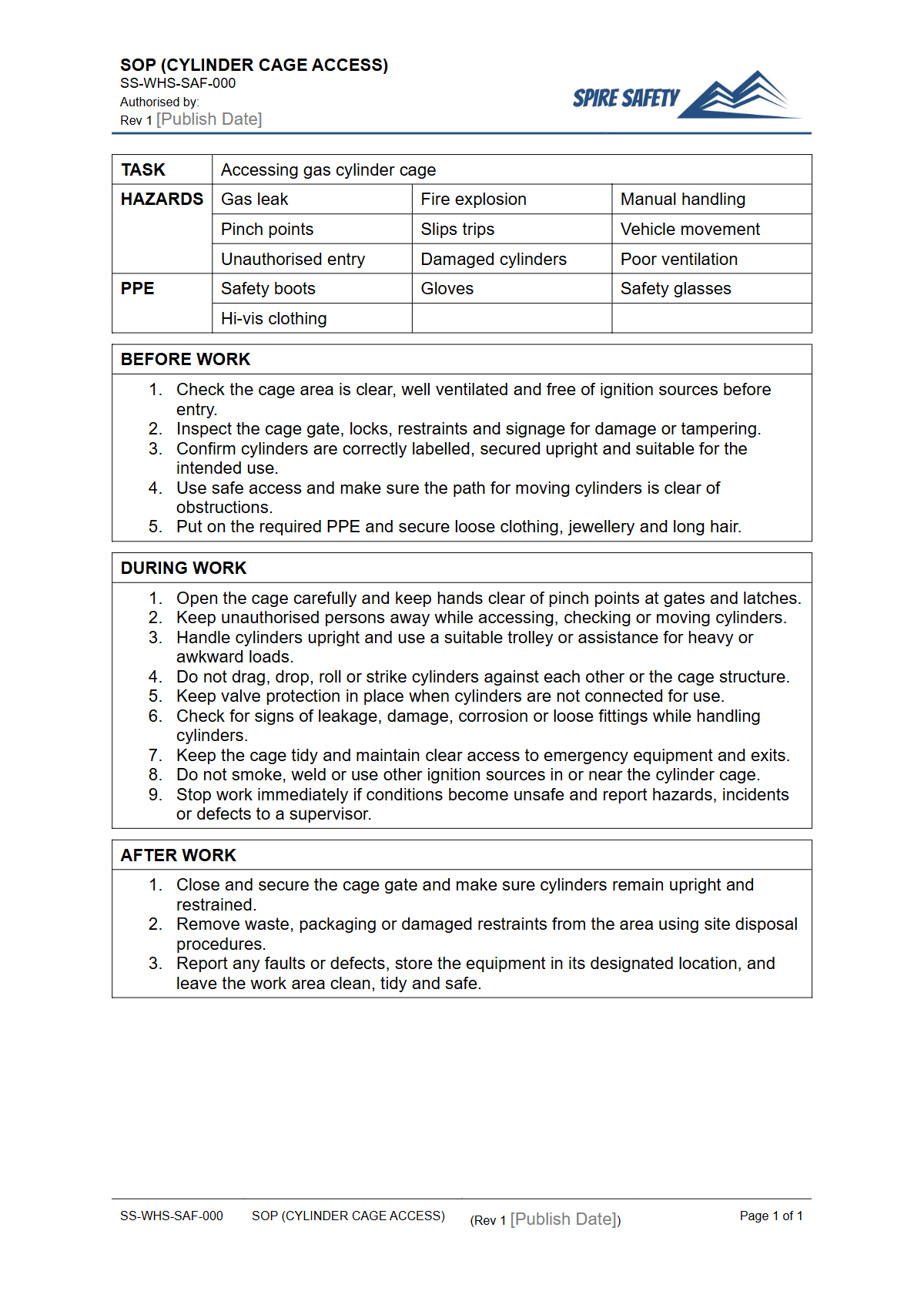
Our Free Safe Operating Procedure (Cylinder Cage Access) Template helps you document required steps for safely using gas cylinder cages.
Free Safe Operating Procedure (Cylinder Cage Access) Template
DOCX • 126 KB + PDF
Updated Oct 2026
No signup required
Purpose of the Free Safe Operating Procedure (Cylinder Cage Access) Template
Managing the storage and handling of gas cylinders is a critical safety task for many Australian businesses. Our Free Safe Operating Procedure (Cylinder Cage Access) Template provides a structured starting point for documenting the process of accessing, storing, and handling gas cylinders within a designated cage.
This SOP is designed to help you outline key hazards, control measures, and step-by-step instructions to guide workers, ensuring tasks are performed consistently and safely. Proper procedures minimise risks such as manual handling injuries, gas leaks, and uncontrolled release of pressure.
This template is based on the model WHS framework and established industry practices for hazardous chemical management. By clearly defining the procedure for cylinder cage access, you help reinforce safe work behaviours and support your broader WHS duties.
The document prompts you to consider site-specific factors like the types of gases stored, required personal protective equipment (PPE), and emergency procedures. A robust WHS management system provides the overarching structure for all your site-specific procedures, including those for hazardous materials.
Video walkthrough
How to use the Free Safe Operating Procedure (Cylinder Cage Access) Template
This document is a template and must be customised to suit the specific requirements of your workplace. Download the DOCX file and adapt it by incorporating details about your equipment, environment, and internal processes.
When customising, consult with workers who regularly perform the task, as their direct experience is invaluable for identifying practical risks and effective controls. Ensure all sections are filled out, including site details, specific PPE requirements, and emergency contacts.
The finalised SOP should be used as a tool for training, inductions, and ongoing competency verification.
Before finalising the document, it's essential to conduct a risk assessment for the task. The SOP should reflect the outcomes of this assessment, detailing the hierarchy of controls you have implemented to manage identified hazards.
If you need expert assistance tailoring procedures like this to your unique operational risks, our WHS consulting services can provide tailored support.
When to use a Safe Operating Procedure for Cylinder Cage Access
An SOP for cylinder cage access should be developed and used whenever workers need to interact with gas cylinders stored in a cage. This includes routine tasks like retrieving a full cylinder, returning an empty one, conducting stocktakes, or performing inspections of the storage area.
Implementing this procedure is particularly important in environments where multiple types of gases are stored, as it helps prevent the storage of incompatible substances together. The SOP also serves as a critical reference during emergency situations, outlining the immediate steps to take in case of a leak or fire.
Many operations involve compressed air systems, which often source gas from cylinders. Documenting procedures for this equipment is equally important, and our Free Air Compressor SOP Template provides a specific framework for that hazard.
Who should use this Safe Operating Procedure
This Safe Operating Procedure should be used by all personnel authorised to handle gas cylinders, including workshop staff, maintenance crews, delivery drivers, and laboratory technicians. It is also a vital resource for supervisors and managers responsible for overseeing these tasks and ensuring compliance with safety protocols.
During onboarding, the SOP should be a core part of training for new employees who will be required to work with or around cylinder cages. It also serves as a refresher tool for experienced workers to ensure standards are consistently maintained.
Moving full cylinder cages often requires mechanical aids like forklifts or telehandlers. If your process involves such equipment, consider documenting its use with a specific Telehandler SOP Template to cover all aspects of the operation.
Periodically reviewing the effectiveness of these controls is a key part of maintaining a safe workplace. A formal WHS compliance audit can help identify gaps in your procedures and opportunities for improvement across your entire safety system.
This document is one of many available to support your organisation. You can explore and download other procedural templates from our complete free WHS resources library to build a comprehensive suite of safety documentation for your business.
Common mistakes
Common mistakes to avoid
- Storing incompatible gases (e.g., oxygen and acetylene) next to each other in the same cage.
- Failing to properly secure cylinders with chains or straps, allowing them to fall.
- Leaving the cage door unlocked or propped open, allowing unauthorised access.
- Using incorrect manual handling techniques when moving heavy cylinders, leading to musculoskeletal injuries.
Legal references
Legal considerations
The following legal requirements may be relevant to this type of work.
- Work Health and Safety Act (Harmonised) — Provides the primary duties for protecting workers and other people from work health and safety risks.
- Work Health and Safety Regulations (Harmonised) — Sets out requirements supporting the management of workplace hazards and risks.
The following codes may be relevant to this type of work.
- Managing WHS Risks Code of Practice — Provides practical guidance on identifying hazards, assessing risks and applying effective controls.
- Work Health and Safety Consultation, Cooperation and Coordination Code of Practice — Provides practical guidance on consulting workers and coordinating with other duty holders.
- Managing the Work Environment and Facilities Code of Practice — Provides practical guidance on safe work environments, workplace facilities and related controls.
Did you know
Cylinder Colour Coding
In Australia, gas cylinder colours are standardised under AS 4484 to help users quickly identify the gas properties. For example, a black shoulder indicates an inert gas, while a light blue shoulder signifies an oxidising gas.
Unsecured Cylinder Risks
An unsecured gas cylinder that falls and has its valve shear off can become a projectile with enough force to penetrate a brick wall. This is why securing cylinders with chains or straps is a non-negotiable safety rule.
FAQ
Frequently asked questions
01What is a Safe Operating Procedure for cylinder cage access?
02Who is responsible for creating an SOP for cylinder cages?
03How often should a cylinder cage access SOP be reviewed?
04Does this template cover all types of gas cylinders?
Share this resource
Free Safe Operating Procedure (Cylinder Cage Access) Template
Browse Categories
How To Use It
- 1Download and open in Word or PDF.
- 2Replace the placeholders with your business details.
- 3Get it reviewed by a WHS specialist before rollout.
Need it customised?
Our WHS consultants can adapt this template to your site, run a gap analysis, or audit what you already have in place.
Book a Free Consultation WHS consulting servicesor call 1300 156 382
Related templates
- Free Safe Operating Procedure (Cylinder Leak Test) Template
- Free Safe Operating Procedure (Dairy Pasteuriser) Template
- Free Safe Operating Procedure (Dairy Yard Cleaning) Template
- Free Safe Operating Procedure (Damaged Freight Hold) Template
- Free Safe Operating Procedure (Dance Floor Cleaning) Template
- Free Safe Operating Procedure (Data Logger) Template