
Free Safe Operating Procedure (Cut Flower Harvesting) Template
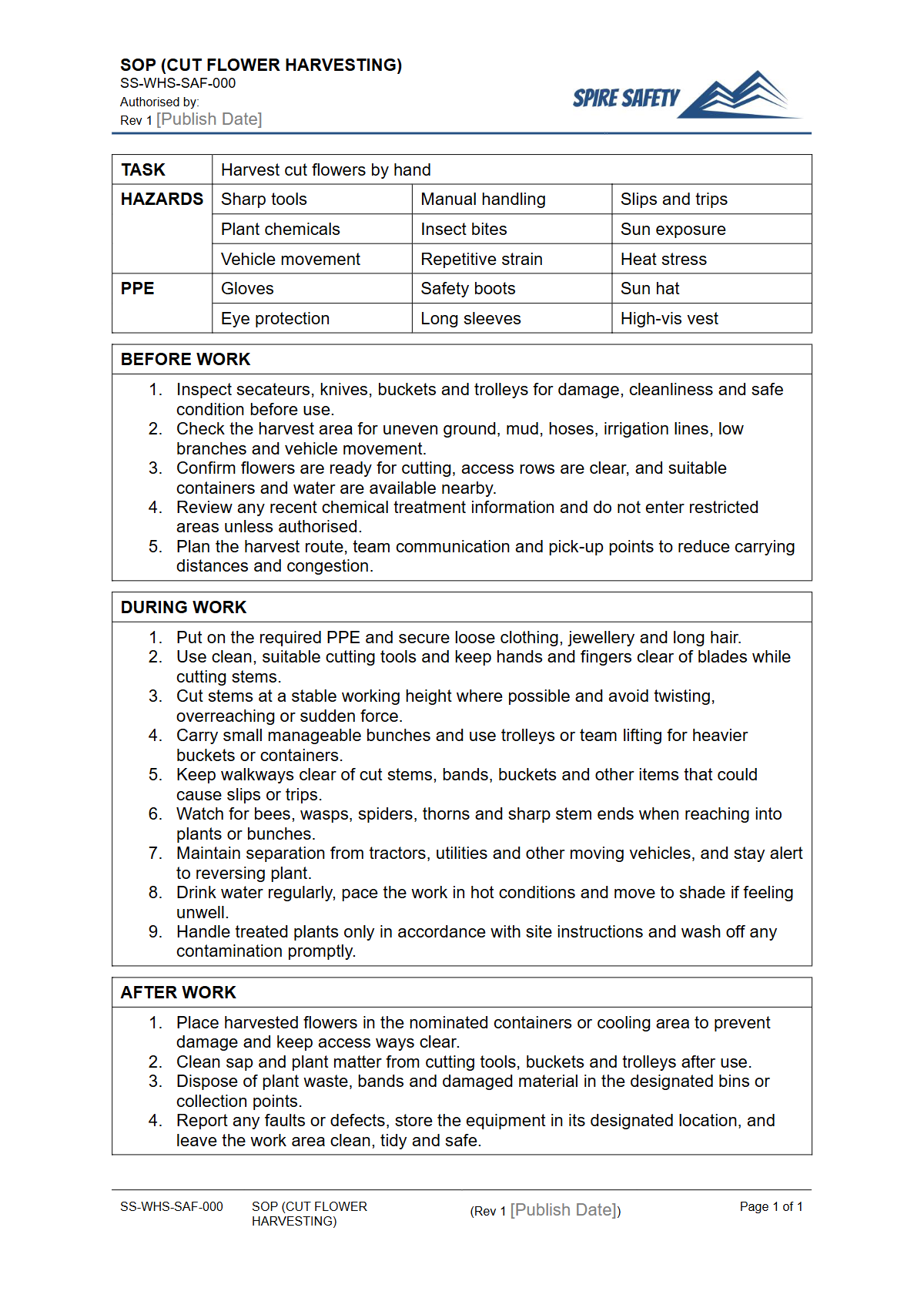
Formalise your safety processes for flower harvesting with our detailed template. Download your free Safe Operating Procedure to get started.
Free Safe Operating Procedure (Cut Flower Harvesting) Template
DOCX • 126 KB + PDF
Updated Oct 2026
No signup required
Purpose of the Free Safe Operating Procedure (Cut Flower Harvesting) Template
This Free Safe Operating Procedure (Cut Flower Harvesting) Template provides a structured starting point for documenting the risks and control measures associated with harvesting cut flowers. While seemingly straightforward, this task involves numerous hazards, including ergonomic risks from repetitive movements, lacerations from sharp tools, musculoskeletal injuries from manual handling, and exposure to environmental factors like sun and heat.
A documented SOP is a critical tool for providing clear instructions, training workers, and demonstrating a commitment to a safe system of work.
Using a standardised procedure helps ensure every worker understands the expected safety standards, from pre-start checks of equipment to correct harvesting techniques and post-harvest handling. It forms a key part of your overall safety management, working alongside procedures for other agricultural activities.
For example, similar principles of risk assessment apply to tasks covered in our FREE Planter SOP Template, ensuring a consistent approach to safety across your operations.
Video walkthrough
How to use the Free Safe Operating Procedure (Cut Flower Harvesting) Template
This template is provided in both DOCX and PDF formats for your convenience. The DOCX file is fully editable, allowing you to tailor it precisely to your farm's unique environment and equipment.
It is essential that you customise this document to reflect your specific operational context.
Important: This is a template only. We have provided a comprehensive framework, but you must adapt it to your workplace.
This involves a site-specific risk assessment and consultation with your workers. You should add details about the specific types of flowers grown, the models of tools used (e.g., secateurs, knives), any vehicles involved, and the layout of your fields and processing areas.
Effective safety documents are not generic; they are living documents that reflect your reality.
During customisation, consider the entire workflow from the field to the packing shed. If harvested flowers are moved onto sorting lines, you should also document the procedures for that stage.
Our FREE Conveyer System SOP can provide a useful guide for this part of the process. Integrating these various SOPs helps build a robust safety framework.
A comprehensive approach ensures that all related farm activities are managed safely. For instance, soil preparation and treatment are precursors to planting and harvesting, and require their own safety considerations.
You may find our FREE Spreader SOP Template helpful for outlining those procedures.
When to use a Safe Operating Procedure
An SOP for cut flower harvesting should be used consistently as a core operational document. It is essential for:
- Worker Induction: Training new or inexperienced employees on the safe and correct way to perform the task before they begin work.
- Refresher Training: Conducting periodic training for existing staff to reinforce safe work habits and introduce any procedural updates.
- Toolbox Talks: Using the SOP as a basis for short, focused safety discussions before a shift begins.
- Incident Investigation: Reviewing the SOP after an incident or near-miss to identify if the procedure was followed and if it needs improvement.
- Work Planning and Supervision: Enabling supervisors to monitor work and ensure it is being performed in line with the established safe procedure.
Integrating SOPs into a holistic safety framework is a key element of WHS best practice. By embedding these documents into your daily operations, you create a proactive safety culture rather than a reactive one.
This approach is fundamental to developing effective WHS management systems that protect your people and your business.
Who should use this Safe Operating Procedure
This SOP is designed for use by all personnel involved in the lifecycle of cut flower harvesting. This includes:
- Farm Owners and Managers (PCBUs): To fulfil their duty of care by establishing and implementing a safe system of work.
- Supervisors and Team Leaders: To train, supervise, and monitor workers, ensuring they adhere to the documented procedures.
- Workers: To understand the steps required to perform their job safely, recognise the associated hazards, and use the specified control measures.
- WHS Officers and Advisors: To use as a tool for risk assessment, training development, and compliance monitoring.
Regularly verifying that documented procedures are being followed correctly in the field is crucial for maintaining safety standards. Periodic reviews and observations, sometimes as part of a formal WHS compliance auditing program, can help identify any gaps between the SOP and actual work practices.
You can find more templates and guides like this one in our free WHS resources library to support your safety efforts.
Common mistakes
Common mistakes to avoid
- Using the template without customising it for specific tools, crops, and site conditions.
- Failing to consult with the workers who perform the harvesting tasks during the drafting process.
- Not providing practical, hands-on training on the SOP to all relevant employees and supervisors.
- Neglecting to review and update the SOP after an incident or when a process changes.
Legal references
Legal considerations
The following legal requirements may be relevant to this type of work.
- Work Health and Safety Act (Harmonised) — Provides the primary duties for protecting workers and other people from work health and safety risks.
- Work Health and Safety Regulations (Harmonised) — Sets out requirements supporting the management of workplace hazards and risks.
The following codes may be relevant to this type of work.
- Managing WHS Risks Code of Practice — Provides practical guidance on identifying hazards, assessing risks and applying effective controls.
- Work Health and Safety Consultation, Cooperation and Coordination Code of Practice — Provides practical guidance on consulting workers and coordinating with other duty holders.
- Managing the Work Environment and Facilities Code of Practice — Provides practical guidance on safe work environments, workplace facilities and related controls.
Did you know
Ergonomic Risk
Repetitive Strain Injuries (RSIs) are a significant risk in horticulture. The high-volume, manual nature of tasks like flower harvesting can lead to chronic injuries if correct ergonomic practices are not followed.
PCBU Responsibility
Under Australian WHS law, a PCBU must manage risks to health and safety. Providing a Safe Operating Procedure is a key administrative control measure to help meet this duty.
FAQ
Frequently asked questions
01What are the main hazards in cut flower harvesting?
02Does this Safe Operating Procedure template cover chemical use?
03Who is responsible for implementing an SOP on a farm?
04How often should a Safe Operating Procedure for harvesting be reviewed?
Share this resource
Free Safe Operating Procedure (Cut Flower Harvesting) Template
Browse Categories
How To Use It
- 1Download and open in Word or PDF.
- 2Replace the placeholders with your business details.
- 3Get it reviewed by a WHS specialist before rollout.
Need it customised?
Our WHS consultants can adapt this template to your site, run a gap analysis, or audit what you already have in place.
Book a Free Consultation WHS consulting servicesor call 1300 156 382
Related templates
- Free Safe Operating Procedure (Cut To Length Line) Template
- Free Safe Operating Procedure (Cutlery Polishing) Template
- Free Safe Operating Procedure (CV Shaft Removal) Template
- Free Safe Operating Procedure (Cyclone Plant) Template
- Free Safe Operating Procedure (Cyclone Separator) Template
- Free Safe Operating Procedure (Cylinder Cage Access) Template