
Free Safe Operating Procedure (Culvert Clearing) Template
Download our free Safe Operating Procedure (Culvert Clearing) template to manage worksite hazards. Get your customisable DOCX and PDF files now.
Free Safe Operating Procedure (Culvert Clearing) Template
DOCX • 126 KB + PDF
Updated Oct 2026
No signup required
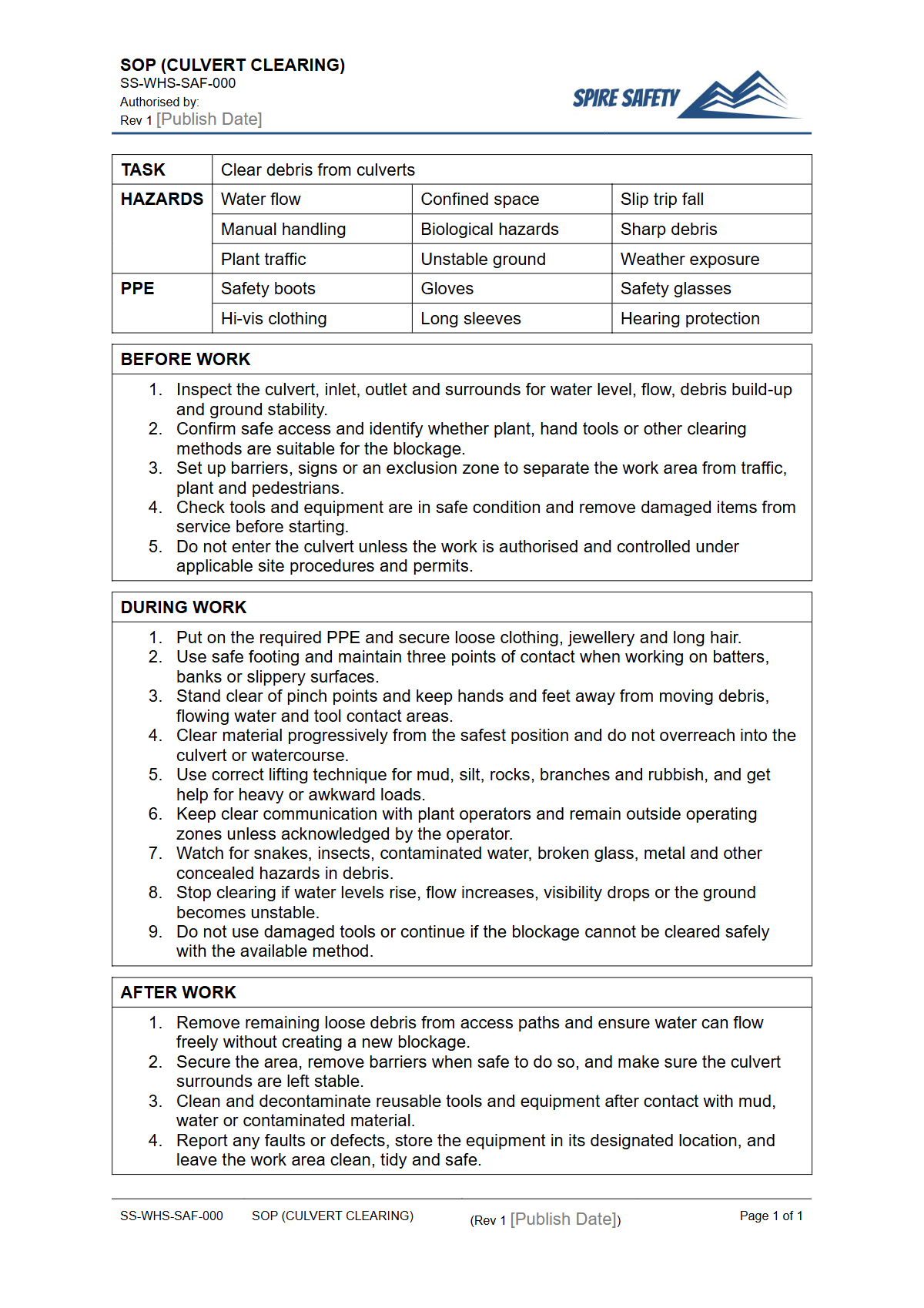
Purpose of the Free Safe Operating Procedure (Culvert Clearing) Template
Culvert clearing is a critical maintenance task for preventing flooding and ensuring infrastructure integrity. However, it presents significant safety risks, including engulfment, hazardous atmospheres, biological hazards, and structural collapse.
This Free Safe Operating Procedure (Culvert Clearing) Template provides a structured framework for identifying these hazards and implementing effective control measures. It guides users through a step-by-step process for performing the task safely, covering pre-start checks, operational steps, and post-task procedures.
Using a formalised SOP helps standardise safety practices, assists in worker training, and demonstrates a commitment to a safe system of work.
A well-developed SOP is a key component of a robust safety framework. It helps ensure that safety measures are not just known but consistently applied across all teams.
Integrating this procedure into your broader safety program can strengthen your overall risk management. Many organisations find that embedding such documents into comprehensive WHS management systems improves consistency and simplifies compliance tracking.
Video walkthrough
How to use the Free Safe Operating Procedure (Culvert Clearing) Template
This document is a starting point designed to be adapted to your specific operational context. To use it effectively, download the DOCX file and systematically work through each section.
Replace the placeholder text with details relevant to your site, the specific type of culvert, the equipment being used, and the personnel involved. It is crucial to conduct a site-specific risk assessment and incorporate its findings into the SOP.
Important Note: This document is a template and must be customised to your specific workplace, equipment, and local conditions. We have not accounted for all possible hazards and control measures.
You must conduct your own risk assessment and consult with your team to ensure the final SOP is comprehensive and effective for your situation. Regular reviews of your SOPs are also a crucial part of maintaining safety standards and can be verified through a formal WHS compliance auditing process.
When to use a Culvert Clearing SOP
A Safe Operating Procedure for culvert clearing should be used every time the task is performed. This includes a range of scenarios such as:
- Routine preventative maintenance to remove silt, debris, and vegetation.
- Emergency clearing following storms, floods, or landslides.
- Clearing as part of larger civil construction or roadworks projects.
- Pre-wet season preparation in areas prone to heavy rainfall.
The procedure is particularly important when work involves entry into the culvert, use of heavy machinery, or work near live traffic. The task may be part of a larger project involving earthmoving, which could require additional procedures like our FREE Scraper SOP (Safe Operating Procedure) Template to manage associated machinery risks.
Who should use this Safe Operating Procedure
This SOP is designed for use by individuals and organisations involved in civil maintenance and construction. Key users include:
- PCBU (Persons Conducting a Business or Undertaking): To meet their primary duty of care to provide safe systems of work.
- Site Supervisors and Managers: To induct, train, and supervise workers performing the task.
- Plant Operators and Maintenance Workers: As a practical guide for safely executing their duties.
- WHS Managers and Advisors: To incorporate into the organisation's overall safety management system.
The use of heavy equipment is common in these tasks. If your work involves earthmoving machinery, you may also benefit from our FREE Dozer SOP (Safe Operating Procedure) Template. For more documentation to support your safety system, you can explore our complete free WHS resources library.
Common mistakes
Common mistakes to avoid
- Failing to identify the culvert as a potential confined space before entry.
- Neglecting to check for underground services (e.g., gas, power, water) before any excavation.
- Inadequate isolation of water flow, creating a risk of sudden inundation.
- Using machinery that is too large or inappropriate for the specific site conditions.
Legal references
Legal considerations
The following legal requirements may be relevant to this type of work.
- Work Health and Safety Act (Harmonised) — Provides the primary duties for protecting workers and other people from work health and safety risks.
- Work Health and Safety Regulations (Harmonised) — Sets out requirements supporting the management of workplace hazards and risks.
The following codes may be relevant to this type of work.
- Managing WHS Risks Code of Practice — Provides practical guidance on identifying hazards, assessing risks and applying effective controls.
- Work Health and Safety Consultation, Cooperation and Coordination Code of Practice — Provides practical guidance on consulting workers and coordinating with other duty holders.
- Managing the Work Environment and Facilities Code of Practice — Provides practical guidance on safe work environments, workplace facilities and related controls.
Did you know
A Flood of Problems
According to infrastructure reports, blocked culverts are a leading preventable cause of localised flooding and significant road damage during heavy rainfall events across Australia.
Ancient Origins
The engineering concept behind culverts dates back to ancient Rome, where similar structures, known as 'cloaca', were used for drainage and sanitation in cities.
FAQ
Frequently asked questions
01What are the main hazards when clearing a culvert?
02Is a culvert considered a confined space?
03Who is responsible for creating a Safe Operating Procedure?
04How often should an SOP for culvert clearing be reviewed?
Share this resource
Free Safe Operating Procedure (Culvert Clearing) Template
Browse Categories
How To Use It
- 1Download and open in Word or PDF.
- 2Replace the placeholders with your business details.
- 3Get it reviewed by a WHS specialist before rollout.
Need it customised?
Our WHS consultants can adapt this template to your site, run a gap analysis, or audit what you already have in place.
Book a Free Consultation WHS consulting servicesor call 1300 156 382
Related templates
- Free Safe Operating Procedure (Culvert Inspection) Template
- Free Safe Operating Procedure (Customer Spill Cleanup) Template
- Free Safe Operating Procedure (Cut Flower Harvesting) Template
- Free Safe Operating Procedure (Cut To Length Line) Template
- Free Safe Operating Procedure (Cutlery Polishing) Template
- Free Safe Operating Procedure (CV Shaft Removal) Template