
Free Safe Operating Procedure (Culvert Inspection) Template
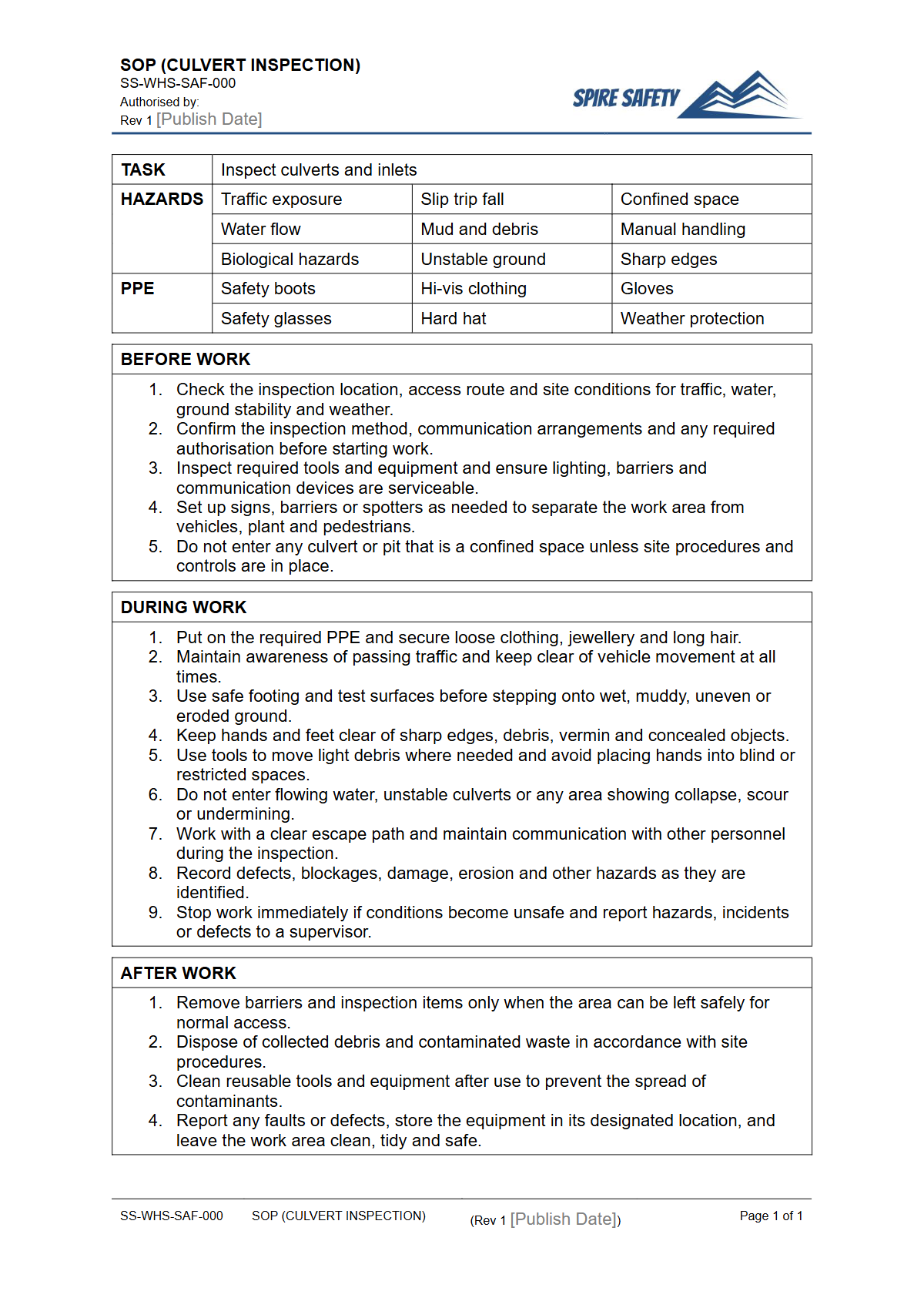
Download our free Safe Operating Procedure (Culvert Inspection) Template. This structured document helps you outline key hazards and controls for culvert tasks.
Free Safe Operating Procedure (Culvert Inspection) Template
DOCX • 126 KB + PDF
Updated Oct 2026
No signup required
Purpose of the Free Safe Operating Procedure (Culvert Inspection) Template
This free Safe Operating Procedure (Culvert Inspection) Template provides a structured framework for documenting the required steps, potential hazards, and safety controls for inspecting culverts. Culvert inspections are high-risk activities that can expose workers to hazards such as confined spaces, structural collapse, hazardous atmospheres, engulfment, slips, trips, falls, and interaction with traffic or mobile plant.
Using a formal SOP helps a Person Conducting a Business or Undertaking (PCBU) meet their primary duty of care under WHS legislation.
A well-drafted SOP is a vital tool for worker training, consultation, and supervision. It standardises the inspection process, ensuring that safety checks are performed consistently and that all risks are identified and controlled.
Integrating this procedure into your broader safety framework helps create a more robust and proactive approach to risk management. A comprehensive safety system ensures that individual documents like SOPs are supported by overarching policies and review processes, strengthening your organisation's safety culture. Developing and maintaining these documents are key components of effective WHS management systems.
Video walkthrough
How to use the Free Safe Operating Procedure (Culvert Inspection) Template
To effectively implement this Safe Operating Procedure, download the DOCX file and adapt it to your specific operational context. The template is a starting point designed for customisation.
Procedure for Implementation:
- Consult: Engage with your workers, supervisors, and any other relevant stakeholders. Their direct experience is invaluable for identifying practical hazards and effective control measures.
- Customise: Add specific details about your worksite, the types of culverts being inspected, the equipment used (e.g., gas detectors, fall arrest systems), and emergency procedures. Also, detail the type of plant that may be used onsite, such as those covered in our free Dozer SOP template.
- Review and Approve: Have a competent person, such as a WHS manager or engineer, review and formally approve the customised SOP before it is put into use.
- Train: Ensure all workers involved in culvert inspections are thoroughly trained on the contents of the final SOP. Maintain records of this training.
- Review Regularly: Schedule periodic reviews of the SOP (e.g., annually) or after any incident, near miss, or change in process.
Important: This is a template only. We are not a law firm and this document does not constitute legal advice.
You must customise this Safe Operating Procedure to the specific hazards, risks, and control measures relevant to your workplace and operations. The PCBU is responsible for ensuring the final document is suitable for its intended purpose and meets all applicable WHS regulations.
When to use a Culvert Inspection Safe Operating Procedure
A Culvert Inspection SOP should be used before any work of this nature commences. It serves as both a planning tool and a practical on-the-job reference for workers.
Its use is critical in several scenarios, including routine infrastructure maintenance schedules, post-weather event inspections (e.g., after heavy rain or flooding), and as part of broader civil construction or earthworks projects. Tasks involving excavation often have their own specific procedures, similar to our free Trencher SOP template.
Furthermore, the SOP should be a central document during pre-start meetings to discuss the day's tasks and reinforce safety protocols. It is also an essential resource when investigating an incident or near miss, allowing teams to review whether the established procedure was followed and if it remains effective.
It should also be used as a foundational document for training new employees or contractors who will be involved in inspection activities.
Who should use this Safe Operating Procedure
This Safe Operating Procedure is intended for a range of personnel within an organisation to ensure a coordinated approach to safety. WHS Managers and Safety Officers will use it to establish and monitor risk control processes.
Supervisors and Team Leaders are responsible for implementing the SOP on-site, ensuring workers follow the specified steps and use the required personal protective equipment (PPE). It is also a vital document for the workers themselves, providing clear, step-by-step guidance on how to perform their tasks safely.
Engineers and infrastructure managers can use the template to ensure consistency and quality in their asset management programs. The effectiveness of these procedures can be verified through periodic workplace inspections.
This process of regular verification is a cornerstone of any functional safety system, often forming part of a scheduled WHS compliance auditing program. Similar procedures for other heavy equipment, such as the process outlined in our Grader SOP template, also require this level of oversight. For more templates and safety documents, browse our complete free WHS resources library.
Common mistakes
Common mistakes to avoid
- Failing to treat the culvert as a potential confined space and skipping atmospheric testing.
- Neglecting to implement traffic control measures when inspecting culverts near or under roadways.
- Using the generic template without customising it for the specific site, culvert type, and local hazards.
- Not providing practical training to workers on the finalised SOP and emergency response procedures.
Legal references
Legal considerations
The following legal requirements may be relevant to this type of work.
- Work Health and Safety Act (Harmonised) — Provides the primary duties for protecting workers and other people from work health and safety risks.
- Work Health and Safety Regulations (Harmonised) — Sets out requirements supporting the management of workplace hazards and risks.
The following codes may be relevant to this type of work.
- Managing WHS Risks Code of Practice — Provides practical guidance on identifying hazards, assessing risks and applying effective controls.
- Work Health and Safety Consultation, Cooperation and Coordination Code of Practice — Provides practical guidance on consulting workers and coordinating with other duty holders.
- Managing the Work Environment and Facilities Code of Practice — Provides practical guidance on safe work environments, workplace facilities and related controls.
Did you know
Atmospheric Dangers
Culverts, especially in rural or industrial areas, can accumulate dangerous gases like methane and hydrogen sulfide from decomposing organic matter or chemical runoff. Atmospheric testing before entry is non-negotiable.
Gradual Failure
Most culvert failures are not sudden events but the result of gradual deterioration from corrosion, soil erosion, or repeated overloading. An SOP ensures regular, systematic inspections to detect these issues early.
FAQ
Frequently asked questions
01What are the main hazards in culvert inspection?
02Does this SOP template cover confined space entry?
03How often should a Culvert Inspection SOP be reviewed?
04Can I use this template for culvert repair as well as inspection?
Share this resource
Free Safe Operating Procedure (Culvert Inspection) Template
Browse Categories
How To Use It
- 1Download and open in Word or PDF.
- 2Replace the placeholders with your business details.
- 3Get it reviewed by a WHS specialist before rollout.
Need it customised?
Our WHS consultants can adapt this template to your site, run a gap analysis, or audit what you already have in place.
Book a Free Consultation WHS consulting servicesor call 1300 156 382
Related templates
- Free Safe Operating Procedure (Customer Spill Cleanup) Template
- Free Safe Operating Procedure (Cut Flower Harvesting) Template
- Free Safe Operating Procedure (Cut To Length Line) Template
- Free Safe Operating Procedure (Cutlery Polishing) Template
- Free Safe Operating Procedure (CV Shaft Removal) Template
- Free Safe Operating Procedure (Cyclone Plant) Template