
Free Safe Operating Procedure (Crusher Operation) Template
Download our Free Safe Operating Procedure for Crusher Operation template.
Free Safe Operating Procedure (Crusher Operation) Template
DOCX • 161 KB + PDF
Updated Oct 2026
No signup required
Purpose of the Free Safe Operating Procedure (Crusher Operation) Template
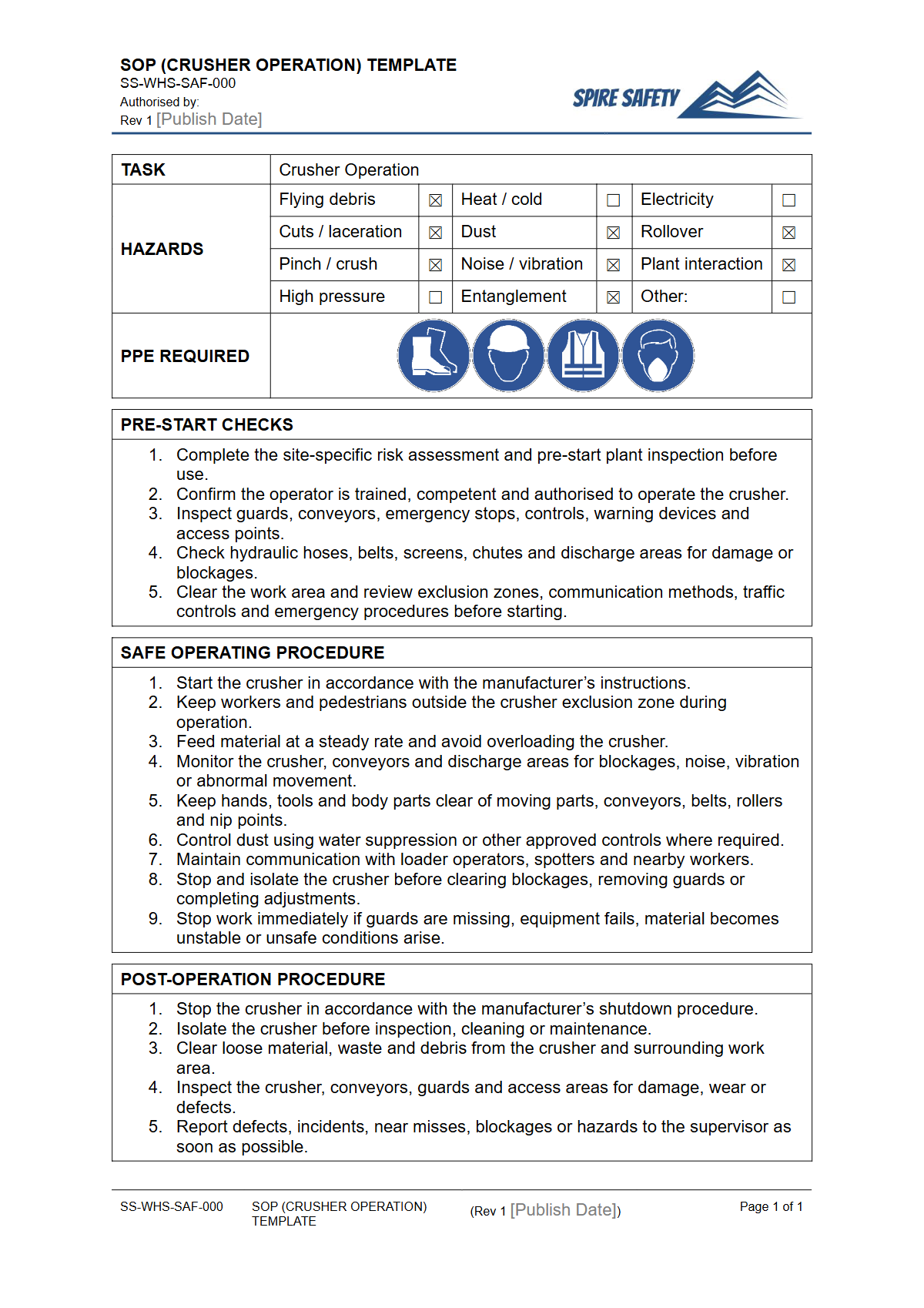
Operating crushers, whether jaw, cone, or impact types, involves significant risks including entanglement, noise, dust exposure, and unexpected movement. This Free Safe Operating Procedure (Crusher Operation) Template provides a structured framework for documenting the required steps to operate this machinery safely.
It serves as a key administrative control measure, designed to guide workers through pre-start checks, operation, and shutdown processes, minimising the risk of injury and incidents.
A well-developed SOP is a fundamental component of effective site safety protocols. It standardises procedures, provides a baseline for training and competency assessment, and demonstrates a commitment to managing high-risk activities.
Integrating this procedure into your broader WHS management systems helps ensure that safety controls are consistently applied and understood by everyone involved in the task.
What’s Included in the Crusher Operation SOP?
This template is structured to cover the key phases of crusher operation. It includes sections for:
- Required Personal Protective Equipment (PPE)
- A detailed pre-operational safety checklist
- Step-by-step instructions for the operating sequence
- Procedures for clearing blockages and performing routine maintenance
- Emergency and shutdown procedures
- A list of common hazards and their associated control measures
Video walkthrough
How to use the Free Safe Operating Procedure (Crusher Operation) Template
To effectively use this document, you must adapt its contents to your specific operational context. A generic SOP is not sufficient to control site-specific risks. Download the template in DOCX format and follow these steps:
1. Review: Read through the entire document to understand its structure and content.
2. Consult: Engage with the machine operators, supervisors, and maintenance personnel who work directly with the crusher.
Their experience is invaluable for identifying practical hazards and effective controls.
3. Customise: Modify the template to reflect your specific crusher model, its unique features, the materials being processed, and the surrounding work environment.
Incorporate your organisation's branding, emergency contacts, and specific safety rules.
Note: It is essential that you customise this template. We are not familiar with your specific machinery, site, personnel, or operational procedures.
A generic document cannot provide adequate safety controls for your workplace.
Crushers are rarely operated in isolation. You should also develop procedures for associated machinery, such as the equipment used to feed the crusher.
Consider downloading our front-end loader SOP to complement this procedure.
When to use a Crusher Operation Safe Operating Procedure
An SOP for crusher operation should be a primary document for any workplace that uses this type of plant. It is particularly critical in several situations:
- Training and Induction: Use the SOP as a core training tool for new operators to ensure they understand the approved, safe method of operation from day one.
- Refresher Training: Provide the SOP to experienced workers as part of regular refresher training to prevent complacency and reinforce safe work habits.
- Risk Assessments: Refer to the SOP during the risk assessment process to verify that documented controls are adequate and reflect current practice.
- Incident Investigations: Use the procedure as a benchmark to determine if work was being performed as required at the time of an incident or near miss.
On large civil or quarry sites, numerous types of heavy plant operate in close proximity. Formalising procedures for all high-risk machinery is essential.
Your safety system may also require documents like a dozer SOP to manage overlapping work areas and interactions between plant.
Who should use this template?
This template is designed for use by individuals responsible for workplace health and safety. This includes:
- Persons Conducting a Business or Undertaking (PCBUs): To meet their primary duty of care to provide and maintain safe systems of work.
- WHS Managers and Advisors: To develop and implement safety documentation as part of the organisation's WHS management system.
- Site and Quarry Managers: To ensure operational procedures align with safety requirements and are clearly communicated to the workforce.
- Supervisors: To train their teams and monitor compliance with established safe work methods on a daily basis.
Once implemented, the SOP becomes a vital tool for ensuring work is performed to a consistent standard. Regular reviews and formal WHS compliance audits can help verify that the documented procedures are being followed correctly in the field.
For assistance in adapting this template or developing a complete plant safety system, you may wish to engage professional WHS consulting services.
Developing a comprehensive suite of SOPs for all plant on site ensures a consistent approach to safety management. If your operations involve other earthmoving equipment, you might find our scraper SOP a useful addition to your safety documentation. For more templates and checklists, explore our complete free WHS resources library.
Common mistakes
Common mistakes to avoid
- Failing to isolate and lock out the crusher before attempting to clear a blockage or perform maintenance.
- Using a generic SOP without customising it for the specific machine model and site conditions.
- Neglecting pre-start checks, leading to operation with faulty guards, belts, or emergency stops.
- Inadequate training on the SOP, resulting in workers not understanding the specific hazards or control measures.
Legal references
Legal considerations
The following legal requirements may be relevant to this type of work.
- Work Health and Safety Act (Harmonised) — Provides the primary duties for protecting workers and other people from work health and safety risks.
- Work Health and Safety Regulations (Harmonised) — Sets out requirements supporting the management of workplace hazards and risks.
The following codes may be relevant to this type of work.
- Managing WHS Risks Code of Practice — Provides practical guidance on identifying hazards, assessing risks and applying effective controls.
- Work Health and Safety Consultation, Cooperation and Coordination Code of Practice — Provides practical guidance on consulting workers and coordinating with other duty holders.
- Managing the Work Environment and Facilities Code of Practice — Provides practical guidance on safe work environments, workplace facilities and related controls.
Did you know
Noise Hazard
Crushing operations can generate noise levels exceeding 110 dB(A). Exposure at this level, even for short periods without adequate hearing protection, can cause permanent hearing damage.
Entanglement Risk
Entanglement in moving parts like flywheels, conveyor belts, and pulleys is a leading cause of fatal and serious injuries involving crushers. Strict lockout/tagout procedures are non-negotiable before any maintenance or clearing of blockages.
FAQ
Frequently asked questions
01What is a Safe Operating Procedure for a crusher?
02Who is responsible for writing a crusher SOP?
03How often should a crusher SOP be reviewed?
04Does this template cover all types of crushers?
Share this resource
Free Safe Operating Procedure (Crusher Operation) Template
Browse Categories
How To Use It
- 1Download and open in Word or PDF.
- 2Replace the placeholders with your business details.
- 3Get it reviewed by a WHS specialist before rollout.
Need it customised?
Our WHS consultants can adapt this template to your site, run a gap analysis, or audit what you already have in place.
Book a Free Consultation WHS consulting servicesor call 1300 156 382
Related templates
- Free Safe Operating Procedure (Cryogenic Dewar) Template
- Free Safe Operating Procedure (Culvert Clearing) Template
- Free Safe Operating Procedure (Culvert Inspection) Template
- Free Safe Operating Procedure (Customer Spill Cleanup) Template
- Free Safe Operating Procedure (Cut Flower Harvesting) Template
- Free Safe Operating Procedure (Cut To Length Line) Template