
Free Safe Operating Procedure (Crowd Queue Control) Template
Effectively manage customer or event queues and minimise risks with our structured template. Download our free Safe Operating Procedure for crowd control today.
Free Safe Operating Procedure (Crowd Queue Control) Template
DOCX • 126 KB + PDF
Updated Oct 2026
No signup required
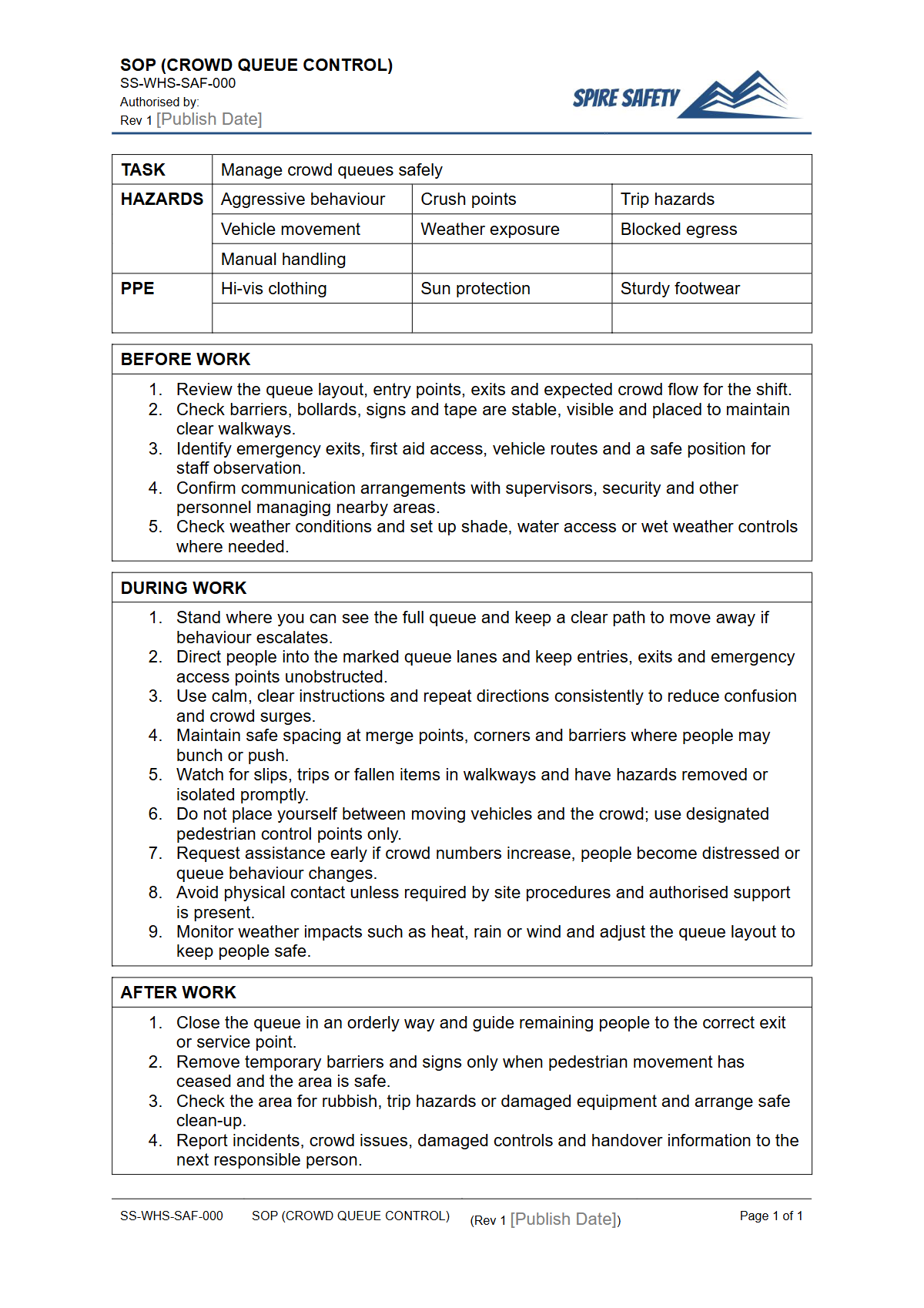
Purpose of the Free Safe Operating Procedure (Crowd Queue Control) Template
Managing queues effectively is critical for safety and customer satisfaction in many industries, from retail and events to transport and healthcare. This free Safe Operating Procedure (Crowd Queue Control) Template provides a structured framework for establishing and maintaining orderly queues, minimising risks to both staff and the public.
Implementing a formal SOP helps prevent injuries from slips, trips, falls, and crushing, while also managing customer behaviour and ensuring fair, efficient processing. It serves as a vital tool for demonstrating due diligence and forms an essential part of your broader safety framework.
A documented procedure ensures that all team members understand their roles and responsibilities, promoting a consistent and professional approach to crowd management. By proactively planning for queue control, your organisation can mitigate potential hazards before they lead to incidents.
Integrating this procedure helps build more robust WHS management systems, ensuring safety is embedded in your daily operations.
Video walkthrough
How to use the Free Safe Operating Procedure (Crowd Queue Control) Template
This Safe Operating Procedure template is a starting point designed for customisation. After downloading the DOCX or PDF file, you must adapt it to the specific context of your workplace, event, or venue. Effective implementation involves several key steps:
- Risk Assessment: Conduct a thorough risk assessment of your queueing areas. Identify potential hazards such as trip hazards (cabling, uneven surfaces), poor lighting, weather exposure, and potential points of conflict.
- Customisation: Edit the template to reflect your specific environment. Include details such as site maps, the type of barriers to be used (e.g., retractable belts, barricades), maximum queue capacity, and staff-to-patron ratios.
- Consultation: Involve your workers in the process. Consult with security staff, customer service teams, and event marshals to get their input on what is practical and effective.
- Training: Provide clear training to all staff involved in crowd management. Ensure they understand the procedures for setting up queues, monitoring them, communicating with the public, and escalating issues.
Important: We have developed this document as a guide. You must review and customise it to suit the unique hazards and operational needs of your business and worksite.
A regular review of your safety documents is best practice and can be incorporated into your WHS compliance auditing schedule to ensure ongoing effectiveness and alignment with current standards.
When to use it
A crowd queue control SOP is essential in any situation where a group of people is expected to line up. This includes both routine operations and special events. Key scenarios include:
- Major retail sales events like Black Friday or Boxing Day sales.
- Entry and exit points for concerts, festivals, and sporting events.
- Public transport hubs during peak hours.
- Service counters in banks, government agencies, or healthcare facilities.
- Temporary situations like vaccination clinics or product launches.
- Emergency situations requiring orderly public movement.
Who should use it
This Safe Operating Procedure is intended for use by anyone with responsibility for managing spaces where queues form. This includes a range of roles across different industries:
- Venue and Facility Managers: Responsible for the overall safety of a building or site.
- Event Organisers and Coordinators: Tasked with planning and executing safe public gatherings.
- Retail Store and Area Managers: Oversee daily operations where customer queues are common.
- WHS/OHS Managers and Advisors: Develop and implement safety policies for an organisation.
- Security Supervisors: Manage the on-the-ground teams responsible for crowd monitoring and control.
For complex venues or large-scale events, it can be beneficial to work with external experts to develop and validate your crowd management plans. Spire Safety offers specialist WHS consulting to help you navigate specific challenges and ensure your procedures are robust and practical.
You can also browse our complete free WHS resources library for more templates and guides.
Common mistakes
Common mistakes to avoid
- Failing to plan for peak demand or unexpected surges in attendance.
- Using untrained or insufficient numbers of staff as crowd marshals.
- Designing queue layouts with trip hazards, dead ends, or poor sightlines.
- Not communicating clearly and regularly with people waiting in the queue.
Legal references
Legal considerations
The following legal requirements may be relevant to this type of work.
- Work Health and Safety Act (Harmonised) — Provides the primary duties for protecting workers and other people from work health and safety risks.
- Work Health and Safety Regulations (Harmonised) — Sets out requirements supporting the management of workplace hazards and risks.
The following codes may be relevant to this type of work.
- Managing WHS Risks Code of Practice — Provides practical guidance on identifying hazards, assessing risks and applying effective controls.
- Work Health and Safety Consultation, Cooperation and Coordination Code of Practice — Provides practical guidance on consulting workers and coordinating with other duty holders.
- Managing the Work Environment and Facilities Code of Practice — Provides practical guidance on safe work environments, workplace facilities and related controls.
Did you know
Safe Crowd Density
Safe standing crowd density is generally considered to be no more than 2 people per square metre. Densities above 4 people per square metre significantly increase the risk of crowd crush and collapse.
FAQ
Frequently asked questions
01What are the key hazards to consider in crowd queue management?
02How often should our crowd control SOP be reviewed?
03Who is responsible for implementing the SOP on the day?
04Does this SOP cover emergency evacuations?
Share this resource
Free Safe Operating Procedure (Crowd Queue Control) Template
Browse Categories
How To Use It
- 1Download and open in Word or PDF.
- 2Replace the placeholders with your business details.
- 3Get it reviewed by a WHS specialist before rollout.
Need it customised?
Our WHS consultants can adapt this template to your site, run a gap analysis, or audit what you already have in place.
Book a Free Consultation WHS consulting servicesor call 1300 156 382
Related templates
- Free Safe Operating Procedure (Crusher Operation) Template
- Free Safe Operating Procedure (Cryogenic Dewar) Template
- Free Safe Operating Procedure (Culvert Clearing) Template
- Free Safe Operating Procedure (Culvert Inspection) Template
- Free Safe Operating Procedure (Customer Spill Cleanup) Template
- Free Safe Operating Procedure (Cut Flower Harvesting) Template