
Free Safe Operating Procedure (Crowd Entry Screening) Template
Manage event and venue safety with our free Safe Operating Procedure for crowd entry screening.
Free Safe Operating Procedure (Crowd Entry Screening) Template
DOCX • 126 KB + PDF
Updated Oct 2026
No signup required
Purpose of the Free Safe Operating Procedure (Crowd Entry Screening) Template
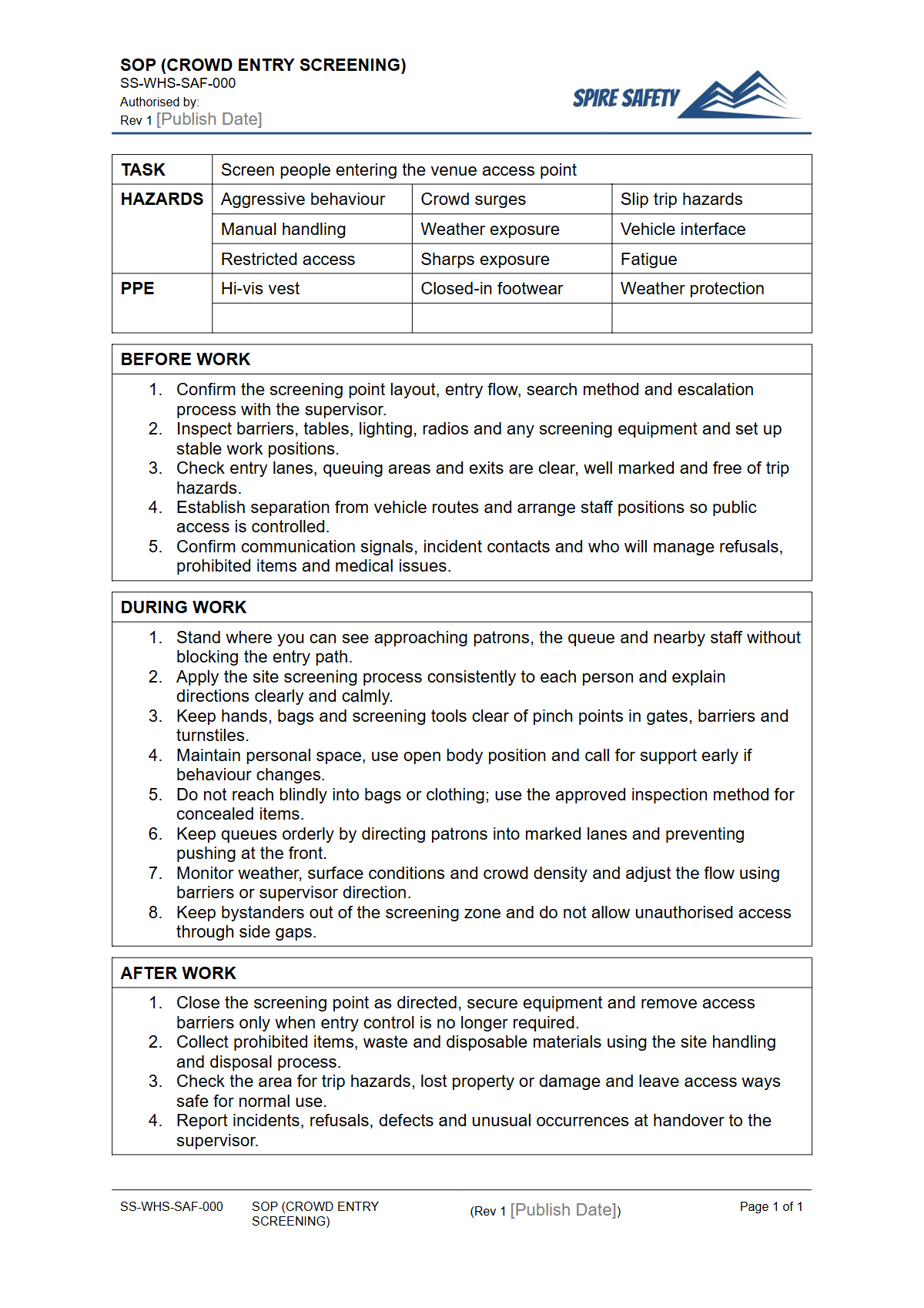
Managing the entry of large crowds into a venue or event space is a critical control point for overall safety and security. This free Safe Operating Procedure (Crowd Entry Screening) template provides a structured framework for outlining the step-by-step process your team must follow.
Its purpose is to standardise screening tasks, minimise risks, and ensure every worker understands their role and responsibilities. By implementing a clear SOP, you can effectively manage hazards such as the introduction of prohibited items, disorderly behaviour, and potential security threats.
A documented procedure demonstrates a commitment to fulfilling your duty of care for both staff and patrons, forming an essential part of your overall event safety plan.
What this Safe Operating Procedure covers:
- Roles and responsibilities for screening personnel, supervisors, and management.
- Required Personal Protective Equipment (PPE) for staff.
- A step-by-step procedure for conducting searches, including bag checks and electronic screening.
- Protocols for managing queues and maintaining patron flow.
- Guidelines for identifying and handling prohibited or restricted items.
- Communication and escalation procedures for incidents or emergencies.
Video walkthrough
How to use the Free Safe Operating Procedure (Crowd Entry Screening) Template
This document is a foundational template designed for customisation. After downloading the DOCX or PDF file, you must adapt it to the specific context of your venue, event, and workforce.
Review each section and replace the placeholder text with details relevant to your operations. This includes specifying the types of screening equipment used (e.g., walk-through metal detectors, hand-held wands), listing the exact items prohibited at your venue, and detailing your unique communication channels and emergency contacts.
The goal is to create a practical tool that staff can easily understand and follow.
Important: This is a template only. We have provided a structured starting point, but you are responsible for ensuring the final document is tailored to your specific workplace, equipment, and the unique risks present in your operations.
You must consult with your workers and other stakeholders during this process.
When to use it
A Crowd Entry Screening SOP should be implemented at any event or venue where controlled access is required to maintain safety and security. It is particularly crucial for:
- Music festivals and concerts
- Major sporting events
- Exhibitions and trade shows with high attendance
- Large corporate functions
- Ticketed public gatherings in arenas, stadiums, or convention centres
- Any venue with specific security requirements or liquor licensing conditions related to entry management.
The SOP should be used as the primary reference document for training new staff and for conducting pre-event briefings with the entire security and guest services team. It serves as an on-the-job guide to ensure consistent application of procedures throughout an event's operating hours. For organisations seeking to formalise their safety protocols, incorporating this SOP is a key step toward building robust WHS management systems.
Who should use it
This SOP is intended for several key groups within an organisation responsible for event and venue management. WHS Managers and Event Organisers will use the template to establish and document the official procedure.
Security Managers and Team Leaders are responsible for implementing the SOP, using it to train their staff and oversee its execution on the ground. Frontline screening personnel, security guards, and guest services staff are the primary end-users who will follow the step-by-step instructions daily to perform their duties safely and effectively. Regular verification that procedures are being followed correctly can be achieved through internal checks or formal WHS compliance audits.
Integrating Screening Procedures with Other Safety Plans
A Safe Operating Procedure for crowd entry screening does not exist in a vacuum. It must be fully integrated with your broader safety and emergency management framework. For example, the SOP should reference your Workplace Health and Safety consultants-approved Risk Assessment for crowd management, which identifies the specific hazards your screening process aims to control. It must also align with your Emergency Response Plan, detailing how screening personnel should react to medical incidents, security threats, or evacuation orders. Connecting these documents ensures a cohesive and comprehensive approach to safety, where every component works in support of the others. You can find other templates to support your safety system in our free WHS resources library.
Common mistakes
Common mistakes to avoid
- Failing to clearly communicate prohibited items to patrons before they arrive.
- Providing inadequate training for screening staff, especially in de-escalation techniques.
- Not having a clear, documented process for handling confiscated items or escalating issues.
- Neglecting to plan for queue management, leading to dangerous choke points and overcrowding.
Legal references
Legal considerations
The following legal requirements may be relevant to this type of work.
- Work Health and Safety Act (Harmonised) — Provides the primary duties for protecting workers and other people from work health and safety risks.
- Work Health and Safety Regulations (Harmonised) — Sets out requirements supporting the management of workplace hazards and risks.
The following codes may be relevant to this type of work.
- Managing WHS Risks Code of Practice — Provides practical guidance on identifying hazards, assessing risks and applying effective controls.
- Work Health and Safety Consultation, Cooperation and Coordination Code of Practice — Provides practical guidance on consulting workers and coordinating with other duty holders.
- Managing the Work Environment and Facilities Code of Practice — Provides practical guidance on safe work environments, workplace facilities and related controls.
Did you know
Queuing Theory
Effective crowd screening isn't just about searching bags; it's also about managing flow. Queuing theory, the mathematical study of waiting lines, is used by event professionals to design entry points that minimise bottlenecks and reduce patron frustration, which in turn lowers safety risks.
FAQ
Frequently asked questions
01What key details should be included in a crowd screening SOP?
02How does an SOP help manage aggressive patrons during entry?
03Is a crowd screening SOP a legal requirement in Australia?
04How often should our crowd entry screening procedures be reviewed?
Share this resource
Free Safe Operating Procedure (Crowd Entry Screening) Template
Browse Categories
How To Use It
- 1Download and open in Word or PDF.
- 2Replace the placeholders with your business details.
- 3Get it reviewed by a WHS specialist before rollout.
Need it customised?
Our WHS consultants can adapt this template to your site, run a gap analysis, or audit what you already have in place.
Book a Free Consultation WHS consulting servicesor call 1300 156 382
Related templates
- Free Safe Operating Procedure (Crowd Queue Control) Template
- Free Safe Operating Procedure (Crusher Operation) Template
- Free Safe Operating Procedure (Cryogenic Dewar) Template
- Free Safe Operating Procedure (Culvert Clearing) Template
- Free Safe Operating Procedure (Culvert Inspection) Template
- Free Safe Operating Procedure (Customer Spill Cleanup) Template