
Free Safe Operating Procedure (Crop Scouting) Template
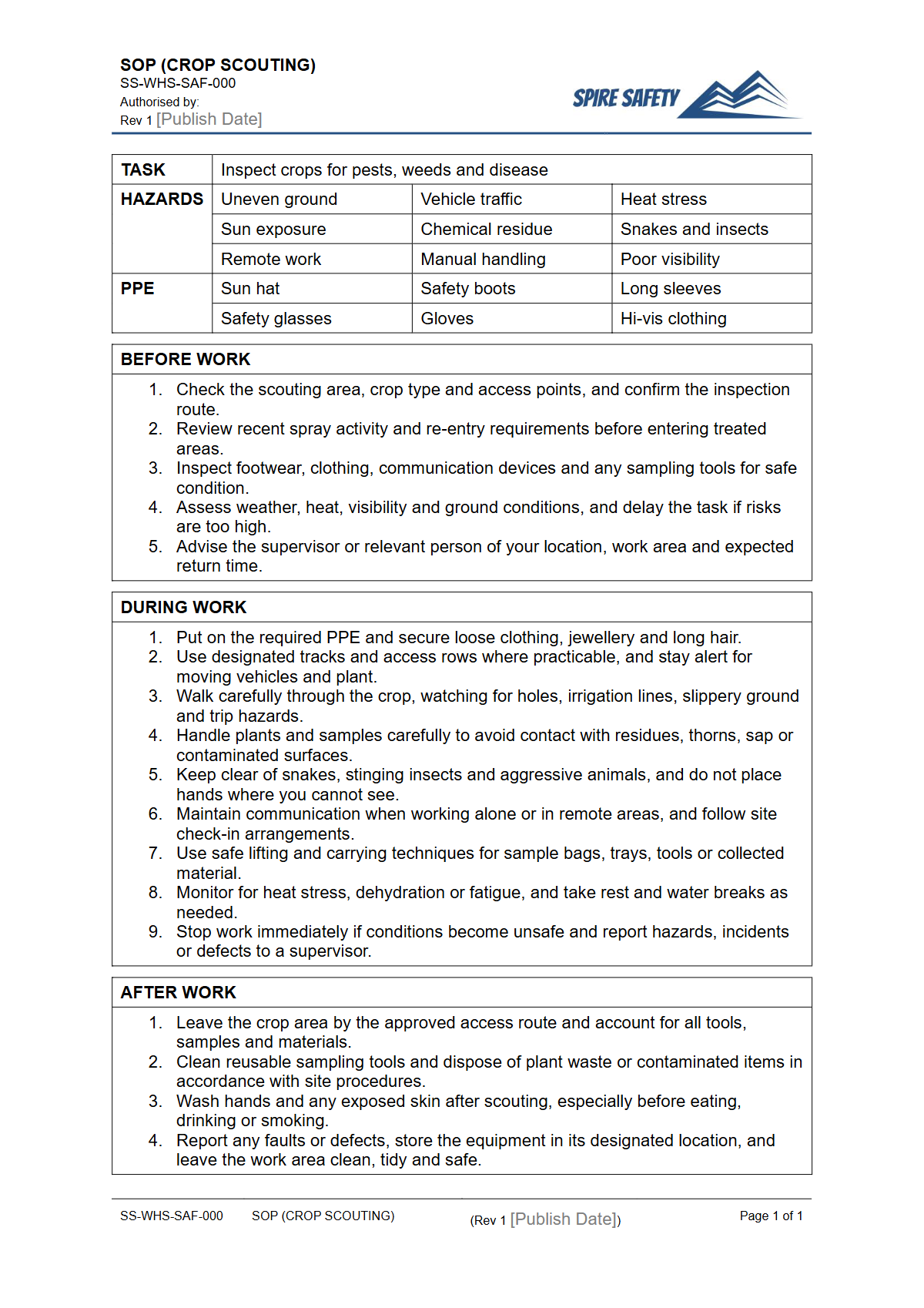
Download our free Safe Operating Procedure for Crop Scouting. This template provides a structured starting point for developing your own WHS documents.
Free Safe Operating Procedure (Crop Scouting) Template
DOCX • 126 KB + PDF
Updated Oct 2026
No signup required
Purpose of the Free Safe Operating Procedure (Crop Scouting) Template
Crop scouting is a critical task in modern agriculture, but it comes with inherent risks. This Free Safe Operating Procedure (Crop Scouting) Template provides a structured framework for documenting the key steps, hazards, and controls necessary to perform the task safely.
Its purpose is to help Persons Conducting a Business or Undertaking (PCBUs) in the agricultural sector meet their duty of care by providing clear, practical instructions to workers. By formalising the process, you can minimise risks associated with vehicle use, environmental exposure, and lone work.
A well-developed Safe Operating Procedure (SOP) is a fundamental component of proactive safety management. It moves beyond simple compliance and becomes a vital tool for training, supervision, and incident investigation.
Integrating task-specific SOPs into your broader safety framework is key to building robust WHS management systems that protect your people and your operation.
Video walkthrough
How to use the Free Safe Operating Procedure (Crop Scouting) Template
This document is a template, not a finished product. It must be customised to reflect the specific environment, equipment, and processes of your farm or business.
Download the DOCX file and adapt it by consulting with your workers and conducting a site-specific risk assessment.
You should add details including:
- Specific types of vehicles used (e.g., UTVs, quad bikes, light vehicles) and their pre-start checks.
- Designated routes, no-go zones, and known property hazards like dams, culverts, or powerlines.
- Communication protocols, especially for lone workers, including check-in schedules and duress alarm procedures.
- Site-specific emergency procedures, contact details, and first aid provisions.
- Required Personal Protective Equipment (PPE) such as high-visibility clothing, sun protection, sturdy footwear, and two-way radios.
Just as crop scouting requires a unique procedure, so do other specialised farm tasks. For example, operating heavy machinery requires its own set of detailed controls, as outlined in our FREE Spreader SOP (Safe Operating Procedure) Template.
When to use it
This Safe Operating Procedure should be a core part of your operational planning. It must be read, understood, and signed off by any worker before they undertake crop scouting duties for the first time.
It serves as a primary training document for new employees and a valuable refresher for experienced staff. The SOP should also be readily available at the worksite for quick reference.
Furthermore, it should be a live document, subject to regular review. Plan to review the SOP at least annually, or more frequently if there are changes to equipment or procedures, or following any incident or near-miss.
This ensures it remains relevant and effective. The same principle of regular review and training applies to other key agricultural tasks, such as those covered in the FREE Seed Drill SOP (Safe Operating Procedure) Template.
Who should use it
This SOP is designed for use by multiple people within an agricultural business:
- Farm Managers and Owners (PCBUs) use it to fulfil their WHS duties, plan safe work, and ensure a consistent approach to risk management.
- Supervisors and Team Leaders use it to induct and train workers, monitor safe work practices, and lead toolbox talks on the specific hazards of scouting.
- Workers, Agronomists, and Farm Hands use it as a practical guide to follow, helping them understand the risks and the required safety measures to protect themselves and others.
If your organisation needs assistance customising this document or embedding it into your daily operations, Spire Safety offers expert WHS consulting to help you develop practical and effective safety solutions. For processes involving other types of machinery, you may find our FREE Planter SOP (Safe Operating Procedure) Template a useful reference for comparison.
Once SOPs are implemented, it's good practice to verify their effectiveness and ensure they are being followed correctly. Regular safety checks and formal audits can identify gaps between documented procedures and actual work practices, providing opportunities for improvement. These verification activities are a key part of maintaining a safe workplace and can be supported through services like WHS compliance auditing.
By establishing clear procedures for common tasks, you create a safer, more predictable work environment. Explore our complete free WHS resources library for more templates and guides to support your safety management efforts.
Common mistakes
Common mistakes to avoid
- Failing to customise the template with site-specific hazards and vehicle details.
- Neglecting to include robust communication and emergency plans for lone workers.
- Not providing practical training to workers on the finalised SOP.
- Forgetting to review and update the SOP after an incident or change in procedure.
Legal references
Legal considerations
The following legal requirements may be relevant to this type of work.
- Work Health and Safety Act (Harmonised) — Provides the primary duties for protecting workers and other people from work health and safety risks.
- Work Health and Safety Regulations (Harmonised) — Sets out requirements supporting the management of workplace hazards and risks.
The following codes may be relevant to this type of work.
- Managing WHS Risks Code of Practice — Provides practical guidance on identifying hazards, assessing risks and applying effective controls.
- Work Health and Safety Consultation, Cooperation and Coordination Code of Practice — Provides practical guidance on consulting workers and coordinating with other duty holders.
- Managing the Work Environment and Facilities Code of Practice — Provides practical guidance on safe work environments, workplace facilities and related controls.
Did you know
Vehicle Incidents
According to Safe Work Australia, vehicle incidents are a leading cause of fatalities in the agriculture industry, with quad bikes and tractors being involved in a significant number of incidents.
Heat Stress
Working in direct sun can increase the body's temperature by 5–8°C. Dehydration begins long before thirst is felt, making regular hydration and rest breaks critical for outdoor workers, even on moderately warm days.
FAQ
Frequently asked questions
01What are the main hazards to consider during crop scouting?
02Is a Safe Operating Procedure legally required for crop scouting in Australia?
03How often should we review our Crop Scouting SOP?
04Can this template be used for lone workers?
Share this resource
Free Safe Operating Procedure (Crop Scouting) Template
Browse Categories
How To Use It
- 1Download and open in Word or PDF.
- 2Replace the placeholders with your business details.
- 3Get it reviewed by a WHS specialist before rollout.
Need it customised?
Our WHS consultants can adapt this template to your site, run a gap analysis, or audit what you already have in place.
Book a Free Consultation WHS consulting servicesor call 1300 156 382
Related templates
- Free Safe Operating Procedure (Crop Thinning) Template
- Free Safe Operating Procedure (Cross Dock Transfer) Template
- Free Safe Operating Procedure (Crowd Barrier Handling) Template
- Free Safe Operating Procedure (Crowd Entry Screening) Template
- Free Safe Operating Procedure (Crowd Queue Control) Template
- Free Safe Operating Procedure (Crusher Operation) Template